
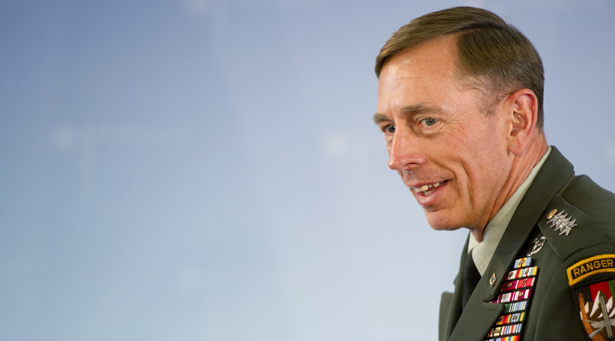
AP Images
While much of the media focus on l’affaire Petraeus has centered on the CIA director’s sexual relationship with his biographer, Paula Broadwell, the scandal opens a window onto a different and more consequential relationship—that between the CIA and the military’s Joint Special Operations Command. In a behind-the-scenes turf war that has raged since 9/11, the two government bodies have fought for control of the expanding global wars waged by the United States—a turf war that JSOC has largely won. Petraeus, an instrumental player in this power struggle, leaves behind an agency that has strayed from intelligence to paramilitary-type activities. Though his legacy will be defined largely by the scandal that ended his career, to many within military and intelligence circles, Petraeus’s career trajectory, from commander of US military forces in Iraq and Afghanistan to the helm of the CIA, is a symbol of this evolution.
“I would not say that CIA has been taken over by the military, but I would say that the CIA has become more militarized,” Philip Giraldi, a retired career CIA case officer, told The Nation. “A considerable part of the CIA budget is now no longer spying; it’s supporting paramilitaries who work closely with JSOC to kill terrorists, and to run the drone program.” The CIA, he added, “is a killing machine now.”
As head of US Central Command in 2009, Petraeus issued execute orders that significantly broadened the ability of US forces to operate in a variety of countries, including Yemen, where US forces began conducting missile strikes later that year. During Petraeus’s short tenure at the CIA, drone strikes conducted by the agency, sometimes in conjunction with JSOC, escalated dramatically in Yemen; in his first month in office, he oversaw a series of strikes that killed three US citizens, including 16-year-old Abdulrahman Awlaki. In some cases, such as the raid that killed Osama bin Laden in Pakistan, commandos from the elite JSOC operated under the auspices of the CIA, so that the mission could be kept secret if it went wrong.
One current State Department liaison who has also worked extensively with JSOC describes the CIA as becoming “a mini-Special Operations Command that purports to be an intelligence agency.” For all the praise Petraeus won for his counterinsurgency strategy and the “surge” in Iraq, he says, his real legacy is as a “political tool,” an enabler of those within the national security apparatus who want to see a continuation of covert global mini-wars. Pointing to the “mystique that surrounds JSOC” and Adm. William McRaven, commander of the Special Operations Command, the liaison says, “Petraeus was trying to implement that kind of command climate at the CIA.”
“Petraeus wanted to be McRaven, and now that window has closed,” he said. “We are firmly in the age of McRaven. There is no other titular figure with the confidence of the president that is able to articulate strategies and hold their own in rooms where everyone else has the same or greater amount of intellectual heft. McRaven is everything that Petraeus is not.”
Retired Army Col. W. Patrick Lang, a former senior defense intelligence official, says that Petraeus’s arrogance—“smoothly concealed beneath the appearance of the warrior scholar”—made him deeply unpopular among the military’s high-ranking officers. Dismissing the media’s portrayal of Petraeus as a “super soldier” and great military leader as “phony bullshit,” Lang describes him as the product of a military promotion system that encourages generals to think of themselves as “divinely selected.” “In fact, he didn’t write the COIN manual, the surge was not the main thing in improving the situation in Iraq…. They sent him to Afghanistan to apply the COIN doctrine in the same glorious way he did in Iraq, and it hasn’t worked. So, if you look beneath the surface from all this stuff, it’s just a lot of hot air. There are great generals, but this guy is not one of them.” Arriving at the CIA, Lang says, Petraeus “wanted to drag them in the covert action direction and to be a major player.”
As for Petraeus’s future, the State Department liaison said, “There will be a lot of profits to be made by him and his immediate circle of advisers, as they’re given a soft landing, whether it’s in academia or within the nexus of the military-industrial complex.”
Giraldi, the former senior CIA officer, expressed concern that in these circumstances, the “CIA is going to forget how to spy.” He also noted the “long-term consequence” of the militarization of the CIA: “every bureaucracy in the world is best at protecting itself. So once the CIA becomes a paramilitary organization, there’s going to be in-built pressure to keep going in that direction. Because you’ll have people at the senior levels in the organization who have come up that way and are protective of what they see as their turf,” he told me. “That’s the big danger.”
Despite President Obama's opposition to messy, large-scale military operations, the president is actually a “very careful hawk” when it comes to military action, Jeremy Scahill argued, in an interview early this year with Francis Reynolds.

