
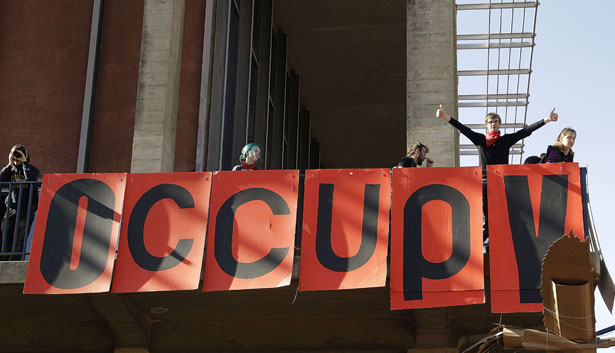
Protesters post signs atop a University of California at Berkeley building as they participate in an Occupy Cal rally outside Sproul Hall Tuesday, Nov. 15, 2011. (AP Photo/Ben Margot)
This article was originally published in the Daily Cal. Follow the paper on Twitter to keep up on its excellent coverage of the Occupy movement.
A crowd of about 3,500 packed into Upper Sproul Plaza Tuesday evening, convening a general assembly where they voted overwhelmingly to re-establish an encampment, despite the police violence that marked encampment efforts last week.
The demonstrators gathered on Sproul for the Occupy Cal general assembly, which followed the Open University strike activities and march earlier in the day. The assembled individuals voted on three proposals, the first of which was whether to organize a debate on public education with a variety of public officials, including members of the campus administration, the UC Board of Regents and Gov. Jerry Brown.
Additionally, they voted on proposals regarding whether to send an open letter to individuals including the UC Board of Regents, the CSU Board of Trustees and unspecified education administrators, as well whether to re-establish an encampment.
All three proposals passed with an overwhelming number of votes with margins far exceeding the 80 percent requirement for any proposal to be passed by the assembly.
“I believe we should continue and stay, to assemble and to build on these steps a truly free university,” said Amanda Armstrong, graduate student and campus head steward for United Auto Workers Local 2865.
Efforts to establish an encampment at the protests last Wednesday were met with police actions that have drawn criticism, attracted national attention and elicited public outcry from a wide range of concerned groups and campus community members.
Prior to the assembly’s meeting, campus Graduate Assembly President Bahar Navab advised students how to peacefully submit oneself to police in the event of arrest, a statement that was met with jeers from the assembled crowd.
“When the police return to beat us into submission, stand strong,” said UC Berkeley senior Morgan Crawford, at a later point during the assembly. Crawford said he was beaten by the police at last Wednesday’s encampment.
At the end of the meeting, around 15 police officers lingered near the outskirts of the assembled group, monitoring. Legal observers wearing neon green hats were also dispersed throughout the crowd.
Just prior to the assembly, the crowd was joined by around 300 demonstrators from Occupy Oakland and unaffiliated city residents, who were all included in votes to decide the group’s future actions.
“I think this whole Occupy situation is good for our world,” said Berkeley resident Nick Fikaris, who was present at the general assembly. “We need some kind of change. And that’s why I’m here, to see the change happen.”
For each proposal, time was given for small groups to discuss options before the floor was opened up to speakers who had a limited amount of time to present their viewpoints. Afterwards, votes were taken and tallied.
Towards the end of the allotted time for the general assembly, the crowd swelled even further in anticipation of UC Berkeley public policy professor and former U.S. Secretary of Labor Robert Reich’s much-anticipated Mario Savio Memorial Lecture.
The general assembly concluded just after 8 p.m., with facilitators declaring the group’s intention to continue convening at 6 p.m. every day, indefinitely.

