
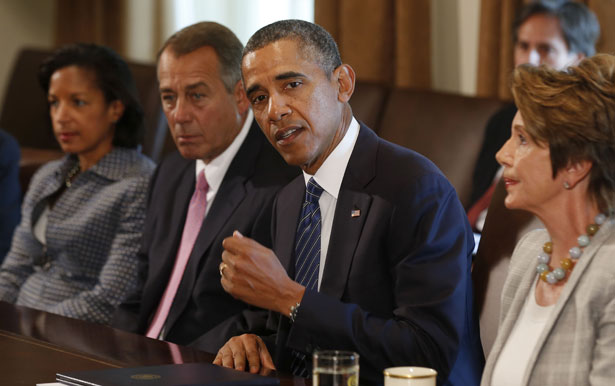
President Obama discusses military response to Syrian chemical weapons use with Congressional leaders. (Reuters/Larry Downing)
President Obama said on Monday in a PBS NewsHour interview regarding Syria that “my intention throughout this process has been to ensure that the blatant use of chemical weapons that we saw doesn’t happen again. If in fact there’s a way to accomplish that diplomatically, that is overwhelmingly my preference.”
Over the following 24 hours, circumstances intervened and made it possible for the president to pursue the diplomatic resolution that Secretary of State John Kerry has referred to as “the ideal way” to remove the chemical-weapons threat. With prodding from the Russians and a show of flexibility from the Syrians, the prospect of military intervention has been delayed.
In his speech to the nation Tuesday night, the president announced that he has asked the leaders of Congress to postpone a vote to authorize the use of force “while we pursue this diplomatic path.”
The president has been freed to focus on his concerns about chemical weapons—which are broadly shared by the American people—without making immediate demands for the military intervention that the American people do not want.
Yes, Obama will keep the “credible threat” of military action on the table. But it is no longer has to be the centerpiece.
The key passage in the president’s speech was his announcement that “I have therefore asked the leaders of Congress to postpone a vote to authorize the use of force while we pursue this diplomatic path. I’m sending Secretary of State John Kerry to meet his Russian counterpart on Thursday, and I will continue my own discussions with President Putin. I’ve spoken to the leaders of two of our closest allies, France and the United Kingdom. And we will work together in consultation with Russia and China to put forward a resolution at the U.N. Security Council requiring Assad to give up his chemical weapons and to ultimately destroy them under international control.”
As he said Tuesday night, diplomatic initiatives have “the potential to remove the threat of chemical weapons without the use of force.”
The president should embrace that potential.
And he should take the American people with him—even if the diplomatic route if difficult, even if it is frustrating.
This is a moment when the president can and should remind the country of the commitment he made when he accepted the 2009 Nobel Peace Prize.
“The promotion of human rights cannot be about exhortation alone. At times, it must be coupled with painstaking diplomacy. I know that engagement with repressive regimes lacks the satisfying purity of indignation. But I also know that sanctions without outreach—condemnation without discussion—can carry forward only a crippling status quo. No repressive regime can move down a new path unless it has the choice of an open door,” said the president.
“In light of the Cultural Revolution’s horrors, Nixon’s meeting with Mao appeared inexcusable—and yet it surely helped set China on a path where millions of its citizens have been lifted from poverty and connected to open societies,” he recalled. “Pope John Paul’s engagement with Poland created space not just for the Catholic Church, but for labor leaders like Lech Walesa. Ronald Reagan’s efforts on arms control and embrace of perestroika not only improved relations with the Soviet Union, but empowered dissidents throughout Eastern Europe. There’s no simple formula here. But we must try as best we can to balance isolation and engagement, pressure and incentives, so that human rights and dignity are advanced over time.”
Obama was right then.
He can and should be just as right now.
John Nichols urges Obama to puruse "open-door" diplomacy.

