
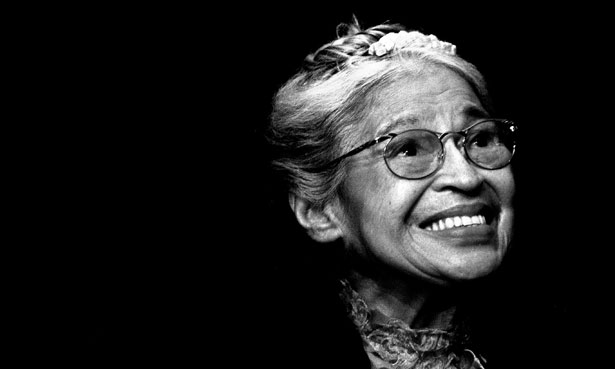
Rosa Parks. (AP Photo/Paul Sancya)
Is it possible to lower the bar for the entire sportswriting profession? Jen Floyd Engel of Fox Sports certainly gave it the old college try with her much-remarked-upon column where she compared Texas A&M quarterback—the Jäger-bombing, jet-setting, Heisman-winning, scandal-plagued, Broseph-in-Chief—Johnny Manziel with Rosa Parks.
The argument is that Rosa Parks, by refusing to leave her seat on that fateful Montgomery, Alabama, bus, brought about something Engel describes as “the tipping point for many Americans long since tired of these immoral laws.” Similarly, Manziel, by raging against an NCAA that profits off his name while he doesn’t get a dime, could be the spark that leads us to “recognize the immorality and absurdity of a system where everybody can make money off these kids except these kids.”
Others have mashed Engel’s column to a fine paste, but I don’t want to go there. Frankly, I didn’t want to write about this at all. But I’m compelled to do so not to take even more potshots at Engel. I wanted to write about this because of Rosa Parks. By comparing the two, Engel does more than trivialize the bravery of Parks. She traffics in a myth about who Parks was and why she chose to fight the indignities of the Jim Crow South. In Engel’s telling—and this is the kindest possible interpretation—Manziel, like Parks, is the unconscious activist thrust by circumstance into firing the first shots at an unjust system.
That’s just not who Rosa Parks was. The image of Rosa Parks we are taught in school and that Engel is propagating is of a woman, usually elderly, who was tired and wouldn’t leave her seat, sparking the Montgomery bus boycott. In reality, she was only 42 years old on December 1, 1955, and as she often said, “The only tired I was, was tired of giving in.”
In fact Rosa Parks had spent over half her life at this point as an advocate for social justice. After graduating high school and registering to vote in the Deep South of the 1930s, rare enough for a working class African-American woman, she first became active with the NAACP in its national campaign to defend the Scottsboro Boys, nine young African-American men wrongly accused of raping a white woman.
Popular
"swipe left below to view more authors"Swipe →
Out of this work, Parks thought deeply about the politics of sexual violence and the irony that nine black boys were on trial for their lives when black women were subject to the terror of rape by gangs of white men without a murmur from the authorities. In 1944, 23-year-old mother and sharecropper Recy Taylor was gang raped by seven men and left for dead. The NAACP sent Parks to investigate. Rosa Parks’s investigation and activism against rape, recounted in Danielle L. McGuire’s brilliant book At the Dark End of the Street, presents an alternative history of the civil rights movement as something that had roots in resistance to the sexual violence perpetrated on African-American women.
Parks settled in Alabama and became secretary of the Montgomery chapter of the NAACP while working as a seamstress. In the summer of 1955, she attended the legendary Highlander Folk School, an education center to train activists to organize for both racial and economic justice. That August saw the lynch-mob murder of 15-year-old Emmett Till. Parks spoke out at meetings about his death, once again at great risk to her personal safety. As she said, “I have learned over the years that when one’s mind is made up, this diminishes fear; knowing what must be done does away with fear.”
On December 1, Rosa Parks made the fateful move of telling bus driver James Blake that she would not be moved, and she morphed from grassroots fighter to historic icon. Her arrest that day was a conscious act of civil disobedience, the most known part of a lifetime of courageous works.
It should go without saying that comparing an African-American woman who at age 31 was willing to investigate a gang raping mob in rural Alabama with little regard for her own life to a wealthy, Caucasian Heisman Trophy–winning college football player just shouldn’t be done. Johnny Manziel may turn out to be the accidental activist of Engel’s dreams: the tipping point against the NCAA’s unjust system of indentured servitude. But Rosa Parks was no accidental activist. Maybe the one positive thing that could come out of Engel’s commentary would be if more people learn the hidden history of Rosa Parks’ life and feel a flicker of inspiration to become conscious fighters for a better world. Johnny Manziel is no Rosa Parks. Rosa Parks is Rosa Parks. The rest of us are still just taking lessons.
Honoring Parks' radical brand of activism requires more than a stupid statue.

