
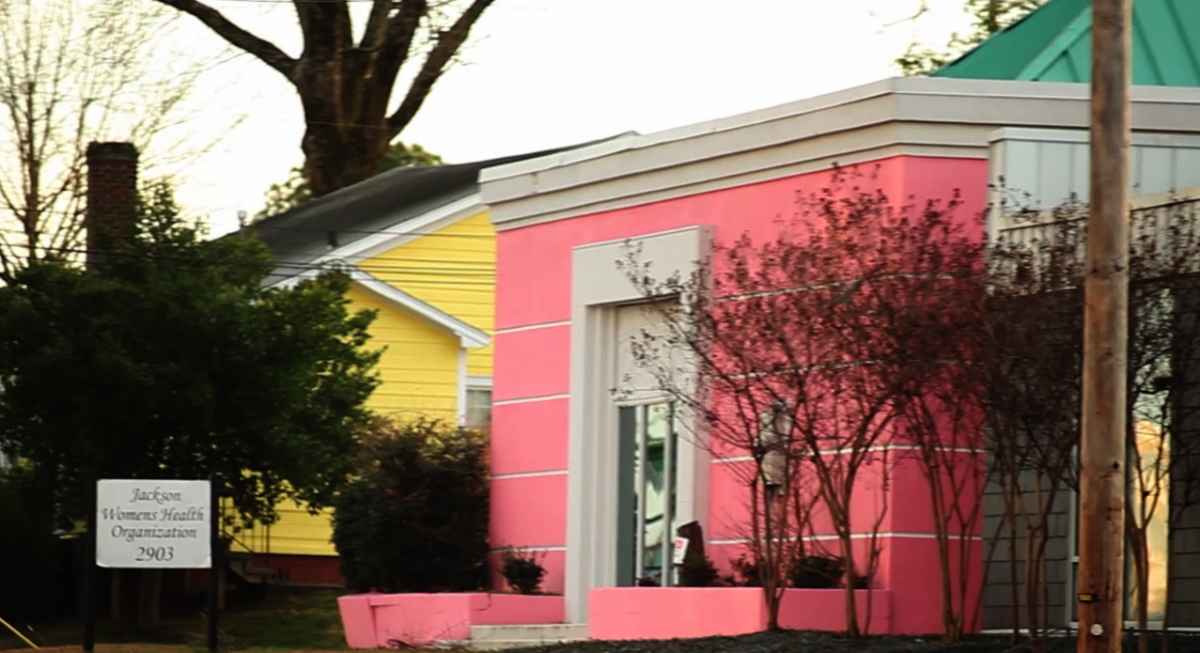
The Jackson Women’s Health Organization was just painted bright pink. (Aaron Cassara)
The Fondren neighborhood in Jackson, Mississippi, is one of those attractive, deliberately indie enclaves with coordinated pastel storefronts and cheekily named cafes—the type of place populated by artists, professionals and young families all living in harmony. Right in the middle of the main drag there’s a freshly painted pink building that blends in nicely with the teal and Easter egg-yellow facades surrounding it. Once inside, you’re hit with splashes of salmon and peach and purple. The furniture is red leather, and colorful art hangs on the wall.
The pink place isn’t an organic taco shop or a community center. It’s an abortion clinic.
The Jackson Women’s Health Organization has been in the news as of late: it has been in serious danger of shutting down since Republican legislators passed a regulation requiring its doctors to secure hospital admitting privileges. After a temporary block by a federal judge, the clinic has been officially informed that it is in non-compliance with the new law. It has filed for an adminstrative hearing, knowing that it will be embroiled in a court battle for months to come. Protesters regularly congregate around the entrance with folding chairs and signs. The day I visited Jackson there were a few stragglers, awkwardly hovering by the front door with posters mercifully free of visuals. I was informed that this was a slow day.
At first glance, Fondren is the best place for this clinic to be. It likely has a higher concentration of pro-choice residents than any community in the state.
“I was stunned when I first came to Fondren in ’95,” says Diane Derzis, the owner of the Jackson Women’s Health Organization. “The district is totally unlike the rest of the city. It’s avant-garde. It’s got its own special thing.” She says people in the community are constantly saying things like, “Go, girl. Y’all are wonderful.”
But with an abortion clinic comes protesters. With protesters come harrowing chants and plastic babies and giant gruesome photos of aborted fetuses with missing limbs. Plopping an abortion clinic in a once junkie-addled, now hipster neighborhood produces an uncomfortable iteration of NIMBY hesitance. Would I, a pro-choice feminist, want to live next door to an abortion clinic in Mississippi? At that moment, I wasn’t so sure.
Popular
"swipe left below to view more authors"Swipe →
“We’re not welcome entirely in that district, because along with us comes the negativity of those protesters,” says Derzis. “I think we become a pain in the ass. The poor guy across the street is trying to have a lunch business, but instead his customers are assaulted by those images.”
A cashier (who preferred not to be named) at Rooster’s—the hipster burger joint directly across the street from the clinic—told me he doesn’t mind the existence of the clinic, but he hates having to look at the protesters’ “distasteful signs.” He notes that the restaurant sees “a drop in business. We see more to-go orders. They’ll be looking across the street when they’re waiting in line, and our regular customers, they’ll get [their order] to go.” Derzis told me about a bartender living across the street who gets woken up in the morning by loud anti-abortion refrains.
“I love you guys, but I hate these bastards,” the bartender often says to Derzis.
Of course, this is partly why the protesters are there: to stigmatize the clinic, to make the neighbors squirm. Derzis and Shannon Brewer-Henderson, the center’s director, both told me about a Republican landlord who owns a building across the street. Derzis and Brewer-Henderson say he dislikes the protesters more than the center itself—he turns his sprinkler on them when they get too close to his front yard—but when the anti-choice crowd calls for the clinic’s closure, he can’t disagree. Nobody wants to hear “baby killers!” outside their window.
Once in a while, this spectacle will have the opposite effect. Brewer-Henderson runs a clinic escort program and says that several volunteers hail from Fondren. “I had one young lady say she passes by here all the time, and it bothers her having to see what these patients are dealing with,” she says. “That’s why she decided to come help out.” It doesn’t always come down to partisan politics. Some of us just grow sick of bearing witness to harassment.
Read Nona Willis Aronowitz’s report on a very different kind of gentrification happening in New Orleans.
Editor's Note: An earlier version of this post erroneously referred to a "Republican architect" who had an office across the street from the clinic. In fact, Derzis and Brewer-Henderson were referring to the landlord of the office building across the street, not one of his tenants. The post has been updated with that correction.

