
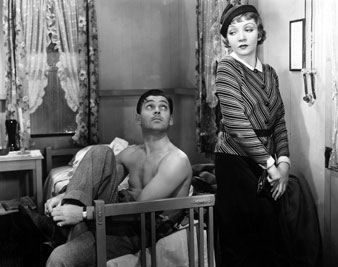
 Everett CollectionClark Gable, Claudette Colbert in It Happened One Night, 1934
What happened was Clark Gable doffed his shirt to reveal his bare chest, prompting the second great crash of the Depression: in undershirt sales.
Among the more gratifying phenomena of the current season has been the growing recognition of It Happened One Night, the Frank Capra production of last year, as one of the few potential classics of the recent cinema. Having been selected as the best American picture of the year by the National Board of Review and other organizations, and having earned for its director and players a handsome collection of gold medals, it is at the moment in its third week of revival at a New York playhouse–a tribute usually reserved for certain films of Chaplin and certain cartoons by Walt Disney. What is perhaps most gratifying about all this is that it has come about without any of the usual ventilation of superlatives which attends the birth of a masterpiece in the American screen world. Nothing in the subject, the personnel, the surrounding circumstances of this particular film offered the least pretext for the beating of the big drum. There had been a whole succession of pictures based on the picaresque aspects of the cross-country bus; neither Claudette Colbert nor Clark Gable was a reigning favorite with the great popular public; and Frank Capra was merely one of several better than average Hollywood directors. In brief, the wholly spontaneous response with which the picture was received could be traced to no novelty or originality in its component elements. A second viewing of it at the Little Carnegie confirms this truth at the same time that it enforces the realization of how difficult it is, at the present stage of motion-picture production and appreciation, to determine what it is precisely which makes a good photoplay.
It is true that the story, which is a mixture of both farcical and realistic situations, is exceptionally well put together from almost every point of view. It is developed with the galloping pace that good farce requires, and the timing of individual scenes is invariably well managed. But here it is hard to distinguish between the work of the script-writers and the work of the director, who is perhaps even more responsible for maintaining an unerring accuracy of tempo throughout. And is it quite fair to ignore what the players may be contributing to the same effect? Although neither Miss Colbert nor Mr. Gable had demonstrated any particular comic talent before this picture, their playing here is at every step exactly in tune with the mood of the occasion. As for the content of the film, which may possibly be distinguished from the treatment, one can remark only that it is authentically indigenous without being in any way novel or striking. An honest documentation of familiar American actualities becomes, in a Hollywood film, more absorbing than intrigue in Monte Carlo or pig-sticking in Bengal. Also one might point out that the manner in which this material is utilized for comic purposes strikes a nice balance between pure farce and serious social satire. The result of the balance is something less tiresome than the first, and less precarious to the comic intention than the second. But the effort to fix and label the particular quality which separates this film from the dozen or more substantially like it in recent years is bound to end only in an admission of critical humiliation. A good photoplay, like a good book or a good piece of music, remains always something of a miracle – in the least sentimental sense of that word. Beyond a certain point the mind is forced to bow down before its own inability to unravel and put together again all the parts of the shining and imponderable whole with which it is dealing.
The Balderston-Unger adaptation of Dickens’s unfinished The Mystery of Edwin Drood turns out to be much the most successful of the several recent efforts to reconstruct the mood and atmosphere of early Victorian England. Under the expert direction of the veteran Stuart Walker, this tale of moral degeneration and crime in a cathedral close is made into one of the most consistently harrowing films of the season. It is worth seeing if only for those scenes in which Claude Rains, as the depraved choirmaster, exhibits once again his unsurpassed talents for the more satanic type of role. Another “thriller” of almost equal merit, The Man Who Knew Too Much, has just arrived from the British studios. Uniformly well acted by a cast that includes Edna Best, Nova Pilbeam, Pierre Fresnay, and Peter Lorre (the child murderer in Fritz Lang’s M), it manages to hold its interest despite the somewhat unconvincing attempt, in the latter sections, to transform London’s Wapping into a replica of Chicago’s South Side. It is probably a fact of some significance that in both these additions to the cinema of horror both acting and direction are on a considerably higher plane of sophistication than the material.

