

Volunteers fill bags for a school lunch program at the Cleveland Foodbank. (AP Photo/Amy Sancetta.)
Lost in the shuffle of last year’s big fiscal cliff deal was the deal that didn’t happen on a new farm bill.
One of the major points of contention was funding for food stamps through the Supplemental Nutritional Assistance Program, run by the US Department of Agriculture. Republicans in the House proposed steep cuts: $16.5 billion over the next decade, which would eliminate food assistance to as many as 3 million low-income Americans. The Senate countered with a farm bill cutting $4.5 billion from SNAP over the same time period.
There was simply no deal to be had on the farm bill, and so Congress passed a simple extension until September 30. Now Congress has to start over—all prior versions of the farm are dead, since there’s a new Congress.
And this time around Republicans are only going to increase, not moderate, their demands for steep food stamp cuts. Representative Frank Lucas, the chair of the House Agriculture Committee, told the Capital Press this weekend that the new House farm bill will mandate $20 billion in SNAP cuts over the next ten years.
Democratic leadership in the House is already blasting Lucas’s proposal. “SNAP doesn’t just offer much-needed support to vulnerable Americans, it provides a significant boost to the economy, nearly doubling the return of every dollar we put into it,” Drew Hammill, communications director for House Minority Leader Nancy Pelosi, told The Nation. “Just when you think you’ve seen the extent of [the House GOP’s] misguided priorities, they strike at the ability of millions of low-income children, the elderly and American families to put food on the table.”
There’s going to be a lot of blowback to Lucas’s proposal—not only from Democrats, particularly in urban areas, but from some Republicans, particularly in the Midwest, who know that cutting food stamps depresses food sales, which in turn hurts farmers.
Some other Republicans, like Senator Thad Cochran of Mississippi, oppose the cuts because so many people in their state rely on nutrition assistance. “I come from a state where we have higher-percentage participation [than the national average],” Cochran said last year. “I have never had to apologize in Mississippi for supporting it,” he said, referring to food stamps.
Popular
"swipe left below to view more authors"Swipe →
But, as is so often the case in recent years, it’s a hardcore group of conservatives in the House that are roiling debate over an issue that used to be mainly non-controversial, and pulling it to the right. The backdrop here is that Representative Paul Ryan’s most recent budget, like the ones before it, demanded food stamp cuts that make Lucas’s plan look as if it was crafted by Mother Teresa.
Ryan’s 2013 budget blueprint calls for $135 billion in food stamp cuts over the next ten years, with $125 billion coming in the first five years. That would toss up to 13 million people from the program.
Boehner has openly acknowledged that hardcore conservatives who found Lucas’s cuts too timid were a primary reason the House couldn’t pass a farm bill last year.
“The current situation that we face is we’ve got people who believe there’s not enough reform in the farm bill that came out of (the House Agriculture) committee,” Boehner said last September, when he announced the House wouldn’t try to pass a final farm bill. “We’ve got others who believe that there’s too much reform in the bill that came out of the committee.” (Read “reform” as “cuts” here, a good rule of thumb for most Washington budget debates.)
But to be clear—Washington should, if anything, be debating an expansion of food stamp benefits. Research shows that for every federal dollar spent on food assistance programs, there is $1.84 in economic benefit.
And the conservative rationale for cutting the program is based on faulty assumptions. Ever since 2009, conservatives have been railing against the rapid expansion of the SNAP program as if it was a policy choice by Obama. (Recall Newt Gingrich’s endless invocations of the “food stamp president” during the 2012 GOP primary.)
But food stamp usage increased as a natural function of the steep recession, which created a lot more people who were eligible for the program. (In fact, Republican counties are responsible for most of the food stamp growth.) Republican demands to enact deep SNAP cuts, while crudely punitive to the millions of low-income Americans who depend on food stamps, are also unnecessary. Spending on SNAP will decrease significantly over the next ten years all by itself as the economy recovers, as this chart from the Center on Budget and Policy Priorities shows:
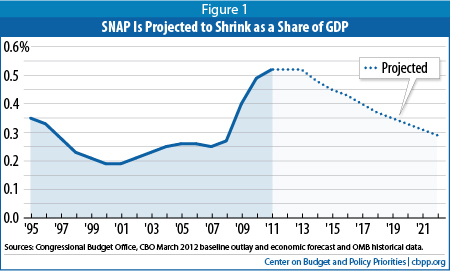
But Lucas’s proposal makes clear the Republicans will still use the current peak to try to enact deep cuts. There’s no doubt that a ferocious battle is looming.
Read George Zornick on Congress's gun control reform failure and where we go from here.

