
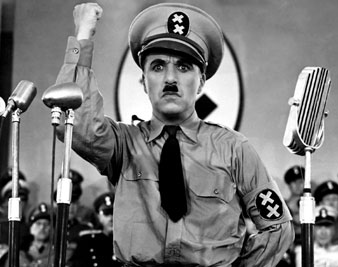
 Everett CollectionCharles Chaplin in The Great Dictator, 1940
Hitler was said to have seen this twice. One tends to doubt, however, that he gave it a thumbs up.
Charlie Chaplin plays three parts in The Great Dictator. First his old one, the funny little man whom the entire world loves; second, Hitler; and third, Charlie Chaplin himself, a social-minded American full of all the good slogans.
The funny little man, this time a little less funny and a little more tragic, appears as a Jewish barber who lost his memory in World War I. Getting it back after many years he finds the ghetto terrorized by the double-cross storm troopers of the great dictator, whom he himself resembles as one egg does another. (Conveniently no one seems to notice the resemblance until the author of the picture—Charlie Chaplin—wants to make use of it.)
The story which develops swiftly from this basic situation takes place in the palace and in the ghetto. In the palace the dictator, assisted by Garbitsch-Goebbels (Henry Daniell) and Herring-Goring (Billy Gilbert), is planning the rape of Austria. He needs money and he is afraid of Napaloni-Mussolini (played excellently by Jack Oakie), whose army stands at the Brenner. When a Jewish banker refuses a loan the great dictator orders a pogrom. All Jews are robbed and Napaloni is duly double-crossed. In the meantime the little barber, now in love with a beautiful laundress (Paulette Goddard), after fighting the storm troopers in his knock-about fashion, has been caught and put into a concentration camp. He escapes, and it is when he is on his way to the Austrian frontier that he is at last taken for the dictator. (The real one is taken for him and thrown into the camp.) Soon enough he finds himself forced to speak as conqueror to the conquered. In this great moment the little man, alas, loses his identity once more and Charlie Chaplin speaks instead for democracy and everything fair and good. A propaganda speech cuts short the unfinished story.
The actor Chaplin is superb in the double role, often surpassing, and on a higher level, even the greatest of his earlier performances. As barber he plays many delightful scenes of the kind one expects from him. He absent-mindedly shaves his girl. Or he barbers a perplexed customer to the rhythm of a Hungarian dance by Brahms. The best scene of all is the one in which he and his comrades decide who shall be chosen to kill the dictator. They eat sweet puddings in one of which a coin is concealed. The man who finds the coin must sacrifice himself. The way they cheat each other over the dangerous dessert without becoming malicious is a delight to watch. The whole scene is perfectly composed, most delicately balanced, and rich in human understanding. The only trouble is that such perfect scenes as this are followed by more conventional passages which would be funny enough in an average picture but let one down in a film that deals so ambitiously with so great a theme.
The same criticism applies to the palace sequences. Outstanding here are the dictator’s dance with the globe, the arrival of Napaloni, and the satire on the psychological approach, with both dictators trying to outsmart each other. Chaplin is really great, sharp and revealing, in all his speeches as dictator, which he renders in an invented language. Incidentally Chaplin speaks so naturally and well that one remembers only afterward that he has been until now a silent actor. He skilfully differentiates the two characters he plays, and at the end, in his own voice, he is forceful and carries conviction.
The picture, which runs for more than two hours, leaves one with a queer mixture of enthusiasm and disappointment. The shortcomings of the film have nothing to do with Chaplin the actor. He has mastered the great and difficult feat of playing the part of Hitler. His portrayal is convincing in every gesture and mood. It is never forced. No, for the shortcomings it is, I suspect, Chaplin the author who is responsible.
Chaplin’s script, I hasten to say, is one of the most ambitious and most original scripts ever written. Yet it does not reach the heights: it is uneven, lacks coherence and sweep, and is in spots already slightly dated. The writer Chaptin is still primarily concerned with scenes for the actor Chaplin. He knows how to make his scenes serve the higher purpose which he has set in choosing universal and controversial themes, but he sometimes asks too much of himself and as a result gives his art and his admirers less than he could. What he needs now is a congenial author. In order not to get into trouble with any person living, I recommend to him two writers long dead. One is the Czech Jaroslav Hasek, author of The Good Soldier Schweik; the other is the Viennese Johann Nestroy—the greatest comedian of his time as Chaplin is of ours, but a greater writer still. He solved, in his parody on Herod and Mariamne, the final problem which Chaplin has failed to solve in The Great Dictator (therefore the shortcut end), namely, the end of the dictator. Nestroy’s dictator, after killing everybody around him, confronts himself, and finds the final formulation: “Ich oder ich“—”I or I.”

