
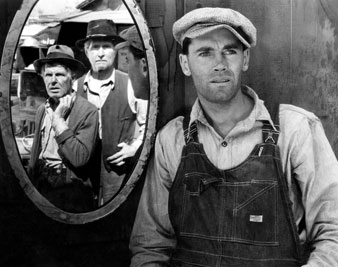
 20th Century Fox/Everett CollectionFrank Darien, Russell Simpson, Henry Fonda in The Grapes of Wrath, 1940
Hollywood was concerned that the saga of the Joads might send a “pro-Communist” message, but in the end, even Whittaker Chambers liked this film, which says something.
The eagerly awaited movie version of John Steinbeck’s The Grapes of Wrath (Twentieth Century-Fox) is one Hollywood production you cannot afford to miss: for its general excellence in direction, acting, and photography, for the fact that in places it breaks out of the straitjacket of formulas and codes; for the significance of the whole undertaking, whatever its motives. With it a new period in the development of American moving-picture art could begin. But even if this hope is not confirmed, the standard which the film sets will remain. To make it a beginning instead of letting it be a mere single accomplishment is now—partly at least—up to the audiences. It would be a great pleasure to see the conventional school of producers that operates on the easy assumption that movies are and should be nothing but (mild) entertainment get a licking at the box office. But of course, no costly manifestation of a society, such as the press, the radio, and the movies, can be freer than the society itself.
Nunnally Johnson, who wrote the movie version, has done his work skilfully. Since The Grapes of Wrath, unlike Gone with the Wind, was not assigned the status of a super-production, Mr. Johnson had to cut sharply into the original. The whole last part of the book is out—the box-car camp, the flood, Rosasharn’s miscarriage, and the very last scene. The picture closes with Tom Joad fleeing (to be “everwhere—wherever you look”) from the government camp. And the family drives on, longing for work, Mother Joad summing up: “We’re the people that live. Can’t nobody wipe us out.”
The tone of the original is often softened, the breath weakened, the scope narrowed, but what remains is still within its limits a passionate and deeply absorbing story. There are flaws. One never sees for example, the Joads or the other immigrants from the Dust Bowl actually at work in the green and golden valleys of California. Why? The contrast between their dreams of what fruit picking would be in a beautiful and fertile landscape and what it turned out to be in reality constituted a natural and very effective element in the original. Would it spoil our appetite for compotes if we could actually see how our fruits are picked? The movie version does not always tell the whole story, but neither does it lie; emotional formulations of little directive meaning are given a prominent place at the cost of concrete and intelligent conclusions. But as a whole the script preserves the spirit of the novel.
John Ford, the director, who last year did an unsurpassed job with Stage Coach, again triumphs. It is he who made this picture what it is. Taste, economy, a sharp sense of artistic balances, and an admirable technical skill enable him to tell of human hearts where others would only report external actions. He is developing more and more a style of his own which combines realism with imagination. As a result he gives us pictures of life which mere naturalism could not achieve. Sometimes one feels that he would like to go a step farther, that he could heighten a scene, make its impact even stronger, that he could shake us where he only moves us—I hope he will one day be allowed to do it. In this film the children in Hooverville do not look really starved, and they do not behave as if they were. There are other retouchings, too, to match the script, but often the director overcomes the limitations imposed and turns them into virtues, achieving his result through implication. Special mention should be made of his camera man, Gregg Toland. The photography is exact and ingenious, and there are many unforgettable shots.
It remains to praise the cast, which in the chief parts and in the bits is equally perfect. Henry Fonda as Tom, Jane Darwell as Ma Joad, John Caradine as Casey play with an air of understatement which fits their stunned bewilderment when they find out what the world still is like in the midst of plenty. If their behavior for long stretches is rather lyrical than tough, it is not their fault. They have not been allowed to play the hardest and most bitter moments of the book. Not enough credit can be given to the supporting cast and its direction. These cops, vigilantes, emigrants, truck drivers, and gas-station attendants on US Highway 66 supply a frightening reality; they are presented without any sentimental concessions. This cannot be said about the whole picture. But, nevertheless, The Grapes of Wrath is Hollywood’s most distinguished offering.

