Are Democratic Voters Turning on Biden?
It’s still early, but recent polls have the president losing against Trump for the first time. Whether they’ll get worse is anyone’s guess.
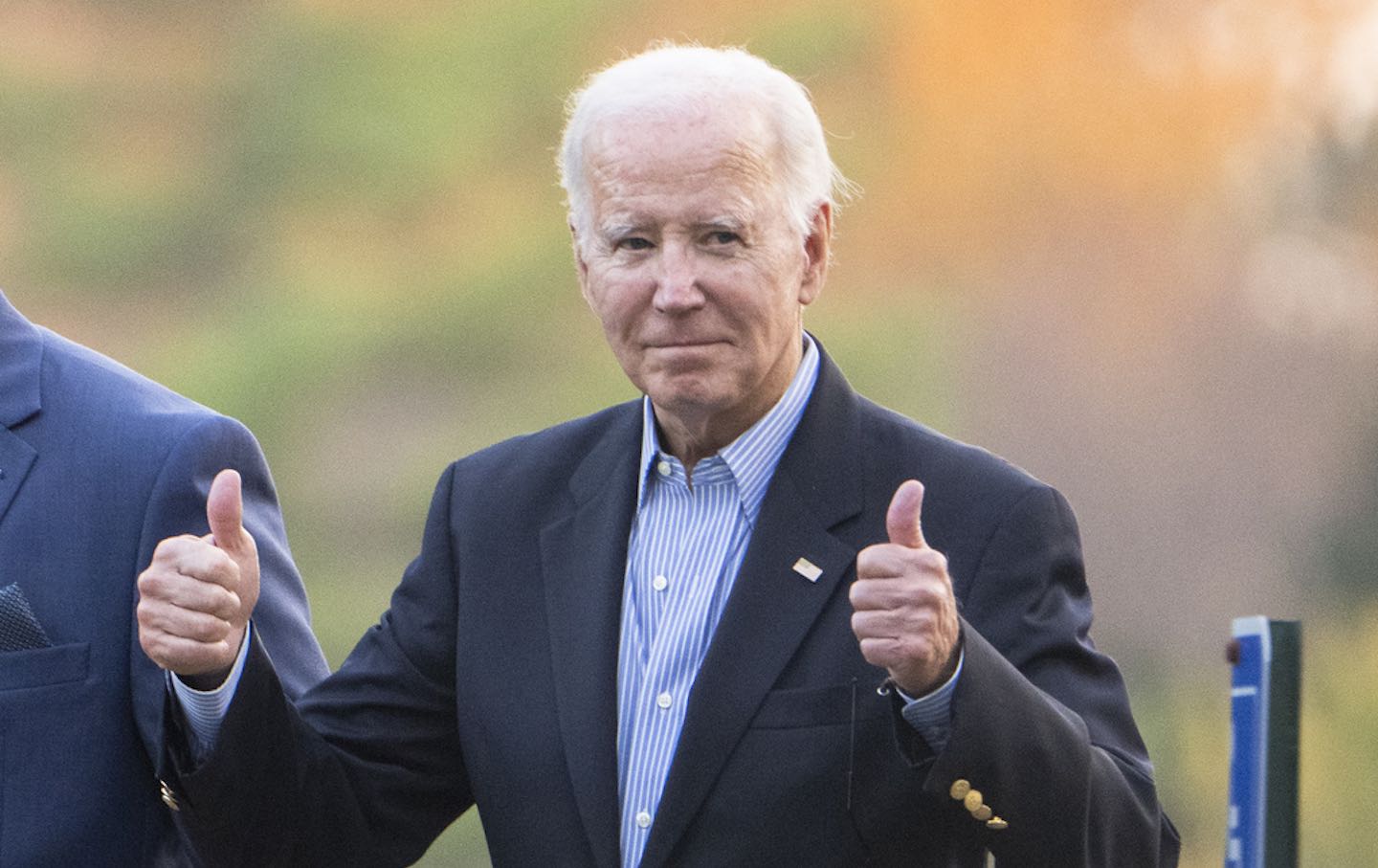
President Joe Biden leaves St. Joseph on the Brandywine Catholic Church in Wilmington, Del., Saturday, October 28, 2023.
(Manuel Balce Ceneta / AP Photo)Less than a year out from the 2024 election, Democratic strategists and consultants are testing the range of the freakout continuum. There’s plenty of material for them to work with. A recent NBC poll has Biden losing against Trump for the first time, with 70 percent of voters in the key 18-to-34 demographic disapproving of his performance, chiefly on the basis of his handling of the Israel-Gaza war. Biden’s support among Black and Hispanic voters—also critical constituencies—is also steadily waning. Swing state polls are also trending Trumpward, in yet another grim development for the Biden camp.
Of course, standard polling caveats apply here: Year-out polls have little meaning, particularly for a campaign that hasn’t lurched into full-messaging mode; even NBC’s poll showing Trump pulling ahead remained within the three-point margin of error. The rightward drift in polling among non-white voters is likely more an organizing-and-mobilization challenge than a persuasion one. And in the run-up to both Obama’s 2012 reelection and Biden’s 2020 bid, there were kindred signs of red-light distress that proved unfounded in the final balloting.
Yet stressed-out campaigns, like unhappy families, are all stressed out in different ways. As Biden turned 81 yesterday, concerns about how the electorate views his age—another persistent sticking point in the polls—gained fresh momentum. It’s true that Ronald Reagan was able to swat down growing concerns about his age during the 1984 general election with a well-timed barb at the year’s last presidential debate—but the Gipper was 73 at the time, an age that seems downright sprightly in today’s gerontocratic political class.
More troubling for Biden is the evident failure of a strong overall economy to translate into a second-term mandate for the incumbent president—a trend in defiance of a good deal of orthodox political science. The austerian agenda of Federal Reserve President Jerome Powell has kept interest rates high in a drive to tamp inflation down to 2 percent, which has meant that key economic indicators like home sales are a drag on many other sectors of the economy. The Biden administration’s mishandling of the Israel-Gaza war also puts him increasingly at odds with majority sentiment in his own party—particularly among younger voters, whose disapproval of Biden’s presidency skyrocketed 15 points between September and November in NBC’s polling. Commentators have taken to comparing Gaza’s influence on Biden’s downtrending numbers to how activist sentiment against the Vietnam War ultimately drove Lyndon Johnson to pull the plug on his reelection plans in 1968—but Johnson was at least getting widespread credit for a robust economy.
Still, what keeps the Democratic establishment stolidly failing to heed the many early-warning signals in front of them is the kind of thinking that promotes a gerontocracy in the first place: a deeply change-averse vision of how political consensus should take shape, and an allied conviction that meritocratic achievement must always prevail over popular sentiment. A Washington Post dispatch on the state of Democratic Party debate over Biden’s reelection prospects recounts a scene at a big donor’s confab in Aspen, Colo.: A participant questioned former Biden chief of staff Ron Klain about what the Plan B might be if it became impossible to deny that a Biden candidacy was unlikely to prevail next November. Klain’s response was a syllogism dilating on unassailable Great Leader virtue right out of The Manchurian Candidate: Joe Biden is the party’s nominee, and an exceptionally strong nominee at that. There is, he confidently asserted, no backup plan.
Of course, Klain is a longtime Biden loyalist, and wouldn’t have likely advised the people funding Biden’s reelection bid to start freaking out pronto. Still, this professional-class tunnel vision is very much of a piece with the elite party consensus assuring all skeptics that Hillary Clinton was ideally positioned to carry the day in the fateful 2016 presidential balloting—that there was, in fact, “nobody more qualified to serve as the president of the United States of America,” as the great meritocracy-groomed president Barack Obama put it on the campaign stump back then. The heavily credentialed Clinton was held to be the pragmatic and savvy alternative to insurgent primary rival Bernie Sanders, who, as the party consensus had it, gave many an impassioned speech but had a thin record of legislative accomplishment to show for his decades-long tours in the House and Senate. But the wonkish cult of the Hillary campaign proved to be one of the largest political disasters in recent memory, and the rising chorus of stay-the-course mantras in Bidenworld invites the queasy surmise that the Democratic Party has learned nothing from that debacle.
In any event, this premonitory round of buyer’s remorse among Democratic backers is coming too late—Klain is right that Biden’s nomination is all but locked in, with a slew of primary filing deadlines coming up at the end of this month and most of the others on course for January. That means that the party elite will continue to focus on a very different set of polls—those showing Biden’s declared primary opponents Marianne Williamson and Dean Phillips trailing him by 60 points. So it’s an all-but official foregone conclusion that the party’s standard-bearer in the critical 2024 presidential race is an incumbent president appearing to many key constituencies like a brittle and out-of-touch figure from a past generation of political leadership, brandishing a hidebound allegiance to the mores of institutional deference in Washington and a myopic-to-immoral allegiance to imperial warfare in the Middle East. In 2020, the specter of a reelected President Trump was enough to render Biden’s many liabilities moot in the final balloting; it was also true that a Covid-constrained campaign schedule did not showcase those liabilities on the same scale that next year’s general election will. Indeed, a Harvard-CAPS Harris poll released this week found that the 2024 candidate with the highest favorability rating among voters is anti-vax conspiracy theorist Robert F. Kennedy Jr. Coming into primary season with a serially indicted, fascism-promoting Trump surging in support among many key traditional Democratic constituencies, it’s far from clear that the party’s fealty to a credentials-first, top-down electoral politics is a luxury the country can afford to indulge any longer.