Biden’s Best Chance for 2024 Is to Take Aim at Corporate America
Poll numbers show increasing dissatisfaction with the president’s performance. To win voters, he needs to follow through on his populist rhetoric.
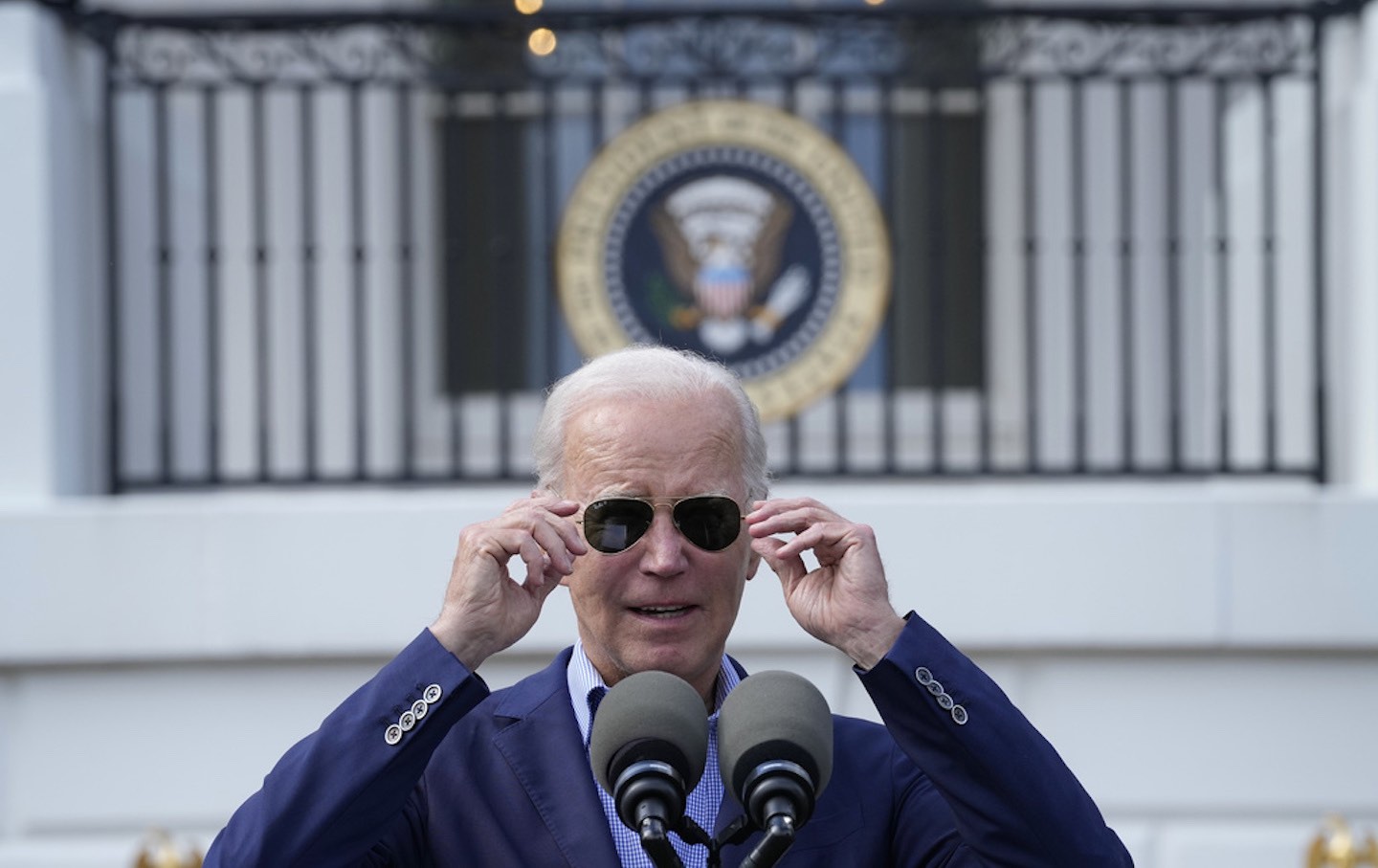
President Joe Biden speaks from the South Lawn of the White House in Washington, Tuesday, July 4, 2023.
(Susan Walsh / AP Photo)The year is ending on a bleak note for Joe Biden: According to a just-released Monmouth Poll, the president has reached his lowest approval rating to date, with just 34 percent of respondents endorsing his presidency. Just three in 10 voters said that Biden cares enough about the issues that matter to them, a lower plurality than Donald Trump ever reached in office, with inflation and immigration leading the roster. The candidate’s age also represents a key sticking point, with even a majority of Democratic respondents flagging it as a concern in a recent Washington Post analysis of 17 different polls. This latest poll swoon marks a 4 percent decline in approval in Biden’s Monmouth numbers, with a 6 percent hike in disapproval.
Belatedly, Biden himself has stressed the need to improve his standing in public opinion, according to Washington Post reporter Tyler Pager. Following his ceremonial Thanksgiving pardon of a pair of turkeys at the White House, the president reportedly upbraided campaign officials and staffers about his persistently low poll numbers, and demanded to know what they intended to do to reverse the trend. With economic indicators continuing to look robust and core inflation tapering off, Biden wanted fresh ideas about why and how the campaign’s basic pitch to voters wasn’t landing with conviction. Pager also reported that Michigan Senate candidate Elissa Slotkin—running in a state where a CNN poll has Biden trailing likely GOP nominee Donald Trump by 10 points—has expressed concern that Biden’s presence at the top of the ticket could impair her election chances.
As Biden’s approval numbers have remained flat and low, Democratic campaign operatives have waved them away, citing similarly anemic numbers for Barack Obama at the outset of his successful reelection bid, and recalling the premature obituaries political reporters composed for Biden after his poor showing in the 2020 Iowa caucuses. But, of course, Obama was still presiding over an underperforming economy, and Biden later harnessed mounting Democratic alarm that a prolonged primary fight would produce a second term for Trump; neither factor plays into Biden’s present plight. What’s more, Biden’s lackluster showing in Michigan, which has a significant Arab and Muslim population, is largely attributable to his complete accommodation of the Netanyahu government’s brutal prosecution of the Gaza War, an issue that he’s proven unmovable on, despite recent feints toward a more critical posture. Add in the war’s further erosion of support among younger voters—who’d already begun to defect after the president bartered away much of his plan for student debt relief in the spring debt-relief deal—and the causes of Biden’s polling woes look less epiphenomenal than structural. As Biden himself seems to recognize, shifting the relevant opinion dynamics will require more than a status-quo variation of the disastrous counter-Trump message of the 2016 Hillary Clinton campaign: “America is already great,” which roughly translated to many median voters as “You’re too dumb to know how good you have it.”
Biden began to retool some key elements of his economic pitch in October, when he relaxed the everything-is-going-fine messaging on inflation in favor of a renewed campaign against junk corporate fees. This overture was a welcome return to some of the populist themes that powered his successful 2020 campaign against Trump, but it’s still a policy initiative that lacks a critical political ingredient: a cast of villainous corporate names and faces to serve as a focus for public ire. Obama had the great good fortune of drawing former private equity baron Mitt Romney as a general election opponent, so he didn’t have to get very creative in campaign villain-casting. But the MAGA-fied Republican Party now abounds with plutocratic bad actors sent directly from central casting, from Elon Musk to Harlan Crow and Barre Seid, from big-box titan Bernie Marcus to just-plain box-titans Dick and Liz Ulhein. This is to say nothing, of course, of the stunningly corrupt Trump clan itself, or its vast retinue of media enablers, from the Murdoch family’s press properties to fledgling streaming entrepreneur Tucker Carlson. This case of shady characters could readily be marshaled under a compelling narrative of rapidly metastasizing elite corruption coursing through the American political economy, and by extension, the key institutions of our body politic. And Biden’s likely general election opponent is tailor-made for such depictions, particularly as his various corporate fraud and criminal conspiracy trials continue building toward resolution.
Biden would likely have trouble endorsing the full sweep of such a message, since he’s by temperament a deferential institutionalist. That outlook has colored everything from his reluctance to reconfigure a terminally corrupt Supreme Court to his chummy encomiums for Netanyahu to his addiction to the long-outmoded rhetoric of bipartisanship.
But Biden is also a deeply political animal, and a party man. By pivoting toward populist positions in matters of political economy in the first place, he laid aside a long record of economic reaction, stemming from his long career in the premier corporate-nameplate state of Delaware. Before his most recent presidential run, Biden was known as “the senator from MBNA” and justly derided for his role as lead sponsor of a punishing and regressive personal bankruptcy bill. With the prospects for a second term—and, as Biden himself has repeatedly noted, American democracy—weighing in the balance, the president can ill afford to bypass a populist platform that speaks directly to Americans’ real economic distress. And it’s just as clear that he and his brain trust can no longer afford to continue waving it away in a flurry of charts and Fed reports.
Whether the lead members of Team Biden will rise to this urgent challenge is the great looming question of Election 2024. One troubling sign that they might not is that they are apparently soliciting the public support of Hillary Clinton.