
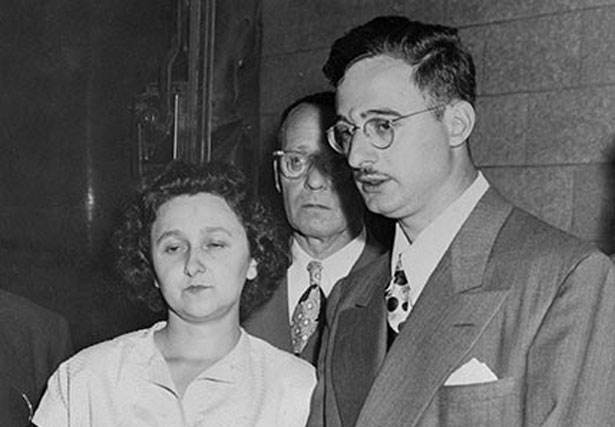
Julius and Ethel Rosenberg. (Flickr/Ninian Reed)
The best thing about The Americans, the new spy show on FX, is that the Soviet spies are not Julius and Ethel Rosenberg. They are a different married couple—Russians, sent by the KGB from Moscow to Washington, DC. The show begins shortly after Reagan takes office.
The show features sex that is better than the sex on Downton Abbey but not as good as Girls.
If Claire Danes and Mandy Patinkin of Homeland had been assigned to this case, they would have caught Keri Russell and Matthew Rhys, the stars of The Americans, in episode one.
Ron Radosh, David Horowitz & Co. will be unhappy with this show (of course they are unhappy about so many things) because the spies in question are not American communists. They would have a point there—the most successful Soviet spies in the United States were not Russians. I’m not talking here about Julius and Ethel Rosenberg. Historians today pretty much agree that Julius was a spy but that he didn’t give the Soviets the secret of the A-bomb; Ethel was innocent but was framed by her brother David Greenglass because the FBI threatened to indict his own wife.
The real A-bomb spies, the people at Los Alamos who really did help the Soviets build their bomb in the late 1940s, were Klaus Fuchs, a German refugee who was arrested and convicted, and Theodore Hall, an American whom the FBI suspected of spying at Los Alamos but who was never arrested. After spying for the Soviets, he had a long and happy life as a distinguished scientist in Britain; late in life he admitted to his crime—and said he never would have done it if he had understood the nature of Stalin’s terror. (See Joseph Albright and Marcial Kunstel’s book Bombshell.) Klaus Fuchs served ten years and was released; Theodore Hall never served a day in jail. Meanwhile, as readers may have heard, the Rosenbergs were executed.
During the Reagan years portrayed in The Americans, the most succesful Soviet spy of all time was at work—and he wasn’t Russian either. He was another American, CIA official Aldrich Ames. In 1985, Ames was named the CIA’s chief of counterintelligence for the Soviet Union and Eastern Europe. He gave the Soviets the names of all of America’s spies inside the Soviet Union. They were all arrested and executed—that story is told by Tim Weiner in Legacy of Ashes. He got away with it for seven years, before being arrested in 1994. Unlike Julius Rosenberg and Klaus Fuchs and Theodore Hall, he didn’t do it because he believed in the ultimate goals of communist society; he did it for $2 million. That would make a good TV show, although a depressing one.
The Americans is about Soviet spies in the United States; why not a show about American spies in Russia? That would take some imagination, since the US didn’t have any spies in the Soviet Union for virtually the entire duration of the Cold War. According to Tim Weiner, “over the whole course of the cold war, the CIA had controlled precisely three agents who were able to provide secrets of lasting value on the Soviet military threat, and all of them had been arrested and executed.”
As for the plot of The Americans, “implausible” is too generous a word; suspending disbelief turned out to be impossible for us. The eighties music, however, was pretty good—if you like Fleetwood Mac.
What’s the buzz in post–Fleetwood Mac Russia? Read Katrina vanden Heuvel and Alec Luhn’s interview with opposition rocker Yuri Shevchuk.

