
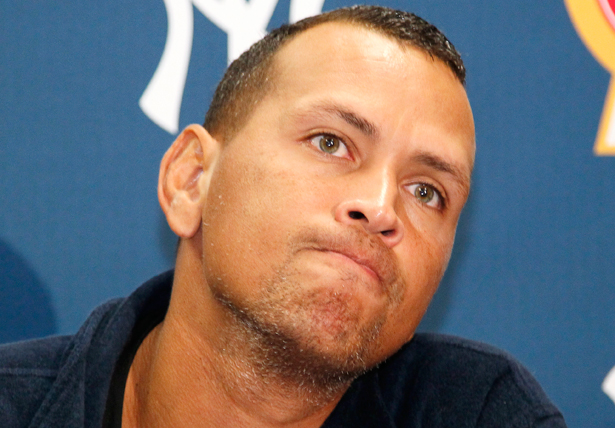
Alex Rodriguez. (AP Images)
In all likelihood, you are feeling bloated by all-things A-Rod. Maybe you’re repulsed by the person and what you feel he’s done to baseball. Perhaps you’re just sick of the 24/7 media swarm over what a ballplayer may or not have ingested. Or possibly you’re just amused by the entire spectacle, a particular highlight of which occurred when A-Rod described his pending suspension as “the pink elephant in the room.”
But the A-Rod focus obscures what’s revealed by the bigger Biogenesis scandal. Gander at the names of everyone suspended.
Tops on the anabolic trophy list after A-Rod is Brewers 2011 MVP Ryan Braun. After that we have a group little-known to the casual fan. There is Jordany Valdespin, Antonio Bastardo, Sergio Escalona, Nelson Cruz, Everth Cabrera, Jhonny Peralta, Jesus Montero, Francisco Cervelli, and minor leaguers Cesar Puello Fautino De Los Santos, Fernando Martinez and Jordan Norberto.
Once we are past Braun, each and every one of these players comes out of baseball’s notorious Latin American pipeline (or notorious for anyone who bothers to investigate).
Almost all the suspended players are from the Dominican Republic. This isn’t coincidence or happenstance. It’s the set-up of our globalized national pastime in the twenty-first century.
Any serious discussion about performance-enhancing drugs and baseball needs to deal with the fact of who is getting caught. Major League owners choose to invest billions of dollars in Latin America to develop talent on the cheap in the school’s baseball academies. In the Dominican Republic, where 40 percent of the country lives below the poverty line, steroids are actually legal and available over the counter.
As Gregg Sarra reported for Newsday in 2009, “Here’s how easy it is to buy anabolic steroids in the Dominican Republic: Walk into the local pharmacy and ask for them.”
Human growth hormones are also available but you need a prescription.
Children get scouted before their tenth birthday, are signed to contracts for peanuts, and their families see baseball—not without reason—as the best shot to escape poverty. The incentive to use steroids weighs on the tweens charged with dragging their families out of poverty. According to my own interviews with major-leaguers who’ve injected their bodies with banned substances, they’re psychologically—if not physically—profoundly addictive.
Look at one of the most prominent people branded with the scarlet “S”, Sammy Sosa. Before his thirteenth birthday, he stitched soles in a shoe factory for, as he remembered, “pennies, just enough to survive.” His choices, as he said, were the cane fields, the army or baseball.
Baseball’s owners prey on this reality. They want to benefit from steroids in the development of talent, and then excoriate those same players when caught on US shores. It’s a context that speaks to the imperial arrogance at the heart of the game. It’s a context right in front of our faces that we are asked not to see. Put simply, MLB owners want to have their anabolic cake and eat it too.
It’s also worth noting that many white, college-educated, US-born players have been front and center speaking about why they oppose steroids in the game, leading one of the main media storylines: that “the players are demanding more testing and harsher penalties.” Perhaps. But it would be nice to hear just one US born player say that maybe—just maybe—the context and reality of a lot of the people getting pinched is profoundly different than their own.
Dave Zirin asks why the baseball players union is refusing to go to bat for their own.

