
 Reuters Photos
The release of memorandums prepared by Bush administration lawyers on how–not if, but how–to torture prisoners confronts Congress with the sort of constitutional challenge its risk-averse members have a penchant for ducking. Over the past thirty-five years, the branch of government best positioned to curb abuses of executive power has repeatedly skipped opportunities to check and balance an increasingly imperial presidency. Just one month after Richard Nixon resigned in disgrace, when President Gerald Ford pardoned his predecessor, Senate majority leader Mike Mansfield and several members of the House Judiciary Committee suggested that the impeachment process could be reopened. But House Democratic leaders, fearing that the move would harm the party’s 1974 electoral prospects, stymied the initiative. California Congressman John Moss, a champion of open government, later complained, “The House should have completed its impeachment action. We were less than we should have been.”
On the matter of presidential accountability, the House has been less than it should be ever since. The chamber that refused to hold Ronald Reagan, George H.W. Bush and their henchmen to account for Iran/Contra abuses–and that took impeachment “off the table” even after revelations that George W. Bush and Dick Cheney had committed acts that former White House legal counsel John Dean identified as “worse than Watergate”–has remained a bystander as successive presidents have engaged in ever more sinister abuses of authority.
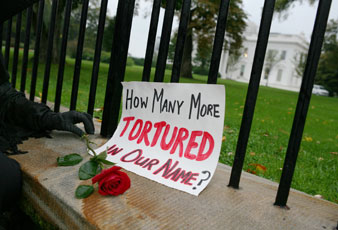
Wisconsin Senator Russ Feingold, chair of the Senate Judiciary Committee’s Constitution subcommittee, who has long urged Congress to get more serious about checking and balancing executive excess, is now rightly arguing that evidence of the Bush administration’s complicity in torture must be addressed. “Horrible abuses were committed in the name of the American people, and we cannot look the other way or just ‘move on,'” he says. But Congress must also confront its own complicity: members must recognize that their repeated refusals to address abuses by sitting and former presidents have facilitated a breakdown in the constitutional order.
This recognition must be joined with Congressional action to remove those who sanctioned and promoted torture from positions of public trust and, if inquiries so conclude, to hold Bush, Cheney and their top aides to account. Going after Jay Bybee, the former assistant attorney general who wrote the most noxious memo–outlining schemes for waterboarding, sleep deprivation, slamming prisoners against walls and putting them in “confinement boxes” with insects–would be a swift and aggressive opening gambit. Bybee is now a judge in the Court of Appeals for the Ninth Circuit; he should be impeached by the House and removed from office by the Senate.
Popular
"swipe left below to view more authors"Swipe →
There are other routes to accountability. New York’s Jerrold Nadler, who chairs the House subcommittee on the Constitution, proposes appointing a special counsel. As Center for Constitutional Rights president Michael Ratner explains, “Some claim that to prosecute those who approved torture techniques would criminalize a policy difference. But torture is against the law.” He goes on to say, “The claim that the administration officials who promoted the use of waterboarding…were acting in the national interest does not absolve them; if it did, all torturers the world over would use the same justifications.” And President Obama, who erred on the side of the transparency demanded by the American Civil Liberties Union in its long campaign to obtain the memos, gets points for ordering an end to the use of the torture techniques they outlined and for expressing at least a measure of openness to a “further accounting” and perhaps prosecution of wrongdoers. But Obama’s fretting about inquiries “getting so politicized” and suggesting a preference for shifting responsibility to a bipartisan independent commission are unsettling.
As a former constitutional law lecturer, Obama should have a firmer grasp of the point of executive accountability. It is not merely to “lay blame,” as he suggests; it is to set boundaries on presidential behavior and to clarify where wrongdoing will be challenged. Presidents, even those who profess honorable intentions, do not get to write their own rules. Congress must set and enforce those boundaries. When Obama suggested that CIA personnel who acted on the legal advice of the Bush administration would not face “retribution,” Illinois’s Jan Schakowsky, chair of the House Permanent Select Committee on Intelligence’s subcommittee on oversight and investigations, offered the only appropriate response. “I don’t want to compare this to Nazi Germany, but we’ve come to almost ridicule the notion that when horrific acts have been committed that people can use the excuse that, Well, I was just following orders,” explained Schakowsky, who has instructed aides to prepare for a torture inquiry. “There should be an open mind of what to do with information that we get from thorough investigations,” she added.
There must also be a proper framework for investigations. Gathering information for the purpose of creating a permanent record is only slightly superior to Obama’s banalities about wanting to “move forward.” Truth commissions that grant immunity to wrongdoers and bipartisan commissions that negotiate their way to redacted reports do not check and balance the executive branch any more than “warnings” punish speeding motorists.
Impeaching Bybee, as recommended by Nadler and Common Cause, would send the right signal. But it cannot be the only one. The House Judiciary Committee should examine all available avenues for achieving accountability–including the prospect of formal action against former officeholders, up to and including the sort of impeachments imagined by Mansfield and his compatriots in 1974. And Nadler and Feingold should use their subcommittees to begin outlining statutory constraints on the executive branch. The point, again, is not merely to address Bush/Cheney-era crimes but also to dial down the imperial presidency that has evolved under the unwatchful eye of successive Congresses.
“Congress…must be vigilant to the perils of the subversive notion that any public official, the president or a policeman, possesses a kind of inherent power to set the Constitution aside whenever he thinks the public interest or ‘national security’ warrants it. That notion is the essential postulate of tyranny,” California Congressman Don Edwards warned thirty-five years ago, when too many of his colleagues thought Nixon’s resignation had caged the beast of executive aggrandizement. That vigilance, too long delayed, is the essential duty of every member of Congress who swears an oath to support and defend the Constitution.

