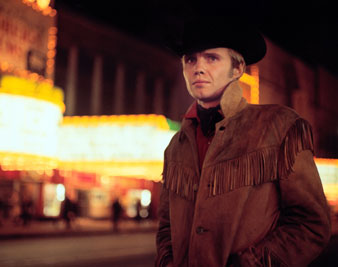
 Everett CollectionJon Voight in Midnight Cowboy, 1969.
Fred Neil’s haunting song, “Everybody’s Talkin'” sets the mood for this tragic buddy movie.
For all its raunchy detail and sardonic manner, John Schlesinger’s Midnight Cowboy (from a novel by James Leo Herlihy) is as sentimental a view of life as Chaplin’s The Kid. And for all its often excellent documentation of the acid look of New York’s main streets and America’s main highways, it is as whimsical as Harold Lloyd in Safety Last. I have no strong objection to tears and make-believe on behalf of family entertainment, but what we are dealing with here is male prostitution in quite explicit terms, and the attempt to wring tender laughter from such a topic strikes me as being itself a kind of commercialized vice.
Put it another way: should we sympathize with a Broadway cowboy hustler who jams a telephone receiver into the bloody and broken-toothed mouth of his middle-aged homosexual client because he must brutalize the poor man into giving him enough money to take a sick pal to Florida? It is a ticklish question and one that should not, perhaps, be raised in an essentially frivolous picture.
Joe Buck (Jon Voight) is a dishwasher in flight from a Texas hash joint. He has come to New York to exploit his only talent, which is priapic. Flashbacks suggest that he lived a lonely childhood with an oversexed grandmother, became a formidable local seducer, was manhandled by the police and a rape gang: but in the present he is another of those wide-eyed Dick Whittingtons who think the big city awaits their charms. With the exception of the above detailed scene, he is taken when he expects to take.
Rico, alias Ratso (Dustin Hoffman), is a crippled Italian con man from the Bronx, whose criminal talents extend no further than rifling overcoats at a party and pilfering light meals off vegetable stands: understandably, he is unwashed, unhealthy and camping out in a condemned apartment house.
These two metropolitan outcasts are eaten by the loneliness that used to torture O. Henry’s heroes. Each recognized the appealing vulnerability of the other; they take in each other’s misery, you might say, and in the end Ratso dies in Joe Buck’s arms on that Florida bus ride into the sunset. Two hearts of gold in the lower depths is almost redundant.
Hoffman and Voight are talented men who turn in spectacular performances that I suspect are bad for their talents. That is, they are given such extravagant trappings of character that they can he melodramatically fascinating on the surface, like some of those species of horned and tasseled caterpillars, and need not—indeed, probably cannot in this environment—project any content from within. Their parts are fabrications rather than creations, and this must induce a shallowness of approach that could in the long run corrupt them.
The whole film, so rigorously perfectionist for venal ends, so moistly indulgent and picturesquely amoral, is corruptive. But it is also blatantly synthetic to the point that it could scarcely corrupt a spectator: only the excellent performers (for the two leads are ably supported) might complain that they are being abused for profit.

