Scenes From a Democratic Earthquake in Iowa
The state was a MAGA citadel. Not anymore.
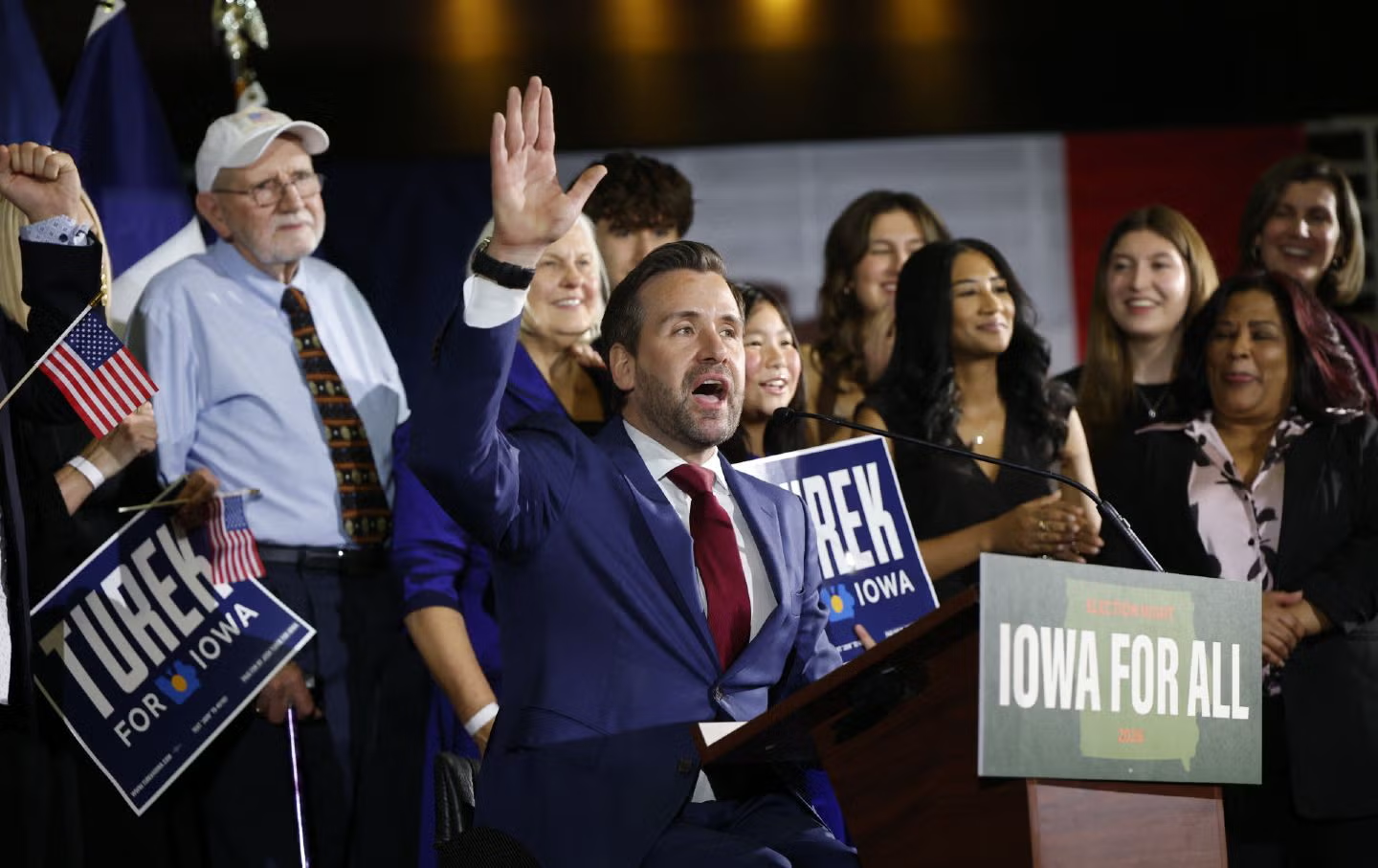
Des Moines, Iowa—“All along I’ve said Iowa was the center of the political universe,” Josh Turek, the Hawkeye State’s newly elected Democratic senator, told a giddy election-night crowd on Tuesday. “And man, did we prove that tonight.”
Some hyperbolic Hawkeye pride was more than a little pardonable on a night when the so-called “blue tsunami” swept Democrats into power across the country. But Turek was not wrong to highlight what was happening in Iowa. This is a state that Donald Trump carried by 13 points just two years ago, and that, thanks to a GOP-dominated statehouse and legislature, had earned the moniker “Florida of the North” for its firmly DeSantis-like lurch into a regressive, deregulatory, and woke-baiting governing agenda. It was supposed to be a firewall in the Republican Party’s doomed fight to hold on to its Senate majority. Millions in super PAC donations and vicious attack ads had flooded the state. And Turek still won.
Not only that: Rob Sand, the Democratic gubernatorial nominee, captured the statehouse for the party for the first time since 2010, and Democrats also took three of the state’s four congressional seats. All those winning candidates were women—another historic breakthrough in an evening full of them.
At the same time, Iowa’s repudiation of the MAGA disease in American politics was very, well, Iowan—which is to say, humble, neighborly, and civically optimistic. I grew up in eastern Iowa, and when I moved to the West Coast, I soon learned that greeting passersby on the street was regarded not as welcoming but creepy. The obsessive punctuality and the usage of honorifics that had been drilled into me as a kid likewise were regarded as quaint throwback rituals—virtual stage directions in a community-theater production of Our Town.
But Turek, like most Iowans, is still very much at home in these traditions. Even after the bruising campaign he waged against GOP Representative Ashley Hinson, he stressed that “I have deep respect for anyone who steps up to run.” (Some Iowans in the crowd were admittedly less generous, greeting the mention of Hinson’s name with a smattering of boos.) In his speech—delivered at the ur-Iowan venue of the state historical society—Turek addressed the state in the familiar second person, as in “Now, Iowa, let us be the city on the hill—the Iowa we grew up in that was the envy of the nation…. Iowa, this is where our comeback begins.”
At the same time, Turek also channeled the capital-P Populist tradition that has decisively shaped the state’s politics over the past century. Near the end of his speech, he called former US senator Tom Harkin to the podium, telling the crowd how Harkin had “changed my life” by working to secure passage of the Americans with Disabilities Act (Turek is wheelchair-bound, having contracted spina bifida in the womb after his father was exposed to Agent Orange in the Vietnam War). Harkin also embodied the crusade to secure fair and equal representation to working-class Americans, Turek explained—a cause that now served as “the North Star” of his own politics.
In this register, the patina of Iowa niceness became something more righteous and confrontational. Turek toned down his congenital niceness when he addressed the parlous state of our politics; in lieu of the amorphous indictments of “a broken system” that many lawmakers favor, he denounced a moneyed oligarchy—not exactly the sort of bipartisan overture he was chided on social media for earlier in the day when he said he’d cast his ballot in some local races for GOP candidates. One of his biggest applause lines was “Tonight, Iowa, we outvoted the billionaires,” and he made the same point in a much more personal idiom later, saying, “In Iowa, Elon Musk does not decide elections.” And he vowed to “end the corruption we’re seeing on both sides of the aisle,” adding, “I am going to DC to overturn Citizens United.”
If Turek is a prairie populist in the Harkin vein, the state’s governor-elect Rob Sand, who celebrated at the same Des Moines gathering, is something closer to Jimmy Stewart’s title character in Mr. Smith Goes to Washington. Sand is the incumbent state auditor and has relied on a long roster of endorsements from Republicans and independents in a campaign that he described as dedicated to “the straight and narrow path of public service, not politics.” When Iowans send their children off to school, he announced, “We don’t tell them to be red or to be blue. We tell them to be good, to be kind, to tell the truth.” Sand’s campaign distilled that sentiment into another typically Iowan slogan: “Not redder and bluer, but better and truer.” Midway through his speech, he paused to revive the civic ritual that he made the signature moment in his town halls across the state, leading the crowd in “America the Beautiful.”
But Sand also went on to explain that this is more than simple goo-goo sentiment. As a matter of basic political math in a state where registered Republicans outnumber Democrats by 180,000, “the smallest party has to appeal to reasonably minded people in the other party.” And in governing a state with GOP majorities in both houses of the legislature, Sand has little choice but to seek some workable common ground with a MAGA-fied GOP.
Speaking of the loyal opposition, Sand said, “I hope you will kindly tell me why you didn’t vote for me—and since I’ll be here for a while, you’ll get to know me better, and maybe change your mind next time.” It’s a pragmatic, improbably wholesome start at charting a path out of the MAGA darkness that’s engulfed the state, but it’s again not without precedent. Throughout much of the 20th century, Iowa had some of the most liberal and most conservative members of the Senate—Harkin and the state’s now super-senior nonagenarian Senator Chuck Grassley, John Culver and Roger Jepsen, Harold Hughes and Jack Miller. This, too, was a legacy of Populism, which in its Upper Midwest iteration found later expression in left-wing movements like North Dakota’s Nonpartisan League and Minnesota’s Farmer-Labor Party. Tuesday’s results supplied a strong confirmation of the argument that the best rejoinder to the phony mogul populism of the Trump era is actual economic populism; it could be that Iowa’s incorrigibly neighborly contribution to that project is to make civic populism a going concern once again. Who’s up for a chorus of America the Beautiful?