
What You Need to Know About the GLP-1 Economy
The making of a medical caste.
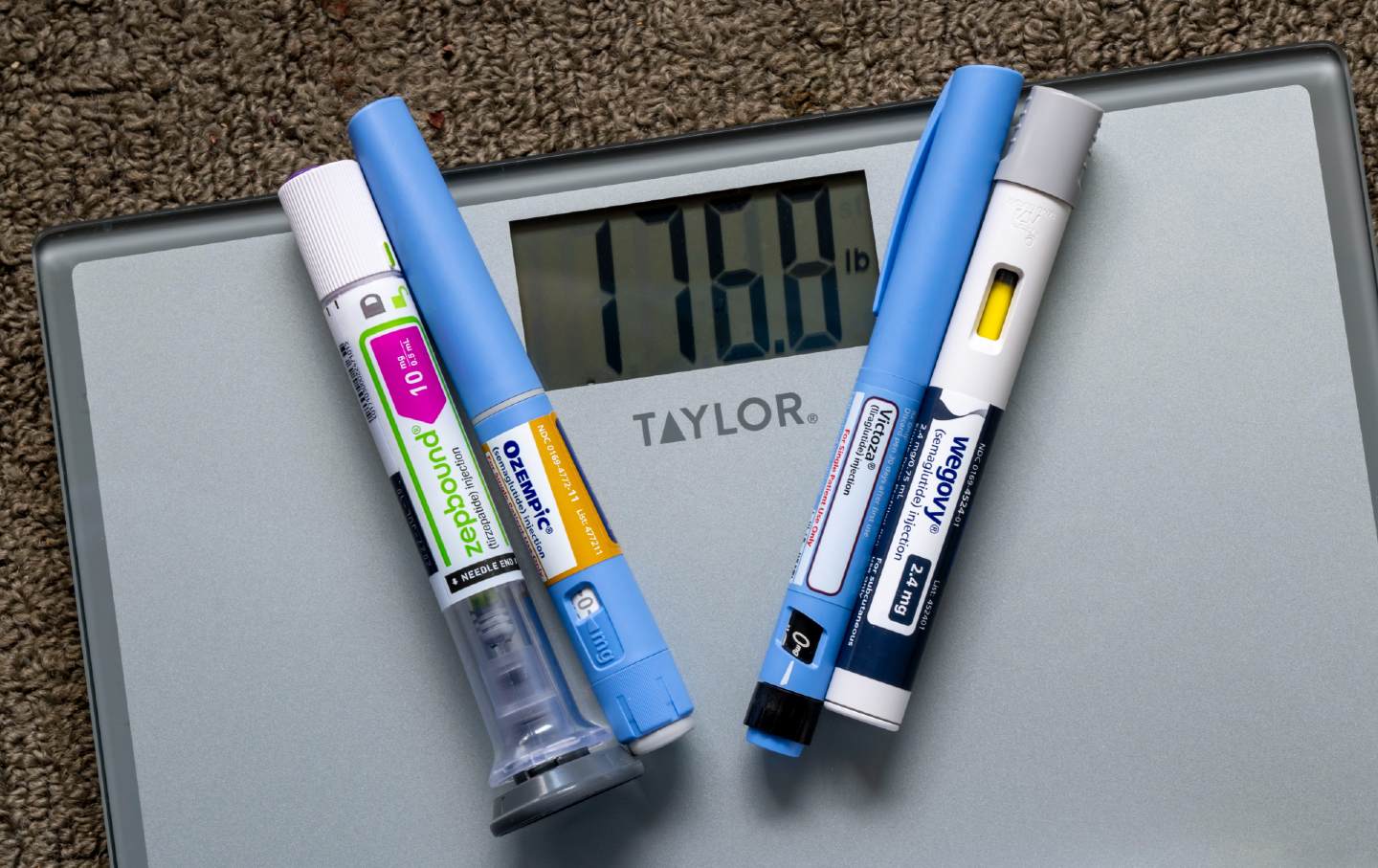
Thousands of words have been written about the use of GLP-1 drugs for weight loss, but the real story seems to have been overlooked. These medications have become a proving ground for a cohort of executives, tech billionaires, and politicians whose “reforms” could quickly accelerate current health inequities and create a new medical caste system in the United States.
The stories we might have read about GLP-1s—in a better world, perhaps—would have reported that a class of diabetes drugs was also found highly effective for weight loss and may treat other conditions as well, and that these drugs are already improving public health while reducing overall health costs—because they cost only pennies per month. The stories we are reading tell us instead that a publicly funded discovery backed by billions in public funding was patented by private firms, who then jacked up prices so steeply that it has worsened medical inflation and left millions of people untreated.
That shouldn’t surprise anyone who knows the history of Novo Nordisk and Eli Lilly, the companies that hold the primary patents for GLP-1s. Each has paid hundreds of millions to settle allegations that include off-label marketing, kickbacks, and insulin pricing. These two companies alone already generate over $60–70 billion in annual GLP-1 revenue, thanks to exclusive rights they keep manipulating with patent gamesmanship.
The result? Despite a massive increase in GLP-1 use for weight loss (more than 30 million users), millions of people are going without. The clinical obesity rate in the United States is 35 to 40 percent of the adult population. Accounting for people satisfied with their weight or using other approaches, that means more than 100 million potential users remain untreated.
New research could make that number even larger. GLP-1s may soon help treat a wide range of other conditions, including liver, heart, and kidney disease, some cancers, Alzheimer’s, osteoarthritis, and potentially even mental illnesses like depression, bipolar disorder, and schizophrenia.
The government could force pricing changes under existing law. Instead, the Trump administration collaborated with manufacturers to create “direct to consumer” pricing for GLP-1s. That means no third parties—insurers or other intermediaries—can negotiate prices. Per the administration’s agreements, those charges are expected to be $299 for Eli Lilly’s product and $350 for Novo Nordisk’s.
That may seem reasonable compared to past charges for these medications, which typically approached or exceeded $1,000 per month. But a Yale School of Medicine/Doctors Without Borders study found that it could cost as little as 75 cents per month to manufacture similar GLP-1s. And those “discounted” charges apply only to starter doses, not to maintenance treatment.
It’s a troubling precedent. The administration agreement creates a separate financing track for one type of drug, outside the current health system’s (already inadequate) financial protections for patients.
Medicare is adopting a similar two-tiered approach. Its GLP-1 pilot program would require patients to pay an additional, separate $50 per month, which wouldn’t count against Medicare’s usual out-of-pocket maximums. Its stated longer-term plan would only apply the maximum after patients have paid the full “direct to consumer” cost of $245 per month. Either approach would make these medications unaffordable for many seniors while extending the new “dual track” system to public insurance.
Meanwhile, the public research funding that made these drugs possible is being slashed. Private wealth will have even more influence over the direction of future medical research. That’s worrisome. Drug manufacturers direct much of their research funding to maximizing profits on existing discoveries, which leaves much less for real discoveries. Tech billionaires are investing heavily in life extension research such as epigenetic reprogramming, longevity treatments, and blood-based therapies. Some of these therapies show promise, but they remain largely untested in humans.
And the tech billionaires don’t just want to add years to their lives. They also want more dollars for their portfolios. Their preferred “monetizing” format, unsurprisingly, seems to be the Internet. The recent “Enhanced Games,” derided as an infomercial for supplements, steroids, and peptides, were backed by a billionaire-funded health portal called “Enhanced.” Another portal, HIMS, originally marketed itself to men as a shame-free source for hair growth nostrums and treatment for what was once called “impotence.” Today, HIMS and its women’s portal HERS feature GLP-1s as their lead products instead, sold at those “direct to consumer” prices. Dozens of other health and wellness portals are doing the same. Not to be outdone, the White House created its branded portal, “TrumpRX.”
The multi-track, Web-heavy health economy is well on its way to becoming reality.
Popular
“swipe left below to view more authors”Swipe →The future this conjures is one where wealthier people can use any life-extending and health-maximizing treatment they like, working people struggle to obtain the basic care needed to sustain life, and members of the lowest “caste” receive little care beyond the occasional emergency room visit. This medical inequality could quickly worsen economic inequality. Studies have shown that some groups with certain health problems consistently earn less and have more difficulty escaping poverty. Among them are women with obesity, people with mental illness, and the physically disabled.
In some ways, a caste system already exists in the United States. People in the wealthiest 1 percent of counties live 10 years longer on average than those in working-class rural counties. The longevity gap between rich and poor has been growing wider for decades.
Health inequity is already a crisis. But the GLP-1 story shows us how quickly even the worst injustices can accelerate, and in ways we have yet to imagine.
Become a Sustaining Donor This September
Between the reemergence of right-wing red-baiting and Donald Trump’s use of the chilling National Security Presidential Memorandum–7 to criminalize left political organizing, we’re seeing McCarthyism reborn before our eyes.
This assault on democracy cannot be ignored or wished away. Resisting it requires bravery in the face of threats and repression, a steadfast commitment to the truth, and the unwavering belief that we can—and will—overcome this darkness.
We must have an independent media that sets the record straight, unearths corruption and abuses of power, and advances a politics of justice and dignity for all if we’re to win this fight.
That’s why I’m writing to you today. This September, The Nation needs to add 100 monthly donors to sustain our progressive journalism. Your contribution makes the next investigative report, the next truth-speaking column, and the next pathbreaking essay all possible.
I hope you’ll support our work with a recurring donation today. If you donate $10 or more a month, we’ll send you a brand new “Hands Off the Free Press!” sticker to recognise your commitment to our cause. Please, donate today.
Onward,
Katrina vanden Heuvel
Editor and Publisher, The Nation
More from The Nation

The Promises and Compromises of the University of California The Promises and Compromises of the University of California
I grew up in a neighborhood manufactured by the University of California, Irvine. It felt like a utopia for academics—until the university forsook its mission of serving the publi...

Is Platonic Co-Parenting the Future of the Family? Is Platonic Co-Parenting the Future of the Family?
Disillusioned with the nuclear family and apprehensive of tethering their reproductive futures to the bleak hellscape of modern love, young people are seeking a different way.


How Trump’s Crackdown on Speech Has Damaged the Student Press How Trump’s Crackdown on Speech Has Damaged the Student Press
I serve as editor in chief and president of The Stanford Daily. Our newsroom has keenly felt the effects of Trump’s campus crackdown, which is why we sued the federal government.
Treat Spotify Like a Public Utility Treat Spotify Like a Public Utility
Music streaming platforms have way too much control over musicians and music lovers. It’s time to rein them in.
What’s the Matter With Effective Altruism? What’s the Matter With Effective Altruism?
President Trump has decried the techbro creed for indulging in AI doomerism, but its excesses are far worse than that.

