
Occupied Minnesota
Minneapolis right now reminds me of what I’ve seen during my time in the West Bank.
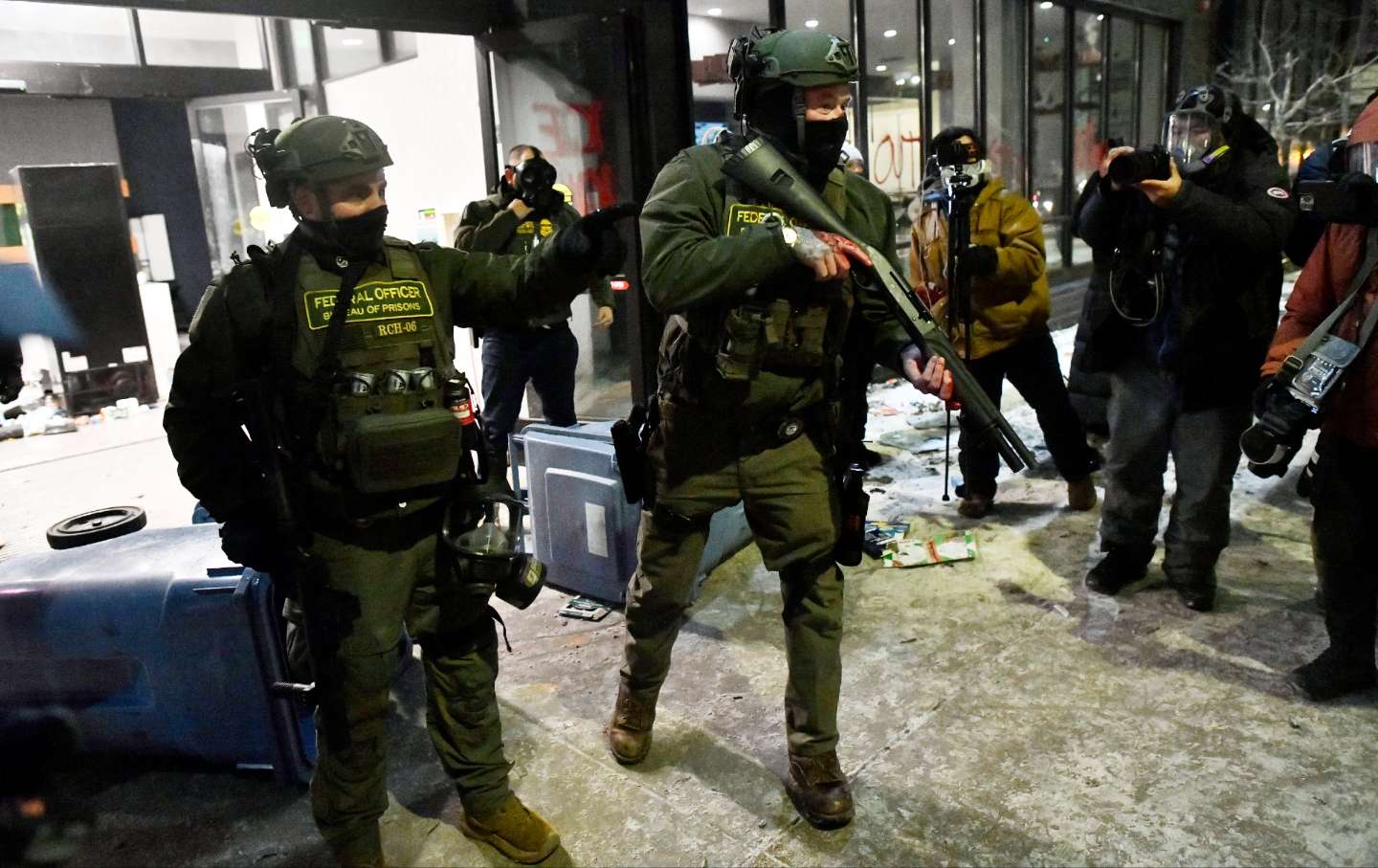
Federal agents push back protesters during the “ICE OUT! Noise Demo” outside a hotel in Minneapolis, on January 25, 2026.
(Octavio Jones / AFP via Getty Images)As someone who has spent a significant amount of time in the West Bank of Palestine, I know an occupation when I see one—and what is happening in Minnesota right now is an occupation.
I came out to Minneapolis to join the Twin Cities group Multifaith Antiracism, Change & Healing (MARCH) in protesting the atrocities being committed by ICE against the people of their state.
Following a couple of days of nonviolence training, trust building, rallying, marching, and direct action, notice came on Sunday—one day after the horrific murder of Alex Pretti—that our assistance was needed at one of the community’s dual-language (English and Spanish) churches. My responsibility was to make sure that parishioners, who were frequently too afraid to leave their homes, could worship together in relative safety.
With liturgical vestments—for myself, a tallit (Jewish prayer shawl) —draped over our many layers of winter clothing, plastic whistles around our necks, and gas masks at hand, just in case, we buddied up for safety and stationed ourselves on the various street corners around the church.
We hoped that our presence as white faith leaders might deter ICE from appearing on this particular day—or that we might at least be able to warn the parishioners if we saw ICE vehicles approaching the church. As services concluded, we walked people to their cars or nearby homes so that if, God forbid, they were snatched up, their families could be immediately informed, volunteering lawyers activated, and video documentation of the kidnapping uploaded to the site created by Minnesota Attorney General Keith Ellison’s office.
It wasn’t the first time I had done this sort of “protective presence.” Staying for a month or two at a time in the West Bank city of Hebron, I used to spend each weekday morning and afternoon accompanying children to and from schools to protect them from Israeli soldiers. Just as in Minnesota—where 5-year-old Luis Ramos was snatched out of his father’s car in the driveway of their home last week—the threat the occupying army posed to Palestinian children was all too real.
With me outside the Minneapolis church on Sunday was a local pastor who had been doing protective presence in the city on a regular basis. As we shuffled our feet to stay warm in below-zero temperatures, he relayed a conversation he had had with his 5-year-old son the day before.
They were in the car when the news of Alex Pretti’s death came through the radio. His son, in a seemingly unaffected tone, said, “They just killed another one, Dad.” It was tragic that the little one had come to see the violence as normal. My heart sank as I thought back to my experiences with Palestinian children who had come to see the presence and actions of the Israeli military as a normal part of their lives.
In 2017, while in the West Bank with a delegation of US veterans, I participated in a nonviolent protest led by renowned Palestinian human rights defender Issa Amro. His plan was for us to set up a pop-up produce market on Hebron’s Shuhadah Street, which had been the city’s main thoroughfare until 1994, when Israeli troops welded its shops closed and permanently shut all business down.“Come and buy vegetables! Cauliflower for one shekel,” Issa’s voice boomed.
The army quickly rolled up, and soldiers jumped out, guns cocked. Issa, with an instinct that I, as a white Jewish woman, have never needed to have, recognized a particularly dangerous look in the soldiers’ eyes, immediately dropped to his knees, and bowed his head.
Two days after arriving in Minneapolis, I joined 100 clergy and faith leaders—almost all of them white—who were lined up one-by-one in an act of civil disobedience outside the Minneapolis airport to protest Delta Airlines’ complicity in over 2,000 deportations. When my turn came to be arrested, I placed my bulky mittened hands out for handcuffing, but the officer didn’t bother placing a zip tie around them. They didn’t tackle me to the ground, beat me, or strip-search me. Unlike the Minneapolis Somali community, roughly 95 percent of whom are US citizens, the treatment I received was closer to “Officer Friendly” than to the thuggish and violent behavior of ICE. In much the same way, Westerners providing protective presence in the Occupied Palestinian Territories will often (though not always) receive less harsh treatment than the Palestinians they have come to support.
As with the experiences I’ve had in the West Bank, my encounters with people on the streets of Minneapolis have been profoundly moving. Everyday people—Uber drivers, hotel clerks, restaurant staff—have greeted me with expressions of gratitude that I am here to support their city. “Stay safe,” each of my Uber drivers, the vast majority of whom have been of African, mostly Somali, origin, have pleaded with me as I exit their vehicles. Yet, it is they who are hosting me in their city. The nourishment my soul is receiving from being of holy service to them is, without a doubt, far more than the impact my presence is having. “Please, you stay safe,” I respond each time. “May God spread over you and your family, and all of the people of Minnesota, a shelter of peace.”
More from The Nation
The Accidental Activists of Data Center Alley The Accidental Activists of Data Center Alley
These would-be rebels in Northern Virginia joined the fight against data centers mostly to stop the encroachment on their homes and exclusive private communities.
An Effective Movement for Palestine Needs Allies Like Zohran Mamdani An Effective Movement for Palestine Needs Allies Like Zohran Mamdani
In order to build a broad-based coalition, we need to work together—not practice purity politics.
The First Amendment Applies to Concert Stages Too The First Amendment Applies to Concert Stages Too
Protests like that of Macklemore on Palestine should never be silenced by billionaire owners.
France’s Students Won’t Back Down France’s Students Won’t Back Down
Without full-time teachers, temperature-regulated classrooms, or school nurses, French students are turning their grievances into a national movement.
Inside Cornell’s Week of Protest Inside Cornell’s Week of Protest
“We won’t be silenced anymore. Our university needs to start protecting us, like they should’ve with Jane Doe and all other survivors on campus.”
Netanyahu Came to New York. New Yorkers Were Ready for Him. Netanyahu Came to New York. New Yorkers Were Ready for Him.
Scenes from the defiant protest against the genocidal leader’s UN speech.

