
The Return of Right-Wing Anti-Zionism—and Antisemitism
For reasons both good and bad, Israel is dividing the Republican Party.
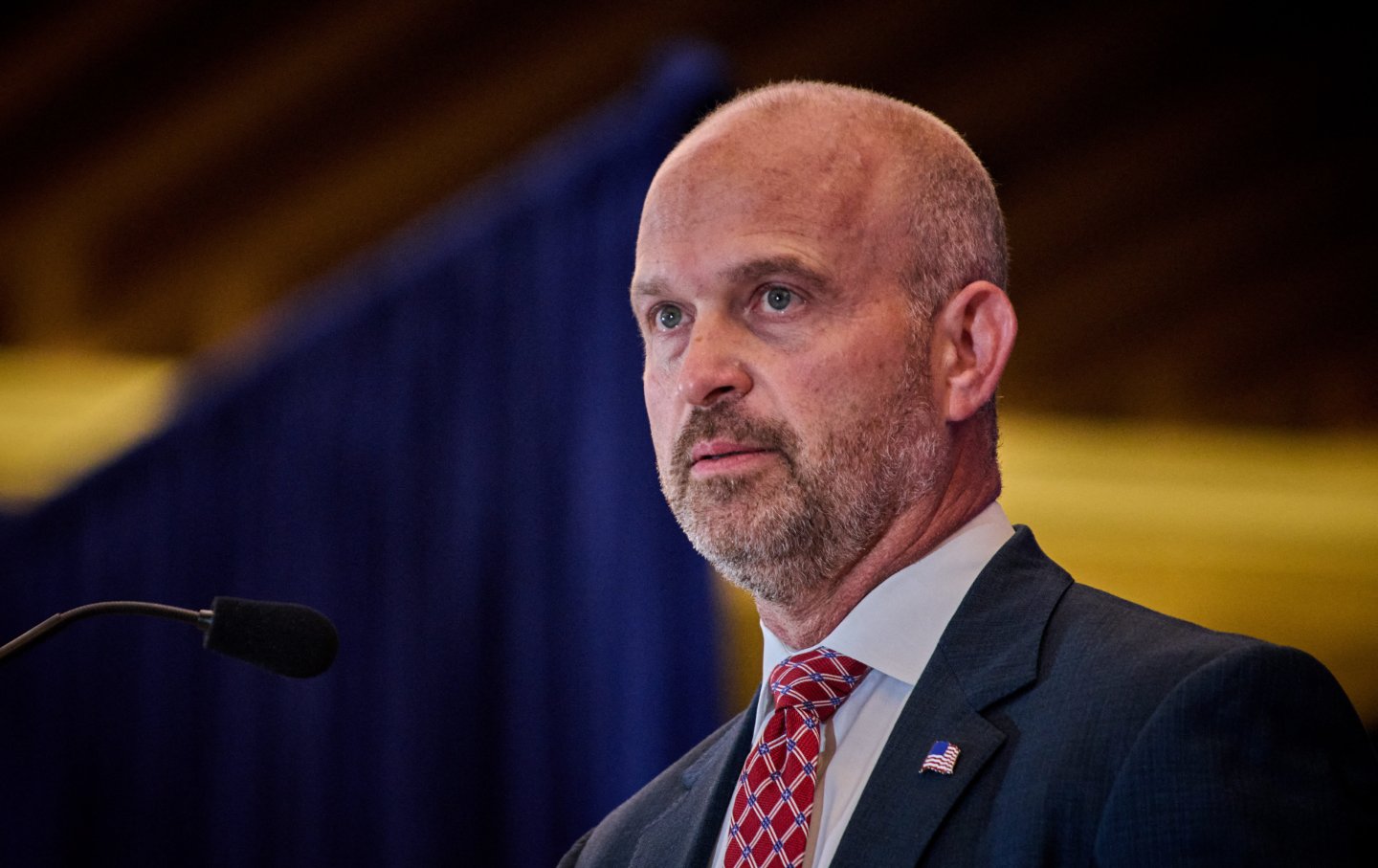
The Heritage Foundation’s Kevin Roberts speaks at the National Conservative Convention in Washington, DC, on September 2, 2025.
(Dominic Gwinn / Middle East Images / AFP via Getty Images)Israel’s merciless slaughter of Palestinian civilians, which dates back decades but intensified after the Hamas attack of October 7, is remaking American politics on both the left and the right. As Kamala Harris acknowledges in her recent memoir, 107 Days, Joe Biden’s lack of empathy for Palestinians helped shatter the Democratic Party and was a constant anchor dragging down her campaign against Donald Trump. Even now, although more Democratic politicians are catching up with public opinion by criticizing Israel and eschewing AIPAC funding, left-of-center political leaders remain polarized. Senate minority leader Chuck Schumer reportedly sees support for Israel as so core to his personal and political mission that he pointedly refused to endorse—or, by all available evidence, even vote for—New York City’s Democratic Mayor-elect Zohran Mamdani due to Mamdani’s criticism of Israel.
The internecine fights on the left are mirrored by internal wrangling on the right, but with one crucial difference. Whereas the common labeling of leftist anti-Zionists as antisemites is usually a spurious accusation made to deflect from legitimate criticism of Israeli human rights abuses and war crimes, there is, in fact, a long history of anti-Zionism and antisemitism being linked on the right. There’s also a long history of conservatives who criticize Israel for perfectly legitimate, non-bigoted reasons—but these days, it’s the antisemitic wing of conservatism that seems to be in the ascendant.
The Heritage Foundation, the once-storied conservative think tank that spearheaded Donald Trump’s Project 2025 agenda, is now an epicenter for the right’s internal battle over Israel. On October 27, Tucker Carlson, who has long-standing ties with Heritage, conducted a lengthy and respectful interview with Nick Fuentes, an overt antisemite and Holocaust denier who opposes America’s alliance with Israel on both anti-Jewish and nationalist grounds. Three days later, Heritage president Kevin Roberts released a video affirming that Carlson would “always be a close friend” of the think tank, that his critics were part of a “globalist class,” and that “conservatives should feel no obligation to reflexively support any foreign government.” That last statement may seem uncontroversial, but in the context of Roberts’s other comments, and his defense of Carlson’s flirtation with virulent antisemitism, it rang alarm bells.
Roberts’ video led to civil war inside Heritage, with powerful donors threatening to withdraw funding. Roberts reassigned staffers involved in the production of the video, one of whom, Ryan Neuhaus, subsequently resigned. Roberts also repeatedly apologized for the video, though he blamed its language on a staffer.
On Wednesday, Roberts presided over a contentious staff meeting (described by some as a “struggle session”) where there was a visible divide between younger, more anti-Israel staffers and older, more traditionally Zionist management. Some of these divides are along religious lines. There is a strong strain of Christian Zionism among Protestants (including mainstream evangelicals, but especially dispensationalists, who believe that the existence of a Jewish state is a necessary precondition for an apocalyptic world war and the return of Christ). But the tradition of Christian Zionism has few adherents among Catholic and Orthodox Christians, who tend to have an outsize role in intellectual organizations such as Heritage.
In the Heritage meeting, one young female staffer articulated this divide, saying:
“I condemn Nick Fuentes’s hateful rhetoric. That being said, I would like to point out that some of the most vocal people against Tucker Carlson have been calling him an antisemite since he started to hold more anti-interventionalist views. A handful of young colleagues and I had no issue with the points you made in the original video. I don’t think that was the right moment to have such an important conversation regarding US-Israel relationships, because now we fear that the concerns we have won’t be addressed. Gen Z has an increased unfavorable view of Israel, and it’s not because millions of Americans are antisemitic. It’s because we are Catholic and Orthodox and believe that Christian Zionism is a modern heresy. We believe it does go against church doctrine and the teachings of the early church fathers to use Christianity as a defense for a secular nation. In Christ, there is neither Jew nor Gentile, and there is no salvation outside of Christ. As a young person, many of us are generally tired of foreign entanglements, while our problems in this country worsen.”
This statement clarifies the difference between left-wing and right-wing opposition to the US/Israel alliance. The staffer’s opposition stems not from concern for Palestinian rights but rather from nationalism (the US should look after its own interests) and religion (Christian Zionism is a “heresy”). The religious divide was also apparent in a comment by Evan Myers, adviser to the President’s Office at Heritage, who noted that the think tank’s National Task Force to Combat Antisemitism was “demanding Heritage host Shabbat Dinners with Heritage interns and junior staff.” According to Myers, “the faith of many Christians at Heritage, myself included, would prevent us from attending these dinners.”
The civil war inside Heritage has deep roots, going back to the birth of the modern American conservative movement during the New Deal era in the 1930s. The first cohort of anti–New Deal activists (often labeled the Old Right) was led by figures—notably H.L. Mencken, Albert Jay Nock, and Charles Lindbergh—who never hesitated to express their antisemitism. With the outbreak of war in Europe in 1939, these three Old Right stalwarts also became prominent leaders of the anti-interventionist movement. This movement was wider than the Old Right and included many conservatives, liberals, and socialists who were free of antisemitism (notably, the pacifist socialist leader Norman Thomas). But the Old Right contingent of anti-interventionists was decidedly motivated by an antipathy toward Jews, a belief that communism was a more serious threat than Nazism, and, in some cases (as with Lindbergh), admiration for fascism as a political model. In 1941, Lindbergh infamously blamed American Jews for trying to drag the country into war, permanently tarnishing his American-hero status.
After the defeat of Nazism, Old Right impulses persisted as a general suspicion of international organizations. As the historian David Austin Walsh notes in his 2024 book Taking Back America, the leader of the postwar far right (notably, the businessman Merwin K. Hart) became muted in their antisemitism but still believed in “limiting Jewish immigration to the United States” and advocated “anti-Zionism and opposition to the U.S. recognition of Israel. This was not rooted in any particular concern for the Arab population of Palestine but rather fear that the international Judeo-Bolshevik-Zionist conspiracy would embroil America in a war, weakening the U.S. and allowing for the victory of international Jewish communism.” The fact that the Soviet Union supported Zionism further entrenched anti-Zionism on the anti-communist right.
Jennifer Mittelstadt, a historian at Rutgers who is working on a study of right-wing anti-internationalists, noted in an e-mail to me that there is a “deep strain of anti-Zionism among those grassroots right-wing anti-internationalists.… It directly informs their negative views of both the creation of the state of Israel and of the United Nations in the 1940s. Their anti-Zionism is sometimes accompanied by an expressed sympathy for Palestinians (and ‘Arabs’ as they would say) in general. And it is almost invariably accompanied by antisemitism as well.”
The anti-Zionist right was not always motivated by antisemitism. The complexity of the situation can be seen by the career of Henry Regnery, a long-standing opponent of the New Deal who started his own publishing company in 1947. Regnery became famous for publishing the work of major conservative intellectuals such as William F. Buckley, Russell Kirk, Willmoore Kendall, and James Burnham.
Regnery also published a very strong list of books calling attention to the suffering of Palestinian refugees, including Nejla Izzeddin’s The Arab World (1953), Alfred M. Lilienthal’s What Price Israel (1953), Freda Utley’s Will the Middle East Go West? (1957), Per-Olow Anderson’s They are human too… (1957), and Ethel Mannin’s Road to Beersheba (England: 1963; America: 1964). Regnery’s own motives as a supporter of America First anti-interventionism might be suspect, but these books were almost always written by impeccable writers with no bigoted motives. Lilienthal was Jewish and rejected Zionism because he saw it as an injustice to the Palestinians and also against the best interests of the United States. Utley was a highly regarded foreign correspondent. Mannin had a long record as an anti-fascist and anti-imperialist activist. Their books described the horrors of the Nakba, the Palestinian catastrophe, at a time when few Americans knew what that was or even cared.
National Review, founded by William F. Buckley Jr. in 1955, was in its early years deeply anti-Zionist for reasons both defensible and indefensible. Buckley was a direct product of the Old Right. His father and namesake, William F. Buckley Sr., was an enemy of the New Deal, an admirer of fascism, and a loud hater of Jews. This patriarch would tell his children “all Jews were Communists” and “stingy, pushy, money-grubbing liars” and intervened (with the help of Buckley Jr.) to prevent his daughter Jane from marrying a Jew. In its early years, National Review was closely affiliated with many antisemites, notably George Lincoln Rockwell (later a founder of the American Nazi Party), Merwin K. Hart, and Revilo Oliver (later a leading theorist of white nationalism). Buckley would on occasion disavow such figures when their politics became embarrassing, especially as changing social mores made overt antisemitism taboo.
In 1956, National Review described Israel as “the first racist state in modern history.” Whatever one’s opinion on the nature of the anti-Palestinian discrimination at the heart of the Zionist project, this was a remarkable claim, and one clearly made in bad faith. The United States and Nazi Germany were racist states long before Israel was formed. Further, National Review at the same time defended the right of states to entrench racist hierarchies (notably in the Jim Crow South, South Africa, and Rhodesia). The magazine was also extremely critical of Israel in the early 1960s for capturing and holding on trial the Nazi war criminal Adolf Eichmann.
But even in National Review, there were occasionally more cogent critiques of the US/Israel alliance, often made by James Burnham, the magazine’s leading foreign policy writer. Burnham, a former CIA analyst, shared the view of many foreign policy experts that US support for Israel fueled anti-Americanism, a position amply vindicated by history.
Buckley and National Review became much friendlier toward Israel after the Six-Day War in 1967, which seemed to vindicate the Jewish state as a regional hegemon that could help thwart Arab nationalism. The makeup of the conservative coalition was also changing during this period, with many Cold War liberals turning to the right because they opposed the New Left. This cohort, labeled neoconservatives, included many ardent Zionists such as Norman Podhoretz and Daniel Patrick Moynihan.
After 1967, anti-Zionism persisted on the right. Often, it was pushed in extremist circles such as Liberty Lobby, run by the antisemite and Holocaust denier Willis Carto. But it also found a voice in more mainstream figures such as the columnists Pat Buchanan and Joseph Sobran (who was senior editor of National Review from 1975 to 1983). Both Buchanan and Sobran combined defensible critiques of American intervention in the Middle East with barely disguised antisemitism, including muted versions of Holocaust denial.
Buckley, who was personally very close to Sobran, was often engaged in the delicate task of coalition management, which involved crafting a consensus that could accommodate anti-Zionist and Zionist factions. In 1991, Buckley published a hedged and tangled disavowal of Sobran and Buchanan, the tortured tenor of which can be seen in this sentence: “I find it impossible to defend Pat Buchanan against the charge that what he did and said during the period under examination amounted to anti-Semitism, whatever it was that drove him to say and do it: most probably, an iconoclastic temperament.” But within weeks of publishing that essay, National Review endorsed Buchanan as a protest vote in the Republican presidential primary in New Hampshire. Buckley fired Sobran in 1993, but continued to send him money until Buckley’s death in 2008.
Popular
“swipe left below to view more authors”Swipe →In the wake of the disastrous failures of George W. Bush’s wars in Afghanistan and Iraq, neoconservatism was pushed further into the political wilderness than at any time in decades. This created an opening for a resurgence of the anti-internationalist politics of the Old Right. As the history shows, this tradition is a mixed one. The kind articulated by Tucker Carlson and Nick Fuentes is rife with antisemitism and should be seen as beyond the pale. But there are many other anti-interventionists on the right, notably Curtis Mills, the executive director of The American Conservative, whose criticism of the US/Israel alliance is beyond reproach. Such voices must be welcomed and celebrated for their brave opposition to an unjust consensus.
There are many reasons for Americans of all stripes, left and right, to oppose the current bipartisan consensus whereby Israel has virtually blank-check support from the United States. This alliance has tarnished America by making it an active participant in a genocide. For the left, the crucial task going forward is to ally with the reasonable right while making sure the antisemites are pariahs.
More from The Nation
Pete Hegseth’s High-Tech Barbarism Pete Hegseth’s High-Tech Barbarism
In livestreaming Nidal Hasan’s execution, the secretary of war is marking his territory in the snuff movie business—and radicalizing people along the way.

Elon Musk’s James Talarico Smear Blew Up In His Face Elon Musk’s James Talarico Smear Blew Up In His Face
But that doesn’t mean the danger from Musk’s lies is over.
Latino Pride: Honoring Heritage, Challenging Columbus Day Latino Pride: Honoring Heritage, Challenging Columbus Day
Hispanic Heritage Month celebrates Latino culture and pride while prompting reflection on Columbus Day and Indigenous recognition.
This November, Vote Like Alito Is on the Ballot This November, Vote Like Alito Is on the Ballot
In this week’s Elie v. U.S., our justice correspondent gives Democrats another reason to vote in November. Plus: How Sarah Huckabee Sanders’s Medicaid unmasked the racists.

Does America First Really Mean Israel First? Does America First Really Mean Israel First?
Mike Huckabee’s aide shows how an extremist agenda dominates Trump’s Middle East policy.

