
The “Refugee Pipeline” Has Been Abandoned
Since Trump took office, assistance for refugees has largely been revoked or suspended, with many recent arrivals from Afghanistan unable to bring their families.
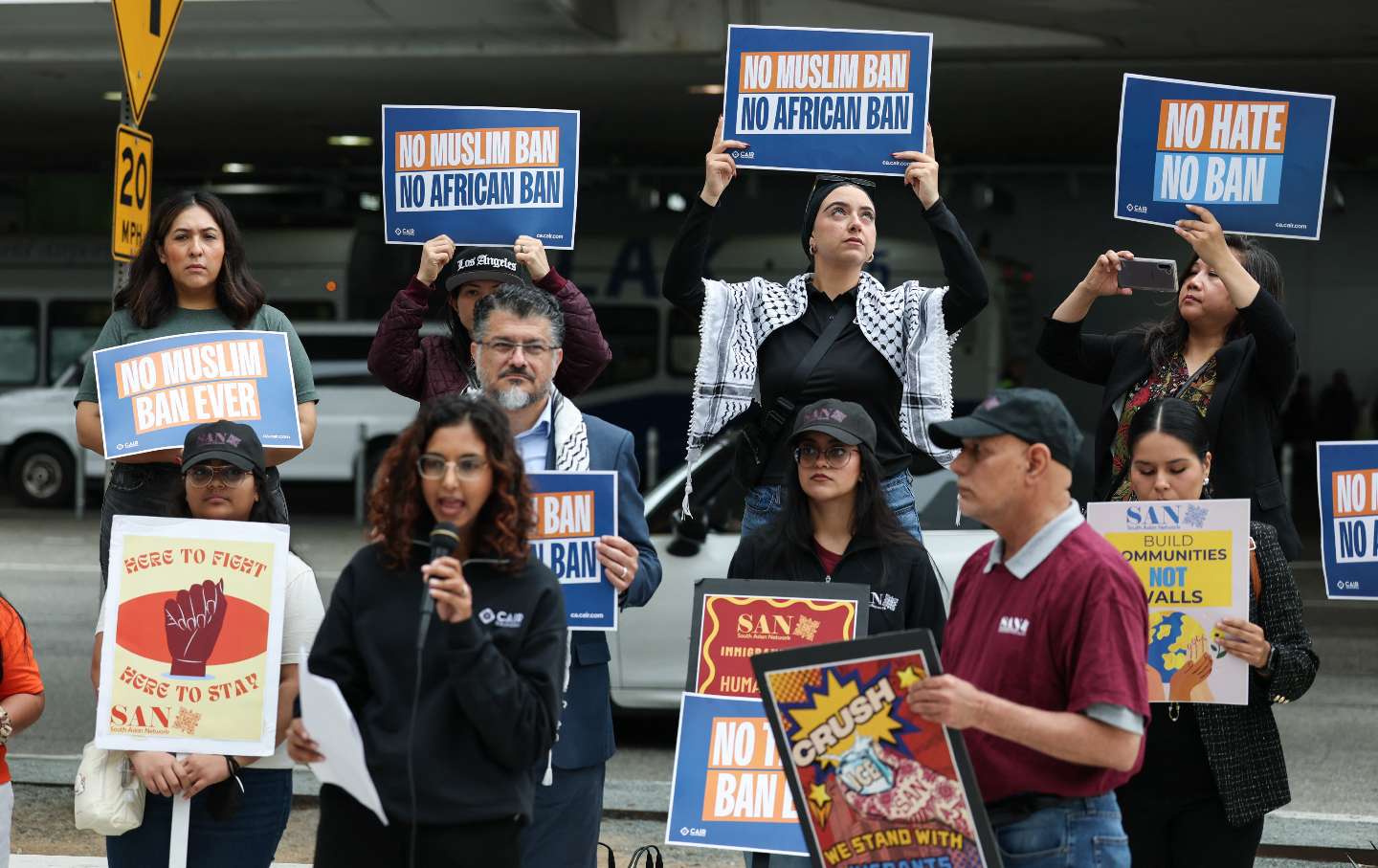
Demonstrators gather to protest against a travel ban announced by US President Donald Trump.
(Patrick T. Fallon / Getty)Since President Donald Trump took office, federal assistance for refugees, once a tool for those in danger, has largely been revoked or suspended.
In Chicago, the resettlement agency RefugeeOne has witnessed the steep decline of new arrivals. Between October 2023 and September 2024, the organization helped 705 refugees. But in the federal fiscal year of 2025, that number plummeted to 50, representing a “complete shutdown of our refugee pipeline” according to Emily Parker of RefugeeOne.
This pipeline refers to the often complex administrative process of resettling refugees out of crisis and into a new country. Most recent arrivals—and the only arrivals allowed—are Afghan Special Immigrant Visa (SIV) holders: people in Afghanistan who worked alongside US forces contracted specifically for 365 days or more. Many of these SIV holders had to leave their families behind, unable to bring them because of the administration’s new policies.
“We can’t replace government programs. We can’t replace family reunification. We can’t physically get people out of countries,” said Parker. “Right now, all we can do is support the people that are already here.”
Nearly 200,000 Afghans arrived in the United States under the Biden administration, many through a relocation effort to find people left behind who had worked with the US government and received SIV. One refugee who made the journey through SIV, Abdul, worked in Herat for several years with Automatic Management Services (AMS), a company contracted by the Afghan Ministry of Defense that collaborates with foreign military forces. His role was to train the Afghan National Police in ordering vehicle parts, sourcing them through Kabul, and distributing them across four military areas in the country.
In 2021, as the US prepared to withdraw and the Taliban regained control, foreign staff began leaving, he said, and AMS shut down. “When the Taliban was coming at that time, I was not thinking, ‘I’m safe,’ or ‘my family is safe.’ So that’s why I came here,” he said.
Afghan employees received documents confirming their employment, which they used to apply for visas. Abdul said he had to receive a recommendation letter, provide a biography, ID, and Human Resource letters in order to get a Chief of Mission (COM) approval that grants the SIV from the US State Department. But since the United States no longer had an embassy in Afghanistan, he had to relocate to Rwanda to complete the visa process. He traveled to Iran then Dubai, spending $4,000 on the journey.
In Rwanda, the US embassy asked about his salary, work location, and company needs, and then issued a visa after two to three weeks. After submitting medical documents and undergoing interviews, Abdul could finally resettle in Chicago.
“Chicago is a very nice place,” he said. “Good people, good downtown. I like it.” He’s now living in an apartment with many other Afghan refugees and other Central Asian or Middle Eastern migrants. In the living room, a Turkish neighbor the refugee called “a sister” helped take care of him, providing fruit platters during the conversation. “It’s like a community,” he said.
Navigating Trump’s new policies has not been easy. On his first day back in office, Trump signed an executive order canceling flights for Afghan refugees—including those reuniting families. In June, he suspended the US Refugee Admissions Program, leaving countless applicants in a bureaucratic void. Other grants such as Temporary Protected Status and Coordinator for Afghan Relocation Efforts have now ceased. In the same month, Trump passed his “Big Beautiful Bill,” increasing fees for asylum seekers and placing a travel ban on Afghans with immigrant or non-immigrant visas.
Abdul’s parents, two sisters, and brother remain in Afghanistan, creating a huge emotional burden for him. His father, who worked at the same company for over a decade, never received a recommendation letter to get an SIV visa, as AMS gave them only to a small percent of employees. He later got one from a former supervisor in India and his case is now waiting for COM approval—often a lengthy process.
Abdul’s story represents thousands, he said. “If my family is not coming here, I’m trying to go back and visit my family”—but it’s not safe to go back, as the Taliban continues to arrest people. After the takeover, Abdul and his family changed their address. He said Taliban have spies everywhere and “they could be your neighbors” who inform them that you worked for the US military.
He now works in food delivery, often sending a few hundred dollars back to his family in Afghanistan for basic necessities, and expressed frustration at not finding a job in America similar to the one he had in Herat. “We don’t want to be a boss or leader,” he said. “We just want a system.”
His family connects over WhatsApp one or two times a week, though the Internet connection is poor. His younger sisters, between ages of 13 and 21, cannot attend school for more than “six years,” he said, referring to the ban that prohibits Afghan women from continuing studies past the sixth grade. He said that his mother misses him, and that his sister repeatedly asks when he’s coming back. “It is hard for me…most of the time I’m lying to them”
He told them he’d be gone for only two to three months. It has now been over a year.
Previously, the State Department’s CARE program helped relocate Afghan allies to countries like Qatar, Pakistan, and the United Arab Emirates, but now it’s almost impossible to escape Afghanistan, according to Parker. “I am in contact with one family whose husband is here. He was a pilot in the Afghan Air Force working alongside the American force,” she said. “His wife and kids never got initially evacuated. They should have, and they just live in hiding in their home. They haven’t been outside in four years…. We’ve pretty much confirmed now that they’re gonna have to wait another four years.” The family, she said, has no means to get outside of Afghanistan. “It’s so risky even to go through Pakistan. It is very, very, very dangerous and scary.”
“While refugee admissions were greatly reduced during the first Trump administration, this is the first time in our history that we’ve seen first a ban on all refugees entering our country and now a trickle of admissions,” said Sally Schulze of Refugee One, which has helped welcome more than 22,000 refugees since the passage of the Refugee Act in 1980. The organization will continue to help any arrivals they receive within the first 90 days, offering food, rent money, immigration counseling, employment help, mental health services, and more. But federal funding is on a per capita basis, so fewer refugees means a tighter budget.
Popular
“swipe left below to view more authors”Swipe →“Our development department does a very good job of ensuring that we have a really good kind of padding of private funding that has been really nice to get from folks that are really looking to help and supplement in light of the loss of grants,” she said, adding that the state of Illinois and city of Chicago is a large supporter of refugee agencies as well.
In 2024, Governor J.B. Pritzker and the Illinois Department of Human Services announced $17 million in additional funding for municipalities to support asylum seekers. And Chicago’s city budget is set to use $150 million for assisting new arrivals.
If funding cuts deepen, however, the agency will be forced to provide skeleton services for those currently in the refugee pipeline, which Parker anticipates will happen over the course of the next two years. This would mean the agency can provide food, water, shelter, and clothing, but programs that help clients apply for college, learn a trade, or add an extra level of adjustment would be the first to go.
“We’re doing our best right now with the folks that are already here,” she said. “But the folks suffering from family reunification, that is a wound that we are not able to heal.”
Become a Sustaining Donor This September
Between the reemergence of right-wing red-baiting and Donald Trump’s use of the chilling National Security Presidential Memorandum–7 to criminalize left political organizing, we’re seeing McCarthyism reborn before our eyes.
This assault on democracy cannot be ignored or wished away. Resisting it requires bravery in the face of threats and repression, a steadfast commitment to the truth, and the unwavering belief that we can—and will—overcome this darkness.
We must have an independent media that sets the record straight, unearths corruption and abuses of power, and advances a politics of justice and dignity for all if we’re to win this fight.
That’s why I’m writing to you today. This September, The Nation needs to add 100 monthly donors to sustain our progressive journalism. Your contribution makes the next investigative report, the next truth-speaking column, and the next pathbreaking essay all possible.
I hope you’ll support our work with a recurring donation today. If you donate $10 or more a month, we’ll send you a brand new “Hands Off the Free Press!” sticker to recognise your commitment to our cause. Please, donate today.
Onward,
Katrina vanden Heuvel
Editor and Publisher, The Nation
More from The Nation
Zohran Mamdani Hosts the World Zohran Mamdani Hosts the World
In a meeting with mayors from around the globe, Mamdani argued that the left must fix everyday problems—or the right will find someone to scapegoat for them.

Is There Any Good News Left? Is There Any Good News Left?
Despite what our algorithms suggest, there’s still news worth celebrating.

CEOs Are Losing Control of AI CEOs Are Losing Control of AI
With no slowdown from Trump’s administration.
Gina Hinojosa: “We Flip Texas, and It’s Over” Gina Hinojosa: “We Flip Texas, and It’s Over”
Talking to Texas gubernatorial candidate Gina Hinojosa about what redistricting could mean and how a new generation of Democrats is speaking more directly to voters.
Trump Wants to Keep Journalists Out of the White House. He Should Get His Wish. Trump Wants to Keep Journalists Out of the White House. He Should Get His Wish.
The president has banned MS NOW, CNN, and Politico from attending press briefings. The rest of the media should respond with a boycott.

