NIH Staff Have Broken Their Silence
Civil servants usually keep a low profile. These NIH employees are putting themselves at risk by calling out the Trump administration.
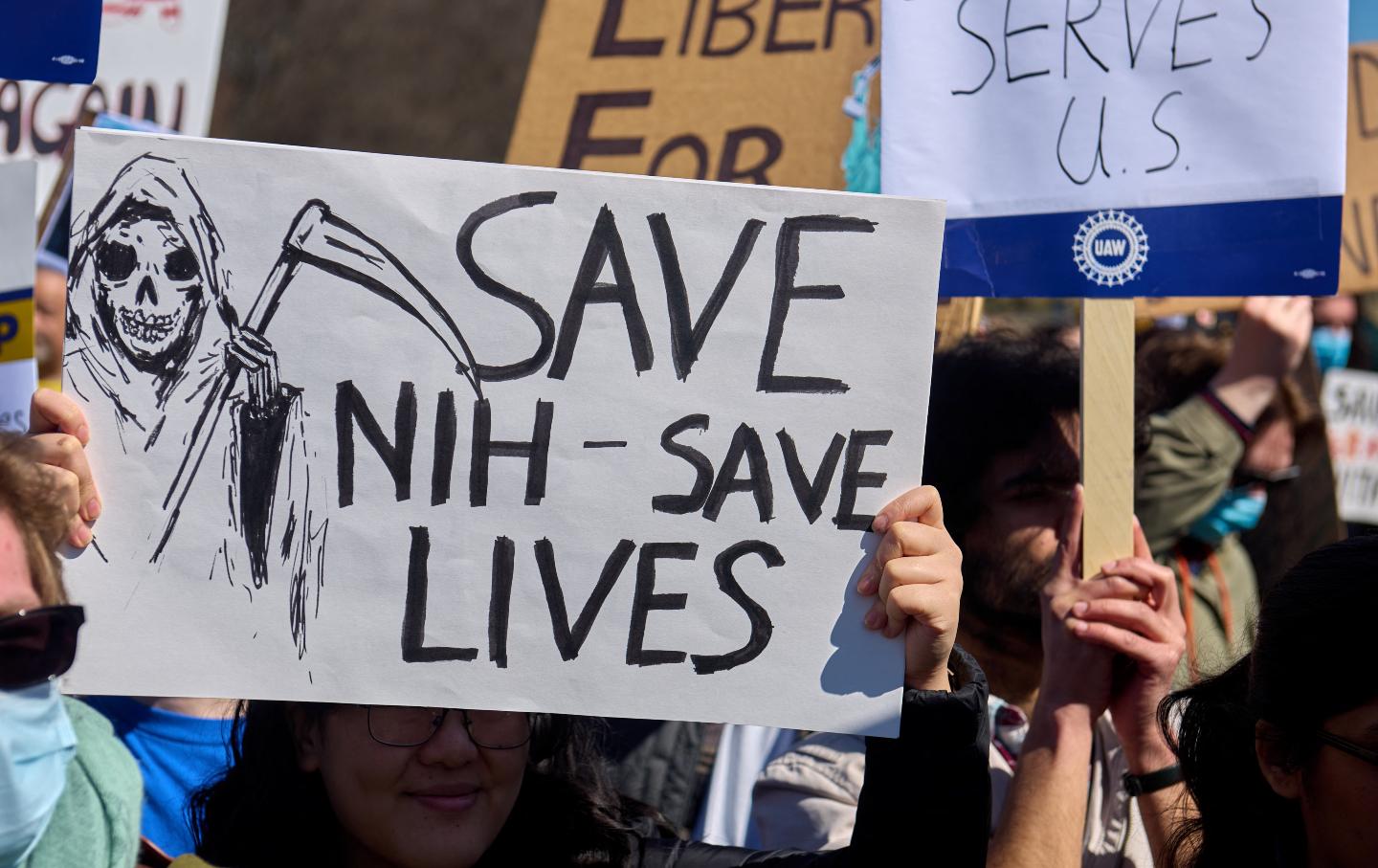
Thousands protest the Trump administration’s federal funding cuts.
(Dominic Gwinn / Getty Images)Civil servants are generally a quiet bunch: They don’t speak out, even as they serve under presidents they might not have voted for, whose policies they may disagree with. They do their jobs in service of the American people, year after year—for some, decade after decade. Their jobs are generally thankless—no one knows who they are—and plenty of people malign them as bureaucrats. Yet our world is deeply indebted to them for most of what we take for granted in our lives. They keep the gears turning for federal programs from health to transportation, from agriculture to education, day after day.
Yet this week several hundred of them—and close to 100 who revealed their names—issued a public letter to their boss, NIH director Jay Bhattacharya, in a stunning rebuke of his leadership and the Trump administration. The staffers, coming from all the component institutes and centers within the NIH, began their letter, called the Bethesda Declaration, by stating that they “are compelled to speak up when our leadership prioritizes political momentum over human safety and faithful stewardship of public resources.” It’s hard to convey how unprecedented this is. I’ve followed the NIH for 35 years, first as an activist and now as a scientist. I cannot remember a time like this at the organization—from Reagan up until this current moment.
The initial release of the letter was supported in a separate document by 40 eminent researchers, including 20 Nobel Prize winners. By the next morning, over 10,000 people of all kinds had endorsed the Bethesda Declaration.
Among the charges of the letter are that Dr. Bhattacharya has helped to “politicize research by halting high-quality, peer-reviewed grants and contracts” on key topics such as health disparities, Covid-19, long Covid, vaccines, the health impacts of climate change, work on LGBTQ health. In addition, any grants meant to diversify the workforce have been canceled. The scale of these grant and contract terminations is stunning: as the letter’s authors say, “since January 20, 2025, NIH has terminated 2,100 research grants totaling around $9.5 billion and $2.6 billion in contracts,” wasting billions of dollars in investments, betraying commitments of patients and others who have volunteered for these studies, endangering the health of clinical trial participants, and damaging the public trust in research.
But the letter doesn’t end there: It also condemns the NIH’s termination of foreign collaborations, its running roughshod over peer review by plucking deeply scrutinized and vetted grants for termination on political grounds, cutting the indirect costs to universities that are used for research infrastructure support, firing hundreds of staff, and impounding funds already appropriated by Congress with all of these cuts. The charges are comprehensive and breathtaking.
Dr. Bhattacharya’s response was dismissive. In a written statement e-mailed to the press, he declared that his own staff have “some fundamental misconceptions about the policy directions the NIH has taken in recent months.” Yes. “Everyone else is wrong and I am right”—par for the course for him, as when he screamed “censorship” and “persecution” when scientists criticized his views on Covid-19 in his own Great Barrington Declaration—a screed that suggested allowing all but the elderly to get infected before we had a vaccine against the virus. He is nothing if not consistent in his own egotism. Except he is in charge now—as real censorship and persecution is happening on his watch—and refuses to acknowledge it as such, even as the NIH teeters on the edge of collapse under his own rule. He justifies most of what has happened over the past few months and is clearly all in now with the wrecking crew from Vought through RFK Jr., and down to his own agency.
But let’s talk about the bravery of this letter for a moment. These NIH staffers have risked their jobs to blow the whistle on Bhattacharya and the rest of the administration. Think about what it takes to push these devoted civil servants to break precedent and speak out. Like many, I’ve been depressed, angry, and anxious for months now. But this kind of courage is contagious, and energizing. We need more of it.
Biomedical research, public health, and healthcare are being dismantled all around us. The budget bill and the coming appropriations process in Congress are going to be a massacre or a victory against the odds for those of us who care. But we’ve got to stand up and fight, not just “show our support,” or complain, or sit on the sidelines to make the day. Our colleagues at NIH have shown us the kind of fortitude and integrity that we need to emulate. “We few, we happy few, we band of brothers” (and sisters), to paraphrase a king, can make the difference. It means bringing the battle to the senators and representatives who will seal our fate. The villainy of these men of the Trump administration is astounding, and I won’t use the forgiving, tepid, collaborationist language of others who still call all this “policy differences.” So stand up this summer. Give thanks to those who stick their necks out for us at great risk to themselves by standing by them and doing the work.
Become a Sustaining Donor This September
Between the reemergence of right-wing red-baiting and Donald Trump’s use of the chilling National Security Presidential Memorandum–7 to criminalize left political organizing, we’re seeing McCarthyism reborn before our eyes.
This assault on democracy cannot be ignored or wished away. Resisting it requires bravery in the face of threats and repression, a steadfast commitment to the truth, and the unwavering belief that we can—and will—overcome this darkness.
We must have an independent media that sets the record straight, unearths corruption and abuses of power, and advances a politics of justice and dignity for all if we’re to win this fight.
That’s why I’m writing to you today. This September, The Nation needs to add 100 monthly donors to sustain our progressive journalism. Your contribution makes the next investigative report, the next truth-speaking column, and the next pathbreaking essay all possible.
I hope you’ll support our work with a recurring donation today. If you donate $10 or more a month, we’ll send you a brand new “Hands Off the Free Press!” sticker to recognise your commitment to our cause. Please, donate today.
Onward,
Katrina vanden Heuvel
Editor and Publisher, The Nation