If Less Than 115,000 Votes Had Switched in Three Battleground States, Harris Would Have Beaten Trump
The Electoral College’s count Tuesday confirms that Trump fell dramatically short of a “massive mandate.”
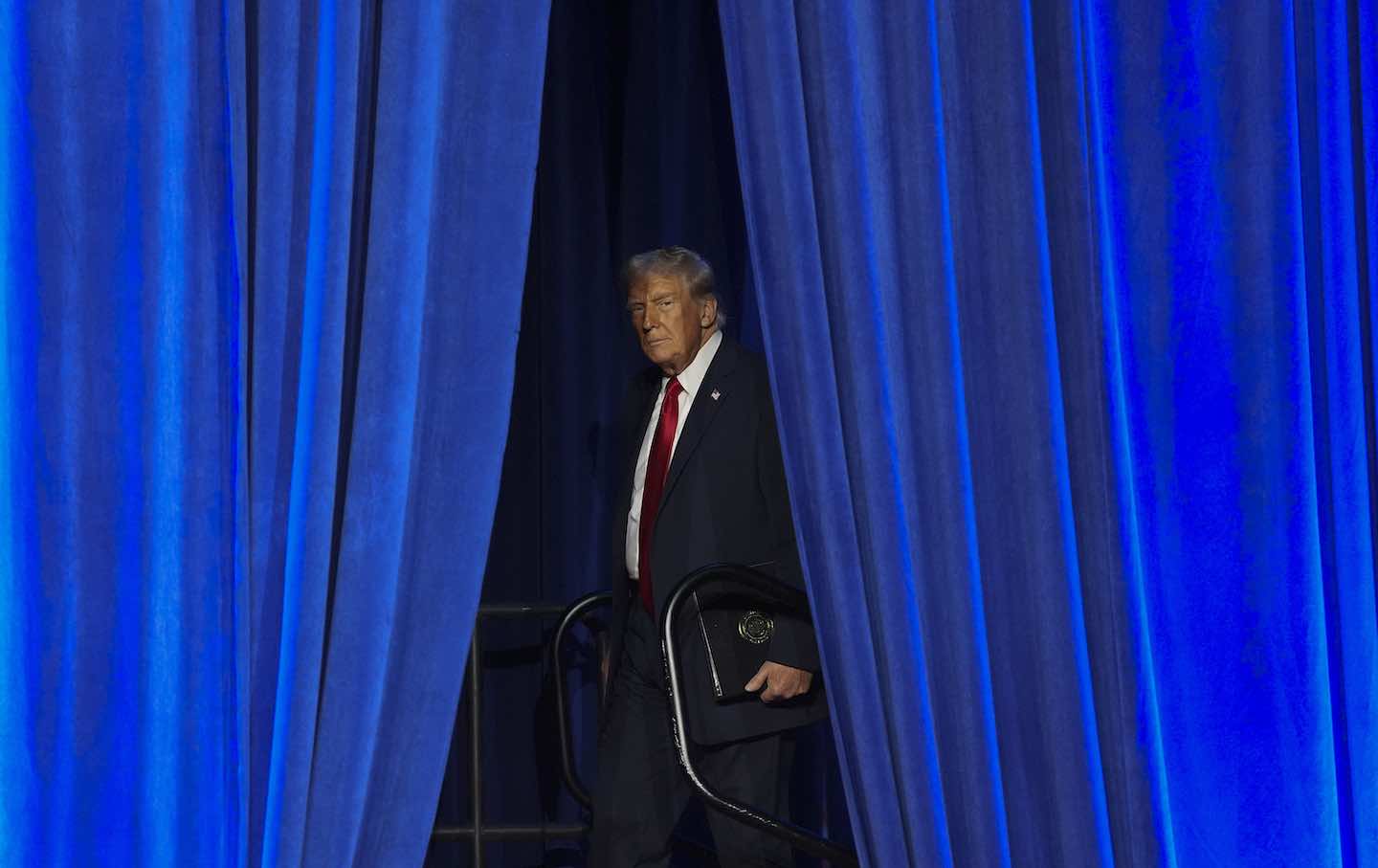
Republican presidential candidate Donald Trump comes out to address the crowd after being declared the winner during an election night party at the Palm Beach County Convention Center in West Palm Beach, Florida on November 6, 2024.
(Photo by Jabin Botsford / The Washington Post via Getty Images)
No institution in American politics is more worthy of consignment to the dustbin of history than the Electoral College. Established by founders who feared the will of the people—and who denied not just the franchise but the most basic measures of equal citizenship to women, people of color, the poor, and in many cases religious dissenters—the quadrennial gathering of political insiders was understood as a check and balance against the popular vote and the promise of genuine democracy. It has continued to function as such through much of the past 235 years. But the Electoral College does, in rare instances, perform the useful function of clarifying what the election results mean.
In the rush from Election Day to Inauguration Day, mid-December elector gatherings across the country provide a brief respite to reflect on the actual sentiments of the American people. The insights that are garnered do not come merely from the tabulation of electoral votes, but from an examination of how the shift of a handful of those votes in a handful of states could have produced an entirely different result: a result that, in this particular circumstance, could easily have favored Kamala Harris.
Knowing that a presidential election was close does not change the ultimate result. But it can change our understanding of that result, just as it can provide salient insights into the credibility of “mandate” claims—especially outsized claims like the ones that Trump and his supporters continue to trumpet.
Such is the case with the 2024 contest that was formally settled Tuesday, when electors met in state capitols across the country to cast their ceremonial votes. The Electoral College gatherings, themselves, did not produce surprises. Republican electors (including at least 13 participants in the party’s 2020 fake-elector plot) voted for Donald Trump and J.D. Vance. Democratic electors voted for Kamala Harris and Tim Walz. Trump got more votes—312 to 226 for Harris—and he will be inaugurated as president on January 20, 2025.
Yet, Trump failed to secure what he has claimed since the morning after the November 5 election: “an unprecedented and powerful mandate”—in either the popular vote or the Electoral College vote. And, the final counts from key states offered a striking insight into how close he came to losing his Electoral College majority.
Trump’s “mandate” claim was always overstated. Serious observers of the political process knew that the slow tabulation of popular votes, which always takes weeks to complete, would reveal that the results were far closer than was suggested by the early returns. Some even suspected that Trump would fall below the 50 percent threshold that allows a winner to claim majority support from the American people.
As it turned out, that’s exactly what happened. As the state counts were completed in advance of the Electoral College gatherings on Tuesday, it became clear that most Americans who cast ballots in the 2024 election had opted for someone other than Trump. The Republican candidate fell more than 300,000 ballots below the threshold for a popular vote majority, taking just 49.8 percent of the total. That’s a significantly lower percentage of the popular vote than President Joe Biden got in 2020, than Barack Obama got in 2012 and 2008, than George W. Bush got in 2004, or than the vast majority of American presidents got on their way to the White House. Indeed, when we compare the popular-vote-percentages of the two major-party candidates, it turns out that the 2024 election was one of the closest presidential contests in American history.
The same goes for the Electoral College vote. Of the 60 presidential elections since the founding of the country, 43 produced more decisive victories for the winner than Trump got. The Republicans percentage of the Electoral College vote in 2024 was lower than for Obama in either of his bids, than for Bill Clinton in 1996 or 1992, than for George Bush, Ronald Reagan, or most of the other post-war presidents.
But the real story of the narrowness of the 2024 election, and of how close Trump came to being defeated, is found in the pattern of narrow results that gave Trump his Electoral College lead. It is no secret that the focus of campaigning by both candidates in 2024 was on seven battleground states—a circumstance that, undoubtedly, depressed turnout in populous states such as California and New York, where Harris might well have piled up the margins needed to secure a national popular vote win.
It is true that Trump won all the battleground states. But in the Great Lakes states of Wisconsin, Michigan, and Pennsylvania—which voted for Trump in 2016, for Biden in 2020, and for Trump in 2024—the Republican nominee barely squeaked by this year. As Dave Wasserman, the well-regarded number cruncher for the Cook Political Report, noted, “the 2024 election was decided by 229,766 votes across Michigan, Pennsylvania and Wisconsin out of about 155.2 million cast nationally.”
If the Harris campaign had mobilized more base voters in those states—rather than squandering precious time on Republican-outreach events with Liz Cheney—they might well have made up the difference. Or, if they could had developed strategies to get just 114,884 working-class Wisconsin, Michigan, and Pennsylvania voters to shift from Trump to Harris, the Democrat would have prevailed.
That’s roughly the number of people that a pair of Taylor Swift shows drew in Philadelphia this year. In Wisconsin, historically the most closely contested of the battleground states, a shift of less than 15,000 votes would have given the state to Harris.
Why does it matter to crunch the numbers? Because politics is about perceptions. And the perception in too many quarters—including much of the media—is that Trump won “a massive mandate.”
It’s not uncommon for presidents to boast that they have more support than is actually the case, and it’s certainly not Trump’s first time doing so. Countless presidents have peddled a fantasy of broad popularity in order to gain an advantage in the wrangling over Cabinet picks and policy initiatives.
But the voters did not hand Trump a massive mandate.
Rather, they produced a result so close that, with just a slight shift of votes, the Electoral College would have made a Democrat the 47th president of the United States.