Trump-Backed Election Deniers Sweep Arizona’s GOP Primary
Arizona Democratic officials say the primary results don’t reflect “what the majority of Arizonans think.”
At the end of July, in a low-turnout primary in which only about 25 percent of GOP-registered voters cast ballots, Arizonan Republicans voted for all the non-presidential candidates on the November ballot. The vote counts are now complete, and the verdict is in: Up and down the ballot, the GOP base opted for hard-core election deniers, many of whom had been endorsed by former president Donald Trump.
Should these election deniers somehow thread the needle and win in the general election, Arizona’s politics would swing further rightward, and its voting processes would be overseen by officials who deny the legitimacy of the past two elections and hope to put up all kinds of obstacles to voter participation. That would spell trouble for the future of the process in the Grand Canyon State no matter who is in the White House.
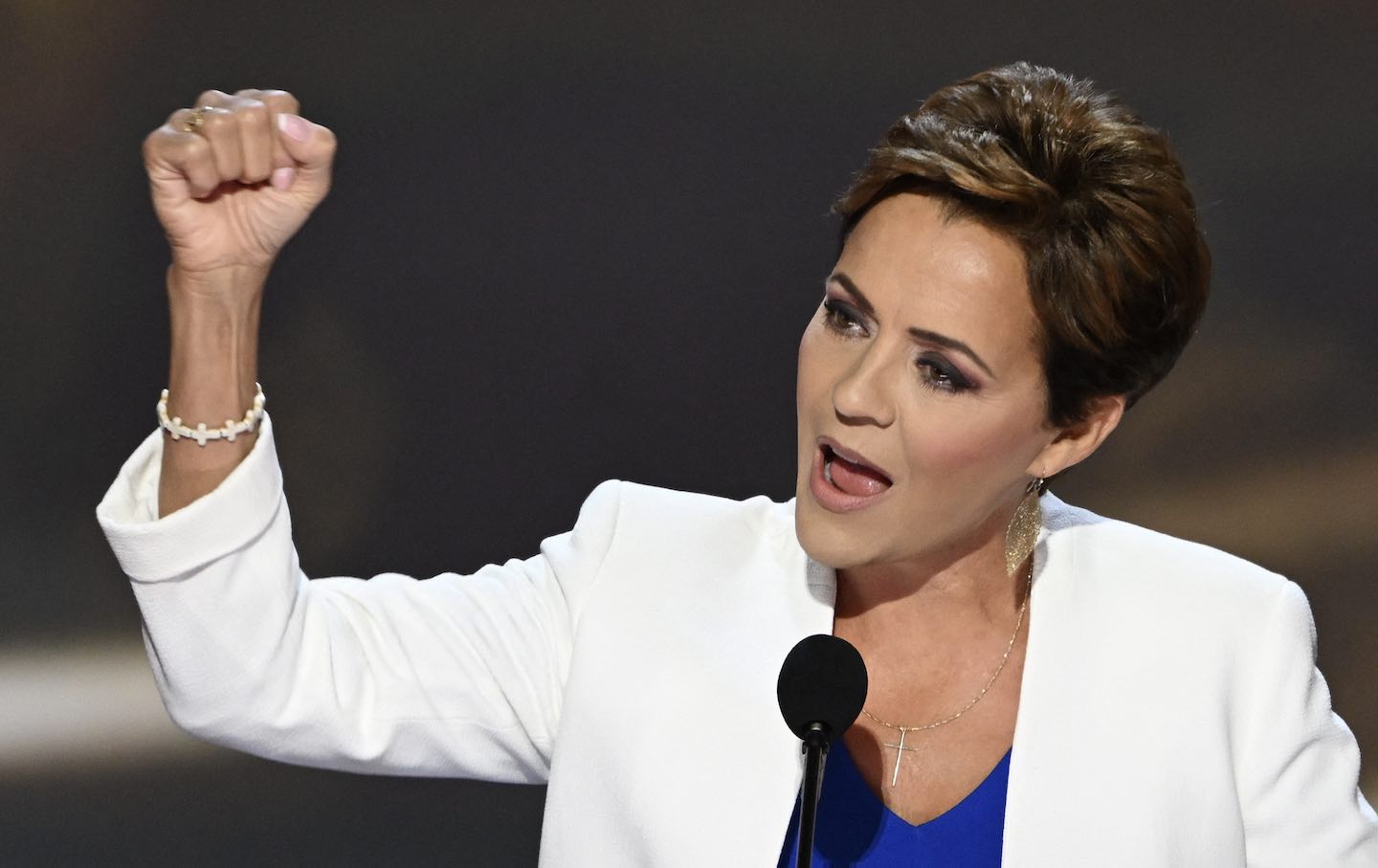
In the most high-profile race, defeated gubernatorial candidate and Trump-wannabe Kari Lake was nominated to be a Senate candidate. She won approximately 54 percent of the vote, with her only major opponent being a local sheriff who, short of money, ran a bare-bones campaign that never was going to represent a serious challenge to the fiery former news anchor. Lake, who shot to national fame in the wake of the 2020 election largely by parroting Trump’s lies about a stolen victory, and who has spent the past 20-plus months denying that she lost the governor’s race to Katie Hobbs—racking up a series of expensive legal defeats in the process—will now compete against progressive Ruben Gallego in one of the country’s most important Senate races.
Lake wasn’t alone in using the GOP base’s suspicion of the electoral process to her advantage. In Maricopa County, the moderate Republican county recorder, Stephen Richer, who stood up to the MAGA mob’s attacks on the voting process and to allegations of widespread voter fraud in the Phoenix area, was defeated in the primary by Justin Heap. In the state legislature, Heap has voted to oppose the use of electronic counting of ballots; he wants to eliminate almost all early voting; and, if he is elected in November, he hopes to bar the use of large voting centers. He wants to replace these centers with small precincts capped at 1,000 registered voters per precinct, which experts have said would render the voting and vote-counting process in a large city like Phoenix far more difficult.
Another defender of the integrity of the 2020 and 2022 elections, Maricopa County Board of Supervisors chair Jack Sellars was also defeated by a roughly two-to-one margin.
The list of victorious election deniers, and defeated moderates, is a long one. In the hotly contested primary race for Congressional District 8, a highly conservative district in which the GOP is all but assured of winning come November, election denier Abe Hamadeh won out over a bevy of opponents, including defeated Senate candidate (and fellow election denier) Blake Masters. In CD 3, a safely Democrat seat being vacated by Ruben Gallego, the firebrand conservative Jeff Zink, who attended the infamous January 6, 2021, rally in DC, easily won the GOP nomination.
And in an ultra-red state legislative district, Mark Finchem, who unsuccessfully ran for secretary of sate on one of the country’s most extreme election-denying platforms in 2022, knocked off the relatively moderate GOP incumbent Ken Bennett, all but guaranteeing himself a place in the legislature come 2025.
With the GOP in Arizona marching entirely in lockstep with the election-denialist predilections of Trump, there is a danger that the machinery for running elections and counting ballots will at some point end up in the hands of extremists. But it’s also more than likely that the GOP, in lurching so far to the right during its primary season, will ultimately poison its relationship to the broader voting public in Arizona. After all, over the past decade the state has gone from being reliably red to being generally purple, and since 2018 most of the key national and state races have ended up narrowly going in the Democrats’ favor. Eighteen people have been charged in the false electors plot from 2020, and recently the first of these pleaded guilty—all of which has kept in the public eye GOP extremism around this issue.
As I wrote earlier this year, it is certainly possible that in Arizona the unreconstructed MAGA movement will take its last, ugly stand, and will end up being handed a series of stinging defeats by voters in the general election. Most recent polls have shown Gallego building a lead against Lake in the Senate race, and with an abortion rights initiative now qualified for the ballot in November after its sponsors submitted hundreds of thousands of signatures earlier this summer, it’s likely that Democratic voters will be particularly energized heading into the general election.
Secretary of State Adrian Fontes, who is responsible for upholding the integrity of the state’s voting processes, believes that last week’s primary results show more about the direction the GOP is taking in Arizona than about where the populace as a whole is on these issues. “I don’t think the state will go the way the Republican Party has gone,” he told me this week. “I don’t think it encompasses what the majority of Arizonans think.”
Fontes, who defeated Finchem in 2022, and who currently is an executive board member of the Democratic Association of Secretaries of States, believes that Arizona’s electoral processes are strong, and that they will survive the assault the current incarnation of the GOP is launching against them. “Doom and gloom I think is overrated,” he says pithily. This past week’s results, he argues, “say a lot about the Republican Party and Republican primary voters. But that’s a small vote compared to the whole.”