Kamala Harris, Tim Walz, and the Battle Cry of Freedom
In Wisconsin, the campaign tapped into one of the most resonant parts of this country’s history—with a little help from Bon Iver.
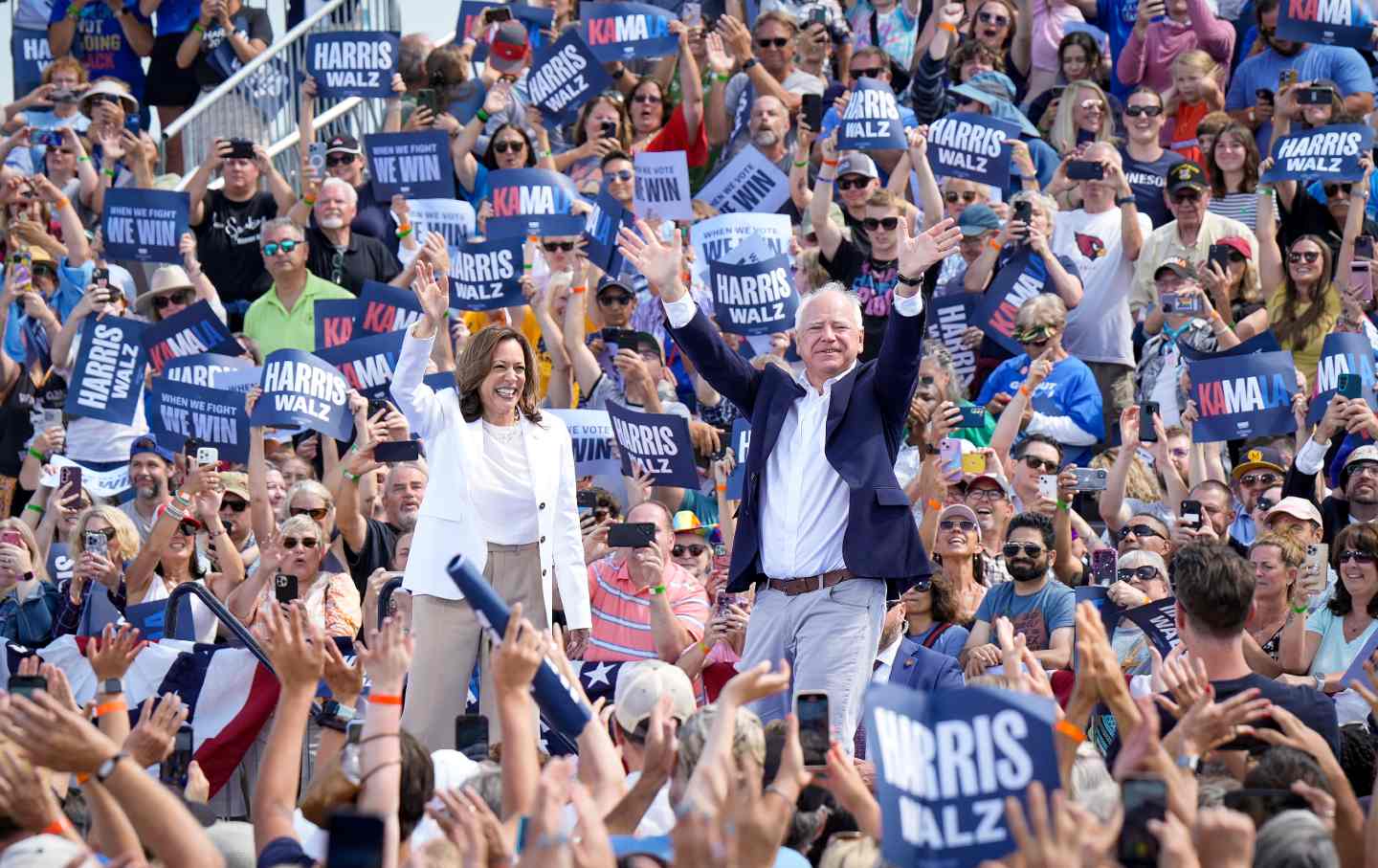
Kamala Harris and Tim Walz at a rally in Eau Claire, WI, on August 7, 2024.
(Glen Stubbe / Star Tribune via Getty Images)EAU CLAIRE, Wisconsin—In the farm towns and county seats of rural western Wisconsin, some of the first memorials to the Civil War dead, and to the heroic struggle to end the original sin of the American experiment, were erected by returning veterans, and by the families of those that did not return. The statues, plaques, and markers placed by the Grand Army of the Republic are still well-maintained today, a testament to the region’s pride in its embrace of the fight not just to save the Union but to upend the cruel systems of governance that had permitted human bondage.
This isn’t just Wisconsin history. Across the Mississippi, in the farm country of southeastern Minnesota that Tim Walz once represented in Congress, the Civil War monuments stand just as tall, and the memories run just as deep. So it was that, when Walz first ran for Minnesota’s governorship in 2018, he recorded a stirring call to action that argued for an expansive view of the state’s potential. While some politicians talked about cutting programs, lowering expectations, and accepting despair and division, Walz declared, “If Washington won’t lead, we will. In this state, we don’t fear the future. We create the future. And when we stand together, we win.” To prove his point, the former high school social studies teacher invoked the state’s history: “Our blood saved the Union at Gettysburg. Our iron forged the tanks that liberated Europe. Our farmers sparked a green revolution that fed the world. Our imagination transformed medicine. What many describe as the Minnesota miracle, that’s just what we do here.”
That reference to saving the Union at Gettysburg was not hyperbole. Walz was talking about the 1st Minnesota Infantry Regiment — the “First Minnesota Volunteers” — which, on the second day of the fighting at Gettysburg, halted the Confederate forces that threatened to break the Union line at Cemetery Ridge. Outnumbered 5-1, the soldiers of the Ist Minnesota charged the enemy troops. Even as they sustained horrific losses, the Minnesotans held the line until reinforcements arrived. Military historians recall that “Of the 262 members of the regiment present for duty that morning, only 47 answered the roll that evening. The regiment incurred the highest casualty rate of any unit in the Civil War.” Union Major General Winfield Scott Hancock, who ordered the attack, reported, “The superb gallantry of those men saved our line from being broken.” Without the 1st Minnesota, the most hallowed victory of the war —one that, in President Abraham Lincoln’s immortal words, had renewed the promise of “a new nation, conceived in Liberty, and dedicated to the proposition that all men are created equal,”— might never have happened.
A little more than 160 years after the fight at Gettysburg, the Democratic ticket of Walz and Vice President Kamala Harris rallied 12,000 Wisconsinites and Minnesotans on the edge of a farm field near Eau Claire. History met them there too; this western Wisconsin region is dotted with monuments to the 8th Wisconsin Volunteer Infantry and their mascot, an eagle known as “Old Abe” who flew over battlefields as the screeching “Yankee Buzzard” that terrified Confederates through four years of Civil War fighting.
Civil War references used to be common at political rallies across the upper Midwest, the place where radical abolitionists formed the Republican Party to oppose the expansion of slavery. Now, supporters of the Republican nominee for president, Donald Trump, show up at his rallies with Confederate flags and Trump himself describes the symbols of the treasonous revolt of Confederate states against the Republic as “part of a Great American Heritage.”
These days, it falls to the Democrats to look honest eyes through the lens of history. Perhaps that explains the remarkably well-chosen acknowledgment of the Civil War at the Harris-Walz rally outside Eau Claire.
Justin Vernon, the leader of the Grammy Award-winning band Bon Iver, performed at the rally. That was not surprising. Vernon is an Eau Claire native who still resides in the area, and he and the Bon Iver crew have often appeared on behalf of progressive candidates, such as former US Senator Russ Feingold and Vermont Senator Bernie Sanders. At Wednesday’s rally, Vernon was typically self-effacing, telling the crowd, “We’re here for the right reasons and we all know what we are here for, We’re gonna do our thing, make this music, and make way for the people we need to hear from.” But the set concluded with a song that spoke to the moment with striking clarity. “We’re going to close out here with a nice, old patriotic song that has been rolling around my head these last months,” said Vernon, before he and the band performed a chilling version of the most visionary and radical of Civil War-era songs, the abolitionist anthem, “The Battle Cry of Freedom.”
Written in 1862 by George Frederick Root, at a time when the Union cause was struggling, “The Battle Cry of Freedom” was a call to arms that identified the treason of the rebels (”Down with the traitors, up with the stars”) and urged the formation of an army of northern abolitionists and unionists, along with formerly enslaved Black Southerners, to defeat the Confederacy (“We will welcome to our numbers the loyal, true and brave, Shouting the battle cry of freedom! And although he may be poor, he shall never be a slave, Shouting the Battle Cry of Freedom”).
Harris has made freedom a watchword for her campaign against the authoritarian threat posed by Trump and his running-mate, right-wing Ohio Senator J.D. Vance. To that end, she has employed Beyoncé’s song “Freedom” as rally music. On Wednesday, however, it was an older, yet no less appropriate call for freedom, that echoed across the farm fields of the upper Midwest. “Oh, we’ll rally round the flag, boys, we’ll rally once again, shouting the battle cry of freedom,” sang Vernon. “And we’ll rally from the hillside, we’ll gather from the plain, Shouting the battle cry of freedom.”