At the NIH, a Scandal Grows Around an Official’s Evasion of Public Records Law
After a top aide to Anthony Fauci was grilled by Congress, questions emerge as to whether others may have sought to avoid transparency around the Covid epidemic.
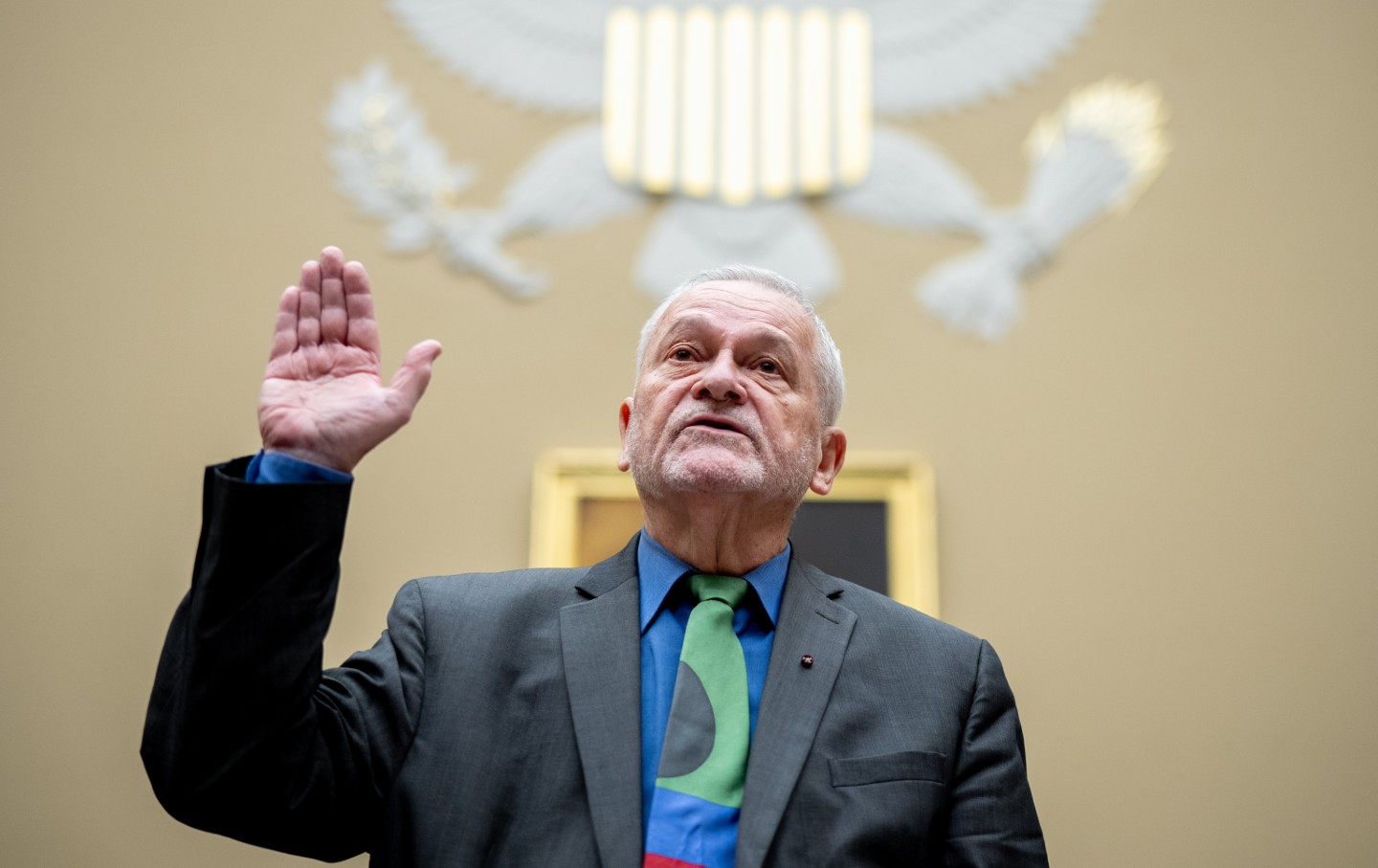
Dr. David Morens is sworn in during a House Select Subcommittee on the Coronavirus Pandemic hearing on Capitol Hill on May 22, 2024, in Washington, DC.
(Andrew Harnik / Getty Images)The House Select Subcommittee on the Coronavirus Pandemic, which is conducting an investigation into the origin of SARS-CoV-2, sent a letter to the National Institutes of Health today in which it suggests that there has been “a conspiracy at the highest levels of NIH and NIAID to avoid public transparency regarding the COVID-19 pandemic.” The allegation comes as the agency is engulfed in a growing scandal about its handling of public records related to the vitriolic debate over the pandemic’s provenance.
The FOIA scandal first came to light last summer. In June 2023, I broke the news in The Intercept that Dr. David Morens, a longtime senior adviser to Dr. Anthony Fauci, had engaged in efforts to evade the Freedom of information Act. In a September 2021 e-mail to a group of high-profile critics of the so-called lab leak theory, Morens wrote: “As you know, I try to always communicate on gmail because my NIH email is FOIA’d constantly.”
“Don’t worry,” he added, “just send to any of my addresses, and I will delete anything I don’t want to see in the New York Times.”
The House subcommittee first obtained Morens’s e-mails as part of its investigation. After news of Morens’s apparent misconduct became public, he was put on administrative leave. The subcommittee, meanwhile, issued a subpoena to gain access to Morens’s Gmail account. The committee obtained some 30,000 additional e-mails and released a large batch of them last week.
The subpoenaed e-mails show that Morens’s conduct concerning FOIA was not a onetime affair. In a November 2021 e-mail to Gerald Keusch, a former high-level NIH official, he asked that “NOTHING gets sent to me except to my gmail, and make sure that what gets sent to my gmail doesn’t have a cc to another government employee who could be FOIA’d.” (Keusch declined to comment for this story.)
Morens’s e-mails also suggest that the problem of FOIA noncompliance at the NIH may not be limited to him. In one February 2021 e-mail, Morens wrote: “i learned from our foia lady here how to make emails disappear after i am foia’d but before the search starts, so i think we are all safe. Plus I deleted most of those earlier emails after sending them to gmail.”
In another exchange, he wrote: “But I learned the tricks last year from an old friend, Marg Moore, who heads our FOIA office and also hates FOIAs.”
Based on these records, the subcommittee alleged in its letter this morning that the NIH FOIA office may have been “complicit in the destruction of official records.”
Morens’s e-mails also raise the question of whether Fauci was involved in or had knowledge of such conduct. In one June 2021 e-mail exchange that included several prominent scientists who have been outspoken on Covid origin issues, Morens wrote the following about one of his e-mails: “Mine was erased long ago (I verified that today) and I feel pretty sure Tony’s was too. The best way to avoid FOIA hassles is to delete all emails when you learn a subject is getting sensitive.”
In another April 2021 e-mail, Morens wrote: “PS, I forgot to say there is no worry about FOIAs. I can either send stuff to Tony on his private gmail, or hand it to him at work or at his house. He is too smart to let colleagues send him stuff that could cause trouble.”
The Select Subcommittee on the Coronavirus Pandemic hauled Morens into a hearing last week during which members of both parties expressed outrage at his behavior.
“Your statements, Dr. Morens, in the e-mails show a disdain for the Freedom of Information Act,” said Debbie Dingell, Democrat of Michigan. “I think your conduct shows a blatant disregard for accountability to the taxpayers who fund [the National Institute of Allergy and Infectious Diseases’] work,” she added. “And quite frankly it really is disturbing.”
Morens apologized for his conduct multiple times during the hearing. In explaining his behavior, he described his lack of clarity over what constitutes a federal record, emphasized that some of his comments were made in jest, and said he could not recall certain incidents. He also defended some of his conduct, saying that it involved personal matters.
When asked by Representative James Comer, Republican of Kentucky, whether he had ever deleted any official records, Morens said no.
“Not to my knowledge, but again we are at the issue of defining what is a federal record,” he said. “I deleted a lot of e-mails. I do it everyday, but in my mind they are trivial things not related to government business.”
Popular
“swipe left below to view more authors”Swipe →When asked whether the NIH FOIA office instructed him on how to delete e-mails or avoid FOIA, Morens denied that it had.
In its letter this morning, the subcommittee released additional records, including more of Morens’s e-mails. Among other things, the letter alleged that another NIH official may have misspelled words in e-mails to evade the keyword searches that are commonly used to respond to FOIA requests, though it provided only two e-mails to support the allegation. The subcommittee requested that the NIH provide a briefing on its transparency and record retention policies by the end of the month. All this comes as Fauci is set to testify at a hearing of the House subcommittee on June 3, during which questions about the NIH’s FOIA practices are likely to arise.
In a response to questions concerning Morens and the NIH FOIA office, a spokesperson for the Department of Health and Human Services, which is home to the NIH, issued the following statement:
HHS doesn’t comment on personnel matters. HHS is committed to the letter and spirit of the Freedom of Information Act and adherence to Federal records management requirements. It is HHS policy that all personnel conducting business for, and on behalf of, HHS refrain from using personal e-mail accounts to conduct HHS business.
Attempts to reach Fauci through his assistant received no response.
An attorney for Morens shared the following statement: “Dr. Morens has a demonstrated record of high quality and important contributions to science and to public service.”