
The Single Most Important Thing President Biden Can Do for the Climate Is Enforce an Immediate Cease-Fire in Gaza
War and warming: US support for Israel’s war in Gaza is deepening the climate crisis—and making it impossible to solve.
The first Earth Day blossomed in Central Park nearly 54 years ago—on April 22, 1970. At the time, it seemed to those of us in the anti-war movement like a diversion from the most urgent tasks of the day: ending the Vietnam war and fighting racism. We were further alienated by President Richard Nixon’s embrace of an environmental legislative agenda coinciding with, and distracting from, his expansion of the war into Laos and Cambodia.
Only decades later, when we joined the environmental movement, did we recognize the deep connection between war and warming, racism and environmental injustice. Today, Earth Day is an opportunity for advocacy. And now must be the climate change moment, with 2023 global temperatures rising to record levels and exceeding the 1.5 degrees Celsius increase above preindustrial levels long identified as the catastrophic tipping point by the world’s scientists and nations. Addressing the gathering climate crisis should be a priority that unites people, movements, and governments. Instead, war, genocide, and settler-colonial occupation have intervened and are pushing countries further apart, with the present specter of a widening Mideast war.
And that is why it is clear to us that the single most important thing President Biden could do to for the climate today is to enforce an immediate and permanent cease-fire in Gaza and end the war against the Palestinian people.
The Israeli campaign against Gaza, with US political complicity and military support, and both governments’ contravention of the order by the International Court of Justice to prevent the killing, stop the destruction of the means of life and the interference with humanitarian aid, has ripped the fragile fabric of international cooperation.
Yet that is exactly the fabric on which any hope for mitigating the climate catastrophe rests.
The fossil fuel industry has taken full advantage of the current global disarray: Oil and gas majors, reaping windfall profits from the Russian invasion of Ukraine, are already shifting away from even their modest investments in renewable energy, and banks are reneging on their fossil fuel disinvestment pledges. The influential Global Turning Points report released by 200 scientists at COP28—the November 2023 Dubai climate summit last November—warns that rapid changes to nature are reaching the long-feared scale to overwhelm entire societies. The study calls on UN Secretary General António Guterres to convene a global summit on the governance agenda for managing Earth-system risks and maximizing global coordination to speed up mitigation and resilience.
Yet right now there is no possibility of such a convocation. Instead, the United States has become a rogue state, in violation of the International Court of Justice order. Its active complicity with Israel’s war in Gaza places the US among a diminishing group of European nations and in opposition to the sentiment of millions of its own citizens, as well as countless more around the world.
The United States, one of the world’s biggest sources of greenhouse gas emissions, and Europe, a consistent force for emission reduction, both played important roles in global climate negotiations. But meaningful joint global action on the climate emergency is out of the question now—at the very moment when it is the only thing that holds out the hope of real solutions. The world’s largest emitters are now staring at one another across battle lines.
Strengthening the ties between the anti-war/anti-imperialist/peace and environmental/climate/justice movements has long been a priority for both of us. We call this effort “war and warming.” The globe’s two most immediate crises—climate change and genocide—are dimensions of the same system with different facets: Call it racial capitalism, imperialism, settler colonialism, environmental racism, or extractivism. Let’s examine this intersection.
According to a report from Brown University’s Watson Institute, the US Department of Defense is “the world’s largest institutional user of petroleum and correspondingly, the single largest institutional producer of greenhouse gases.” In other words, military emissions significantly drive the total of US emissions. And this is a peacetime analysis.
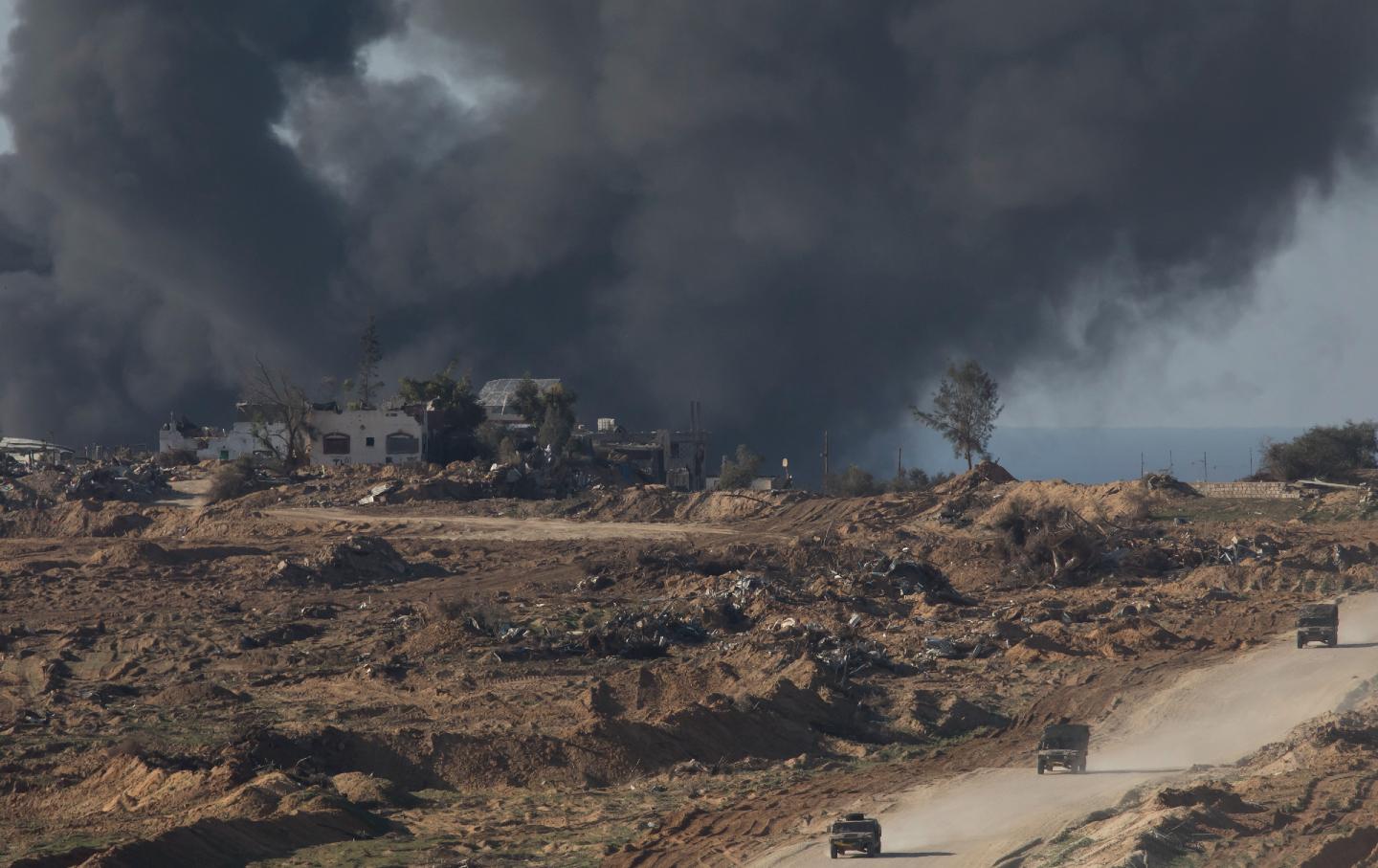
The Guardian reports that planet-warming emissions over the first two months of the war exceeded the annual carbon footprint of more than 20 of the world’s most climate-vulnerable countries. According to an analysis by researchers in the UK and the US, 99 percent of the carbon dioxide emitted in the first 60 days after the October 7 Hamas attack is attributed to Israel’s aerial bombardment and ground invasion of Gaza, while almost half the war’s total CO2 bootprint is from US cargo planes flying military supplies to Israel.
“From the river to the sea” might be the touchstone slogan on both sides of the Israeli/Palestine conflict, but the Jordan River is currently reported as running at just 10 percent of its historic average flow, while the rise of the Mediterranean Sea is predicted to be impactful by the end of the century—if not long before. The Intergovernmental Panel on Climate Change warned that temperatures in the Mediterranean region are rising extraordinarily fast: about 20 percent faster than the global average. And climate change itself has long been recognized as a conflict multiplier.
These realities should influence our response to the Israeli war against the Palestinian people, as well as the US role in widening the regional war. War is simultaneously deepening the climate crisis—and making it impossible to solve. The linkage is clear. It is imperative for us to reflect this in our organizing, our advocacy, in the streets and classrooms, and in our thinking in ways we have not yet done. As we near Earth Day 2024, let’s make an immediate and permanent cease-fire in Gaza a point of global unity.
More from The Nation
An Effective Movement for Palestine Needs Allies Like Zohran Mamdani An Effective Movement for Palestine Needs Allies Like Zohran Mamdani
In order to build a broad-based coalition, we need to work together—not practice purity politics.

The First Amendment Applies to Concert Stages Too The First Amendment Applies to Concert Stages Too
Protests like that of Macklemore on Palestine should never be silenced by billionaire owners.
France’s Students Won’t Back Down France’s Students Won’t Back Down
Without full-time teachers, temperature-regulated classrooms, or school nurses, French students are turning their grievances into a national movement.
Inside Cornell’s Week of Protest Inside Cornell’s Week of Protest
“We won’t be silenced anymore. Our university needs to start protecting us, like they should’ve with Jane Doe and all other survivors on campus.”
Netanyahu Came to New York. New Yorkers Were Ready for Him. Netanyahu Came to New York. New Yorkers Were Ready for Him.
Scenes from the defiant protest against the genocidal leader’s UN speech.
A Message From Prairieland Prisoner Autumn Hill: “Don’t Be Afraid” A Message From Prairieland Prisoner Autumn Hill: “Don’t Be Afraid”
I talked to the political prisoner about the politics of love, her case, surviving as a trans woman in a men’s prison, and how she makes it through the day.

