
The True Threat of Donald Trump’s “Bloodbath” Speech
Deplatforming the former president hasn’t worked, so America needs to rediscover his depravity.
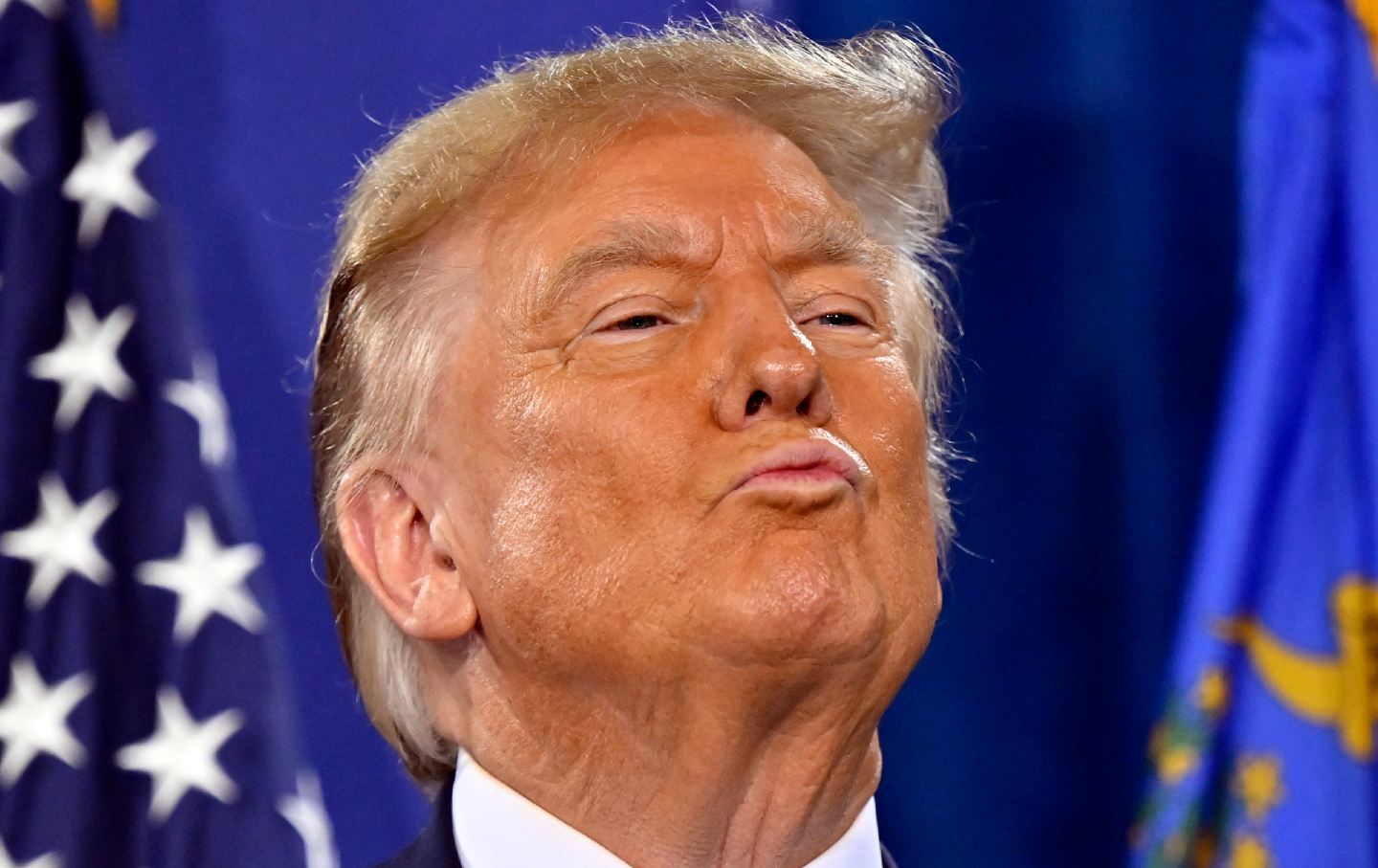
Just a few years ago, Donald Trump’s speeches were national events. Now, they have become strangely muffled affairs that are experienced and debated mostly secondhand via curated snippets on social media or cable news. Trump had long been good for ratings, so in his first presidential run in 2016, he benefited from an unprecedented gift of free media, estimated to be worth more than $4.6 billion in unpaid advertising, as news networks such as CNN, MSNBC, and Fox irresponsibly aired his lengthy rallies at length with minimal editing.
After the aborted coup of January 6, 2021, there was a concerted and largely successful effort to deplatform Trump. His Twitter account was deactivated, and Facebook stopped amplifying his message. Even before January 6, networks such as MSNBC and CNN had already started in 2019 to be more chary of giving Trump lengthy, unedited airtime. In November 2022, Elon Musk restored Trump’s Twitter account—but the former president has, with the exception of one post, stayed away from Twitter in preference of a little-used platform (Truth Social) he has a financial interest in.
To a remarkable degree, Trump’s words are now a markedly smaller part of public discourse than they were in his in his first presidential run. This has created an anomalous state of affairs where Trump is talked about as much as ever but rarely heard from in his own voice. In the current election cycle, the only people watching Trump rallies in full are attendees, journalists, and the few hardcore fans (or truly masochistic haters) dedicated enough to track down the events on C-SPAN or YouTube.
But like all attempts to thwart Trump through nonpolitical means, deplatforming has failed as a strategy. For the third presidential election in a row, Trump has clinched the Republican Party nomination. In polling, he has enjoyed a lead over his Democratic counterpart Joe Biden for more than six months (in contrast to 2016 and 2020 when he only rarely led his Democratic rivals).
Paradoxically, deplatforming might be helping Trump, since it allows Republican-leaning voters to conjure up a party standard-bearer who shares their politics rather than having to pay attention to the actual Trump, whose posts and speeches are animated by nastiness and recrimination.
On Thursday in Dayton, Ohio, Trump delivered a speech that, going against recent trends, actually gained traction in the news cycle.
“We’re going to put a 100% tariff on every single car that comes across the line, and you’re not going to be able to sell those guys if I get elected,” Trump said.… “Now, if I don’t get elected, it’s going to be a bloodbath for the whole – that’s gonna be the least of it. It’s going to be a bloodbath for the country. That’ll be the least of it.”
The Biden campaign seized on the remark as evidence of Trump’s violent intent. Republican defenders (and even some Trump critics) insisted that this was overreach, since the remark could be read as merely referring to economic devastation.
Steven Cheung, a Trump’s campaign spokesman, e-mailed The Washington Post, “If you actually watch and listen to the section, [Trump] was talking about the auto industry and tariffs.”
Surprisingly, Republican Senator Bill Cassidy of Louisiana offered a balanced interpretation. Speaking on the NBC program Meet the Press, Cassidy noted, “You could also look at the definition of bloodbath and it could be an economic disaster. And so if he’s speaking about the auto industry, in particular in Ohio, then you can take it a little bit more context.” Then Cassidy offered this important qualification: “The general tone of the speech is why many Americans continue to wonder, ‘Should President Trump be president?’ That kind of rhetoric, it’s always on the edge, maybe doesn’t cross, maybe does—depending upon your perspective.”
Cassidy’s remarks suggest that even among Republican elected officials—a class that has every reason to want to appear as Trump loyalists—the former president’s rhetoric is unsettling.
There is something a little bit ridiculous in saying that a crude, scattershot, and digressive speaker like Donald Trump has to be treated with exegetical care, with particular attention to nuance and context.
In any case, hermeneutical precision wouldn’t exonerate Trump; rather, it makes clear that he is more depraved than ever.
It’s worth looking at what else was in that Trump speech, apart from the “bloodbath” passage. As Axios reported, it opened with an announcer telling the crowd, “Ladies and gentlemen, please rise for the horribly and unfairly treated Jan. 6 hostages.” The speakers then played what is now a regular feature of Trump events, an alternative rendition of the national anthem recorded by the so-called J6 Prison choir. Trump referred to the January 6 defendants as “amazing people” and “hostages” whom he will help when elected. Trump has in effect created a patriotic cult around the January 6 coup attempt.
Axios also notes that Trump’s speech was full of “insults, obscenities, and dehumanizing rhetoric about immigrants.” About migrants, Trump said, “In some cases, they’re not people, in my opinion.” Along with his earlier comments about immigrants’ “poisoning the blood of our country,” the new remarks can only be interpreted as eliminationist in intent. It is the classic language of fascist bigotry.
The ”bloodbath” comment has to be seen not in isolation but as one more ingredient in a toxic mix. If Trump were a normal politician who didn’t exalt defendants who attacked the Capitol and who didn’t speak of migrants as less than human, then one might be justified in a charitable interpretation that sees “bloodbath” as only a lurid economic metaphor. But in the context of the fascist bile of Trump’s entire speech, the “bloodbath” metaphor takes on a more ominous tone.
Popular
“swipe left below to view more authors”Swipe →But there’s no need to focus on just a few sentences of Trump’s speech. The entire performance is disgustingly authoritarian. The key takeaway is not the debatable meaning of any of Trump’s words but the necessity of making Trump’s threat clear to voters. Deplatforming hasn’t worked, and the best way to defeat Trump might be to encourage voters to spend more time listening to him.
Of course, amplifying Trump’s lurid words is effective only if he is faced by a rival who offers a more attractive alternative. In 2016, Hillary Clinton failed to offer that alternative. Four years later, Joe Biden succeeded—although his Electoral College victory was frighteningly close. For 2024, it remains an open question whether Biden can again present an anti-Trump vision that energizes the electorate.
More from
Jeet Heer 
Even Republicans Are Waking Up to Trump’s Corruption Even Republicans Are Waking Up to Trump’s Corruption
And, somewhat shockingly, so are Democratic elites.
Where Is the Outrage Over Trump’s Racist Targeting of Ilhan Omar? Where Is the Outrage Over Trump’s Racist Targeting of Ilhan Omar?
The establishment press and some Democrats are strangely mute over the president’s flagrant abuse of the legal system.

The Real AI Threat Is Already Here The Real AI Threat Is Already Here
Never mind some future apocalypse—AI is being used right now to cause enormous suffering.
Elon Musk’s James Talarico Smear Blew Up In His Face Elon Musk’s James Talarico Smear Blew Up In His Face
But that doesn’t mean the danger from Musk’s lies is over.
Does America First Really Mean Israel First? Does America First Really Mean Israel First?
Mike Huckabee’s aide shows how an extremist agenda dominates Trump’s Middle East policy.
The Death Penalty Has Become a Torture Machine The Death Penalty Has Become a Torture Machine
Christa Pike's botched lethal injection proves there is no humane form of execution.

