This Valentine’s Day, It’s Not Just Love That’s on the Ballot
Basic dignity is threatened as LGBTQ+ freedoms are increasingly endangered.
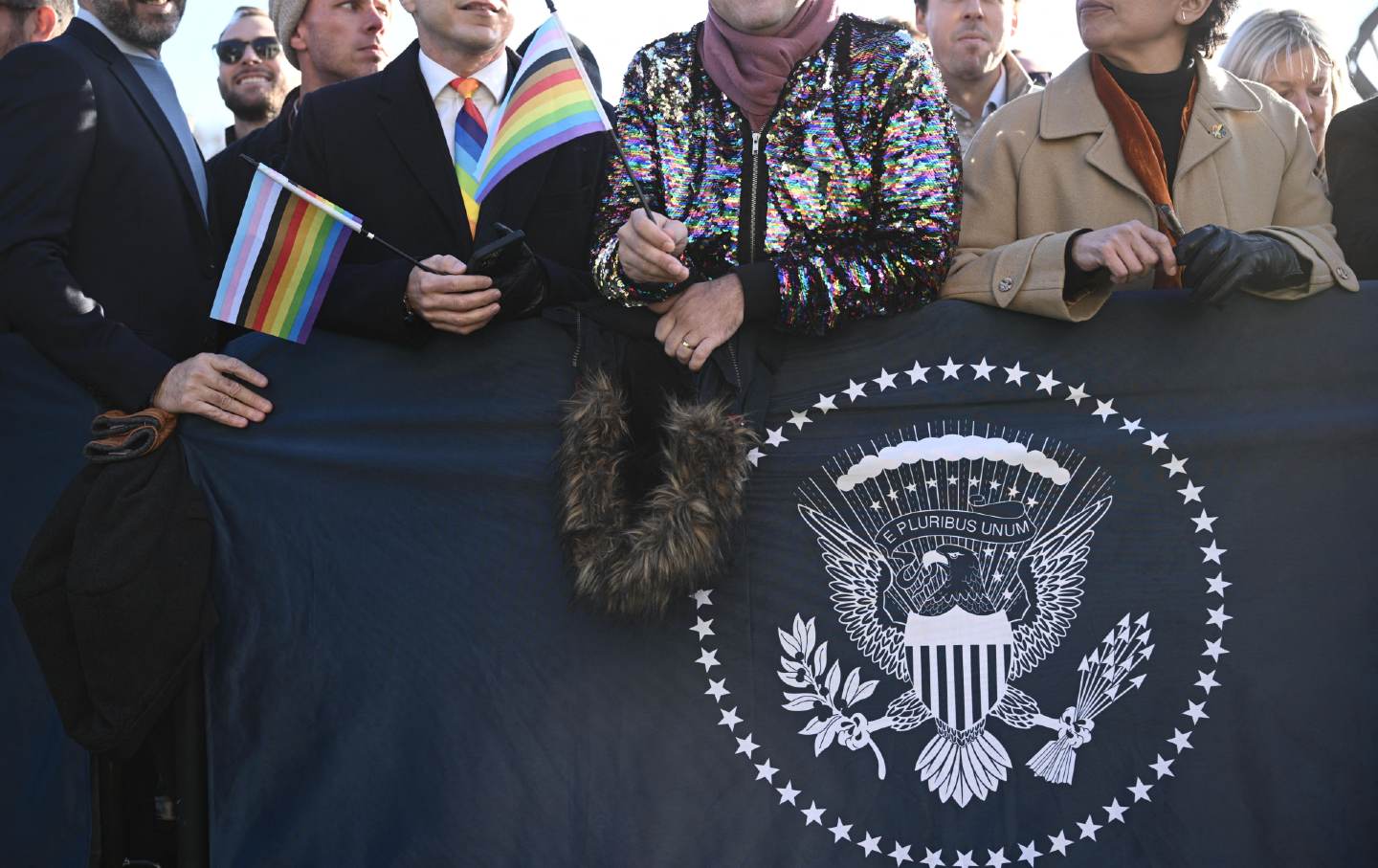
This Valentine’s Day, it’s not just love that’s on the ballot. It’s basic dignity.
For nearly a decade now, same-sex couples in America have been able to celebrate this holiday with full legal recognition of their marriages. Thanks to Obergefell v. Hodges, all spouses are created equal—no matter where they live, or who they love.
But LGBTQ+ freedoms are increasingly in danger. Last year, a record 510 anti-LGBTQ bills were introduced into state legislatures. Anti-trans fervor from the far right has coincided with a spike in transphobic and homophobic hate crimes against people like Laura Ann Carleton, a shopkeeper in California who was shot and killed for displaying a Pride flag outside her store.
If there were ever a moment when queer rights were a “settled issue” in America, it’s long gone.
This rising tide of hatred comes at an inflection point. In 2024, LGBTQ+ rights are at stake up and down the ballot—in amendments that could reshape state Constitutions, legislative elections that could determine the outcome of those 510 bills, and a presidential election that could cement the Supreme Court as an extreme reactionary body for generations.
After striking down the constitutional right to abortion in 2022, Justice Clarence Thomas said the court “should reconsider” other rights, like same-sex marriage. (With all due respect, the most important thing Thomas “should reconsider” is his retirement timeline.)
In response, Congress passed the Respect for Marriage Act, which requires states to recognize same-sex marriages performed in other states. It does not, however, require them to issue new marriage licenses to same-sex couples. That means, if the court overturns Obergefell, states could once again ban new gay marriages from taking place. As of 2022, 35 states had inactive statutory or constitutional bans ready to go—which is why some states have taken it upon themselves to preemptively protect same-sex marriage now.
Last month, the New York state legislature passed an Equal Rights Amendment, which would enshrine protections for LGBTQ+ individuals in the state Constitution. Voters in California have a similar opportunity: They’ll weigh in on an amendment that would officially remove the state’s inoperative ban on gay marriage from its Constitution. Voters in both states will be asked to ratify the amendments in November.
Unfortunately, it’s not just blue states hard at work. The ACLU is tracking a staggering 402 anti-LGBTQ bills across America. As has become the terrifying new norm in states with right-wing governments, some of these bills attempt to outlaw the mere mention of sexual orientation in schools. Others go further, forcing teachers to out students to their parents for using pronouns that don’t correspond with their biological sex. Whether they become law or not, these bills have a regressive effect on queer life in America: anti-LGBTQ+ hate speech on social media more than quintupled after Florida passed its “Don’t Say Gay” bill. No one benefits when the legitimacy of their existence is put up for debate.
As dangerous as these bills are, there is perhaps no body with more influence on the future of LGBTQ freedom than the Supreme Court. And Donald Trump’s appointees have already begun to chip away at gay rights. Last year, in a 6-3 decision—you can guess which six and which three—the court ruled that a Christian web designer could refuse to design a wedding website for a gay couple. (Never mind that the couple in question was completely made up.)
If Trump is given a second term, and the chance to appoint a couple of fresh-faced Federalist Society justices, we could descend even further into this dystopia. The court could hear a case challenging a conversion therapy ban. Trump could continue appointing homophobic judges to lower courts around the country. Obergefell and other basic human rights will be on the chopping block.
On the other hand, if President Biden is reelected with a Democratic House and Senate, he could go beyond the Respect for Marriage Act and codify Obergefell into federal law. If, through some unmentionable act of God, he is given the chance to appoint more justices, he could prevent the Supreme Court from drifting even further to the right. And he could continue to communicate, with the full power of the presidential bully pulpit, that in the United States of America, LGBTQ+ people are respected, supported, and loved.
In a characteristically eloquent dissent for the that web design case—the kind that makes you really wish she could be writing more majority opinions—Justice Sonia Sotomayor underscores where the real power to pursue justice and equality lies in America: “I fear that the symbolic damage of the Court’s opinion is done. But that does not mean that we are powerless in the face of the decision. The meaning of our Constitution is found not in any law volume, but in the spirit of the people who live under it.”
More from The Nation

Brazil’s Workers’ Party Is Not Stopping Brazil’s Workers’ Party Is Not Stopping
With just a few days remaining before the runoff election, supporters of Lula’s party are doing everything possible to rally support behind the president.

The Jewish Case Against AI The Jewish Case Against AI
Haredi rabbis and the secular left agree: This technology is a threat to the entire social fabric.
Vivek Ramaswamy’s New Attack Ad Should Be a National Scandal Vivek Ramaswamy’s New Attack Ad Should Be a National Scandal
The Ohio GOP gubernatorial candidate has accused his Democratic opponent, Amy Acton, of lying about being raped when she was 12 years old.

Dirty Business Dirty Business
Trump turns to Russian oil to lower fuel prices in the United States ahead of the midterm elections, throwing Ukraine under the bus.
The Fight for Educational Equality Is Also a Fight for a Just Supreme Court The Fight for Educational Equality Is Also a Fight for a Just Supreme Court
The court has severely weakened our ability to make an education system that fulfills the promise of Brown.