
Letter From Poland
Undoing the country’s authoritarian experiment.
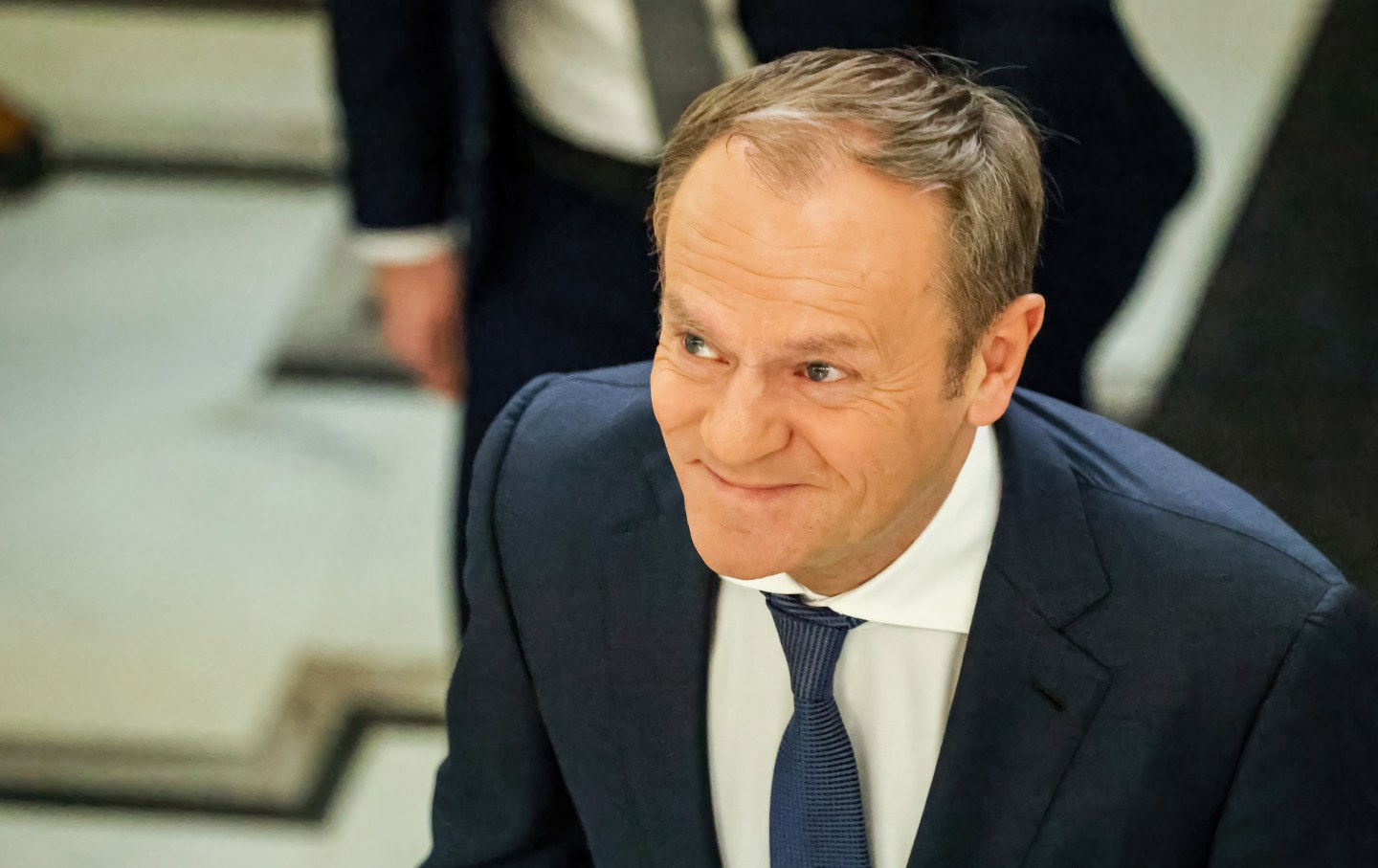
Winning the election was hard enough, what with Jarosław Kaczyński’s Law and Justice Party (PiS) using all available state resources to keep itself in power. But after the Polish opposition coalition did manage a slim but decisive victory in October 2023, actually being able to govern is the real challenge.
The right-wing populist parties dotting the political landscape today want to make it every bit as impossible to lose power as their ancestors in the 1930s did. Rather than formal dictatorship, however, they try to undo the principle of a neutral state, staff key institutions with only their own people, and sow the political landscape with mines that make it impossible for an opposition to take power even when it does win elections. That is why the Trump team is planning to purge state institutions and replace professionals with ideologues. This is why Viktor Orbán eliminated both an independent judiciary and media, and regularly changes the electoral law to suit his party’s interests.
PiS did this too, and so when the opposition coalition was finally allowed to form a government in December, it almost seemed as if it would be too hamstrung to do anything. Poland has several state-owned TV and radio stations, all of which had been used by PiS to lie about the opposition (branding them foreign agents) and spread any number of global right-wing racist conspiracy theories from the Great Replacement to the world-wide persecution of Catholics or the totalitarian threat coming from “gender ideology.” A new government would seem to have an obvious right to alter the content of official state media—except that PiS had already transferred public media governance to a newly created “National Media Council” in which PiS had a guaranteed majority.
The new government duly named a new minister of justice to take formal charge of the prosecutor’s office—a key position in any effort to investigate and roll back the politicization of that office under PiS, which deployed Pegasus spyware against political opponents. Except that PiS had earlier appointed a loyal official to a long-term post as “national prosecutor”—meaning that PiS would continue to control state legal policy despite being voted out of government.
Is there any way out of this legal blackmail? Is there any way to restore democratic rule of law without breaking the law? And who actually decides the law? The Constitutional Court that formally decides what the law is is itself dominated by PiS—through a process that same court declared unconstitutional at the beginning of PiS’s rule.
With the world’s new right parties coordinating among themselves how to seal their domination once they get elected so that their influence lingers even without electoral victories, the effort by the new government under Prime Minister Donald Tusk to reverse the PiS stranglehold is thus a crucial test case.
So far, Tusk has come out swinging. It has been astonishing to watch the boldness, determination, and agility of the new Polish coalition. From one day to the next, they clear one after another of the “minefields” laid by PiS. The minister of culture announces that the state, and not the National Media Council, owns state TV, and it cuts off the broadcast signal of the hostile station, whose officials then lock themselves in their offices, and issue their own broadcast from a new location. When President Andrzej Duda, a loyal PiS member with over a year left in his term, vetoes emergency funds to rebuild the media, the government declares state media legally bankrupt, allowing him to appoint temporary caretakers while new funds are sought.
Days later, while the PiS-loyal private media denounces these actions as “scenarios we’ve seen only in Russia or Belarus” aimed at “surrendering Polish sovereignty to the Germans,” the new attorney general goes to work on the legal front, producing five legal opinions showing that PiS’s national prosecutor had in fact been constitutionally ineligible for the position. He offers to let the PiS-appointee resign, and when rebuffed, simply notifies him that he has been replaced by a new national prosecutor, loyal to the principles of the new government.
Not that these measures go unchallenged. Besides the unhinged cries from PiS about a new totalitarianism (which has so far led to declining PiS poll numbers), and the mutinous response of some local prosecutors appointed by PiS who refuse to recognize the authority of the new attorney general (also so far not winning much public support), there have been legal challenges, too. The problem here, though, is that Poland’s entire legal world has been the target of the most meddling by PiS. With several of its restructuring measures rejected both by the once-independent Constitutional Court and by the European Court of Justice—the highest appeals court for European Union members—Poland’s different sides now appeal to entirely different courts.
The Constitutional Court, tampered with by PiS at the outset of its reign and with a chief justice appointed illegally, has quickly issued rulings against the government, but with the court’s legitimacy in shreds, the government barely takes notice. When courts with judges the government deems to have been chosen properly rule against them, the government comes up with an alternative legal rationale, preserving its changes in the interim.
Is the new government breaking the law in order to restore the rule of law? In no possible constitutional arrangement is a democratically elected government required to hand the reins of communication and law enforcement to its mortal enemies. Even though PiS insists exactly on this—the legal equivalent to January 6—the government rightly refuses. Ewa Łętowska, one of Poland’s most prominent legal scholars, recognizing the dangers to violating laws in the name of law, nevertheless justifies the government’s actions through reference to US Supreme Court Justice Robert Jackson’s assertion from 1949, “The Constitution is not a suicide pact.”
PiS has so weaponized the law that, as another top legal scholar, Wojciech Sadurski, argues, following their laws would only “sabotage all efforts to restore the rule of law. If a pyromaniac burns down your home, rebuilding it sometime requires knocking down a few more walls and fixtures, and not just painting over the ruins.”
Some have taken a different position. Poland’s Helsinki Foundation of Human Rights, while recognizing the toxicity to democracy of PiS control of public media, nonetheless says that the government’s use of creative legal measures to change the situation, rather than the promulgation of a new law, “raises certain doubts.”
Adam Leszczyński, meanwhile, author of A People’s History of Poland, modeled explicitly on Howard Zinn’s work, seems more critical, and even hopeless. The new government is on a crusade against PiS just like PiS was on a crusade against democracy. Perhaps this crusade is necessary, but as a result, he fears, no one will be able to restore a liberal political consensus.
Popular
“swipe left below to view more authors”Swipe →To which the government replies that it is trying, and that in due course it will introduce new, depoliticizing laws concerning the media, the courts, governance of state-owned companies, and all other areas where PiS rule has been so destructive. But it can’t do so now, because the urgency is so great, and because any law it proposes will be vetoed by President Duda.
For now, most supporters of the new government are actually thrilled and energized by its quick and decisive actions. For many, this was not what they expected—not least in the remarkable metamorphosis of Donald Tusk. Whereas in his previous time as prime minister, from 2007–14, he resolutely papered over the most bitter political conflicts with a self-deprecatory air that it’s not necessary to fight so much—that PiS wasn’t really much of a threat, and that everyone should calm down—now he seems as tough as nails, fully determined, utterly calm, and fixated. Gone also are his neoliberal obsessions of the past. Where he once reveled in pushing through a raising of Poland’s retirement age—a key factor in the 2015 victory of PiS, which promised to roll it back—now his Civic Platform party champions raises for public-sector workers, childcare grants to mothers of young children seeking a return to the labor market, and abortion on demand for up to 12 weeks.
Tusk’s political skill has also so far enabled him to keep fully united what might yet become a fractious governing coalition, as it includes both a leftist sub-coalition (a combination of new leftists as well as sympathizers with the old Communist Party) and a Catholic-agrarian conservative sub-coalition. For now, though, unity is guaranteed also by the determination among all coalition partners to root out the PiS-state and build a new legal framework that will prevent it from returning.
But can it prevent it from returning? Today’s “right-wing populists,” as Donald Trump and Jarosław Kaczyński make perfectly clear, respect no laws limiting their pursuit of a state that gives them untrammeled power—a state run in the interests of “the nation” which they insist they alone embody. That is why the current Polish effort to restrain PiS is thus such a crucial test. We in the United States may soon need to learn its lessons.
More from The Nation

Albanian Student Strikes Spur a Political Crisis Albanian Student Strikes Spur a Political Crisis
A new round of protests against the ruling party’s corruption has Prime Minister Edi Rama giving cops bonuses to crack down on dissent.
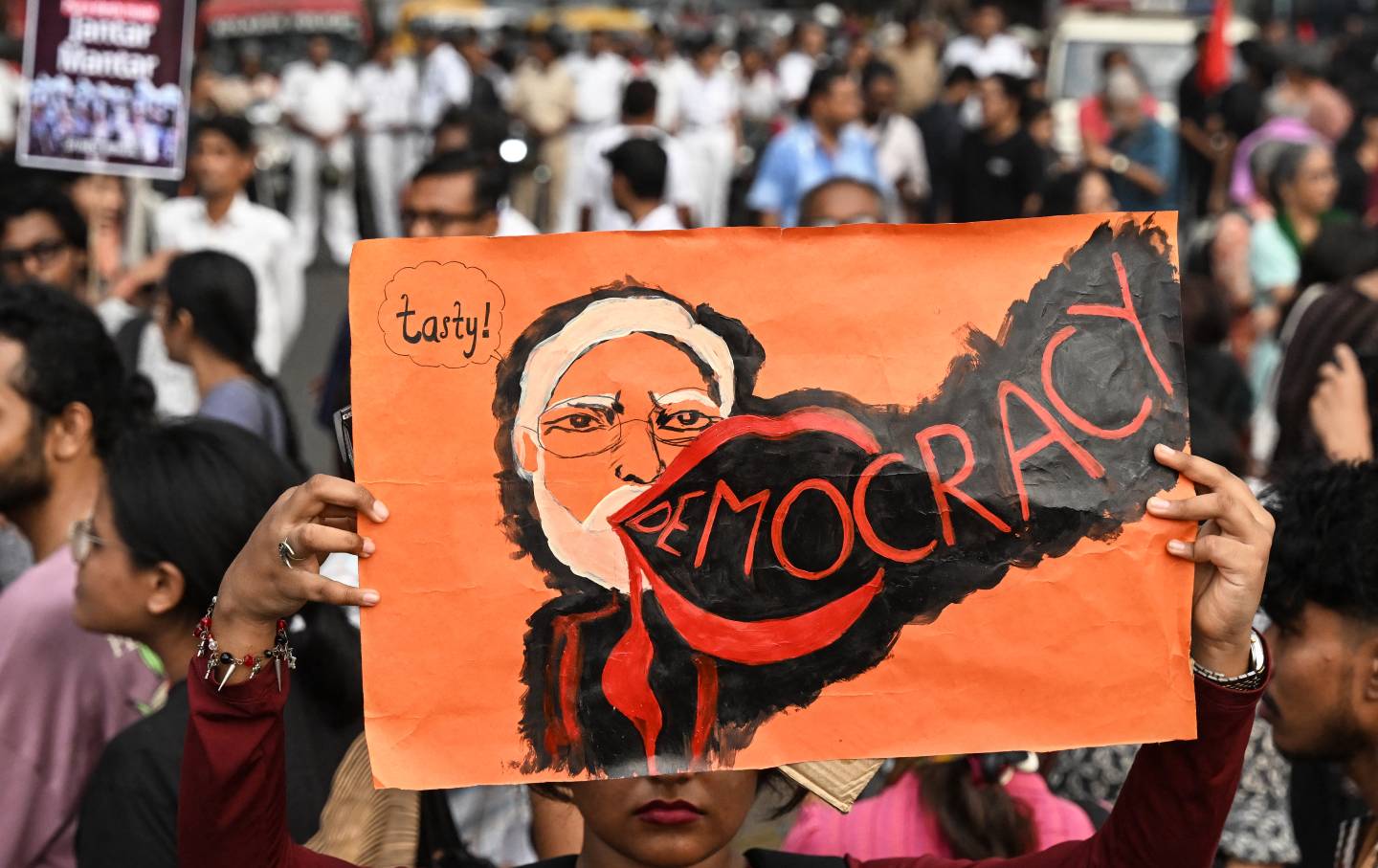
Inside India’s Gen Z Cockroach Janta Movement Inside India’s Gen Z Cockroach Janta Movement
Young Indians are challenging the purge of voter rolls by Modi’s right-wing government. Shrishti Khanna, who was detained by Delhi police while covering the protests, explains.
The Clarion Call of “NAZA” The Clarion Call of “NAZA”
Yuval Abraham and Rachel Szor’s new film not only documents the horrors of the present but give us a glimpse of a possible future too.

The Specter of Lepenism Looms Over France’s Social Crisis The Specter of Lepenism Looms Over France’s Social Crisis
Joining forces with the “yellow vests,” youth demonstrators are raising the alarm in a country falling to the far right.

Progressives Are Backing Puerto Rican Independence. It’s About Time. Progressives Are Backing Puerto Rican Independence. It’s About Time.
More and more leftists are concluding that statehood for the island is not enough.

The Saudi Phase of the Iran War Signals More Chaos to Come The Saudi Phase of the Iran War Signals More Chaos to Come
The conflict that Donald Trump has repeatedly proclaimed an unequivocal American victory keeps spiraling out of control.

