California’s Urban “Doom Loop”
The West Coast’s major cities are overrun with empty office space—all while the homeless population keeps growing.
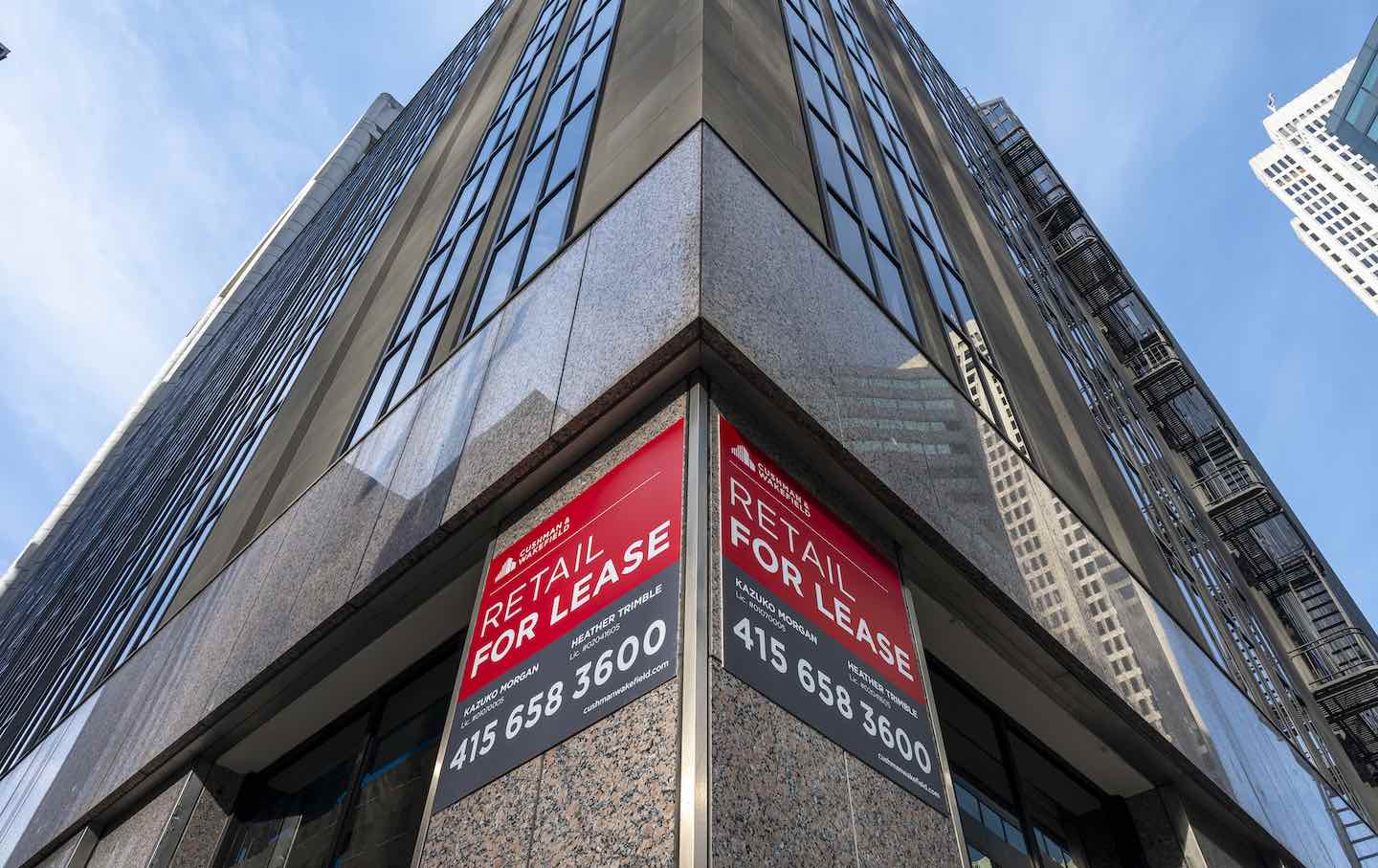
A “For Lease” sign on a building in San Francisco, Calif., on Tuesday, December 5, 2023.
(David Paul Morris / Bloomberg)A lot of attention has been paid recently to Manhattan’s soaring rates of empty office space. More than 22 percent of available office space is currently unused, which translates to the equivalent of about 40 empty skyscrapers. Construction on large office buildings has pretty much ground to a halt, and developers don’t see that changing much for the rest of the decade.
But as bad as that urban “doom loop” might be in Manhattan, it’s worse in San Francisco, where more than a third of office space is now dormant, up from 25 percent in late 2022. That translates to 30 million square feet of unused space, and means that the city is experiencing the weakest post-pandemic recovery of any major urban area in the country. Once-thriving commercial areas have been largely abandoned, with homeless encampments ranged along the base of underused office towers.
That said, this isn’t San Francisco’s problem alone. Most cities in the American West are also struggling mightily to get back on solid ground. The office vacancy rate in Portland, Ore., is above 22 percent; it’s slightly higher in Seattle, Wash. It’s considerably lower in Los Angeles, at about 15 percent, but the forecast is that over the coming three years it will also rise above 20 percent. Moreover, the LA recovery is desperately uneven; while suburban office parks are doing just fine, the downtown area is posting vacancy rates almost as high as those in Manhattan.
The implosion of the office-based work culture is happening at the same time that residential real estate markets throughout the West continue to tighten, with too few new homes being built and those that are either for sale or for rent costing a fortune for buyers and tenants alike. The apartment vacancy rate in San Francisco is 6.7 percent, and in LA it is slightly under 5 percent. The median price for a two-bedroom home in the Bay Area stands at about $1.5 million—a small decrease from the peaks of 2021, but, with interest rates hovering at around 7 percent, still vastly outside the range of affordability for average-income would-be buyers. And the average rent for a two-bedroom in the city is now close to $4,000 per month.
One would think, given this mismatch, that developers would be scrambling to convert empty office space into usable homes. In most cities, however, with Los Angeles being an honorable exception, that’s not happening. In 2022, LA developers converted empty office space into nearly 700 housing units, putting it at the top of the national charts for such conversions. No other West Coast cities made the top 10. Despite rhetorical support for the process from San Francisco Mayor London Breed, and a city-backed study that found that such conversions in the downtown area could generate over 11,000 units of housing—similar studies have been done in D.C., Chicago, New York, and other metropolises, and have resulted in city pledges to begin the transition process—the costs of conversion are huge and the regulatory process onerous.
In June, the city announced a plan to jump-start development. Yet, so far, it’s been more talk than action: The owners of only eight buildings have expressed interest in converting their properties to housing. If all of these projects moved forward, they would generate slightly over 1,000 housing units—this in a city with over 4,000 unsheltered homeless on any given night. Yet even the modest goal of 1,000 new units carved out of vacant office space is, to date, more theoretical than real, and none of the eight projects has progressed beyond the aspirational stage.
There are now more affordable housing requirements in cities such as San Francisco than there were a decade ago, and that’s a good thing. But, given the scale of California’s housing emergency, the city and the state need to put financial muscle behind these requirements, if necessary by significantly subsidizing the affordable housing developments so as to accelerate the construction process in an unfavorable, high-interest-rate, climate. Until that happens, the claims by developers that strict affordable housing mandates cut too much into their profit margins will continue to flow, and those developers will shy away from ambitious new housing projects. Left largely to the private market, desperately needed wholesale conversions of empty office spaces in cities such as San Francisco will, I fear, remain largely a pipe dream as 2024 gets underway.