
How Can Universities Fix Title IX? By Listening to Survivors.
A student group at the University of California conducted a study of Title IX services on campus. “We thought if we did a survey then they would have to listen to us.”
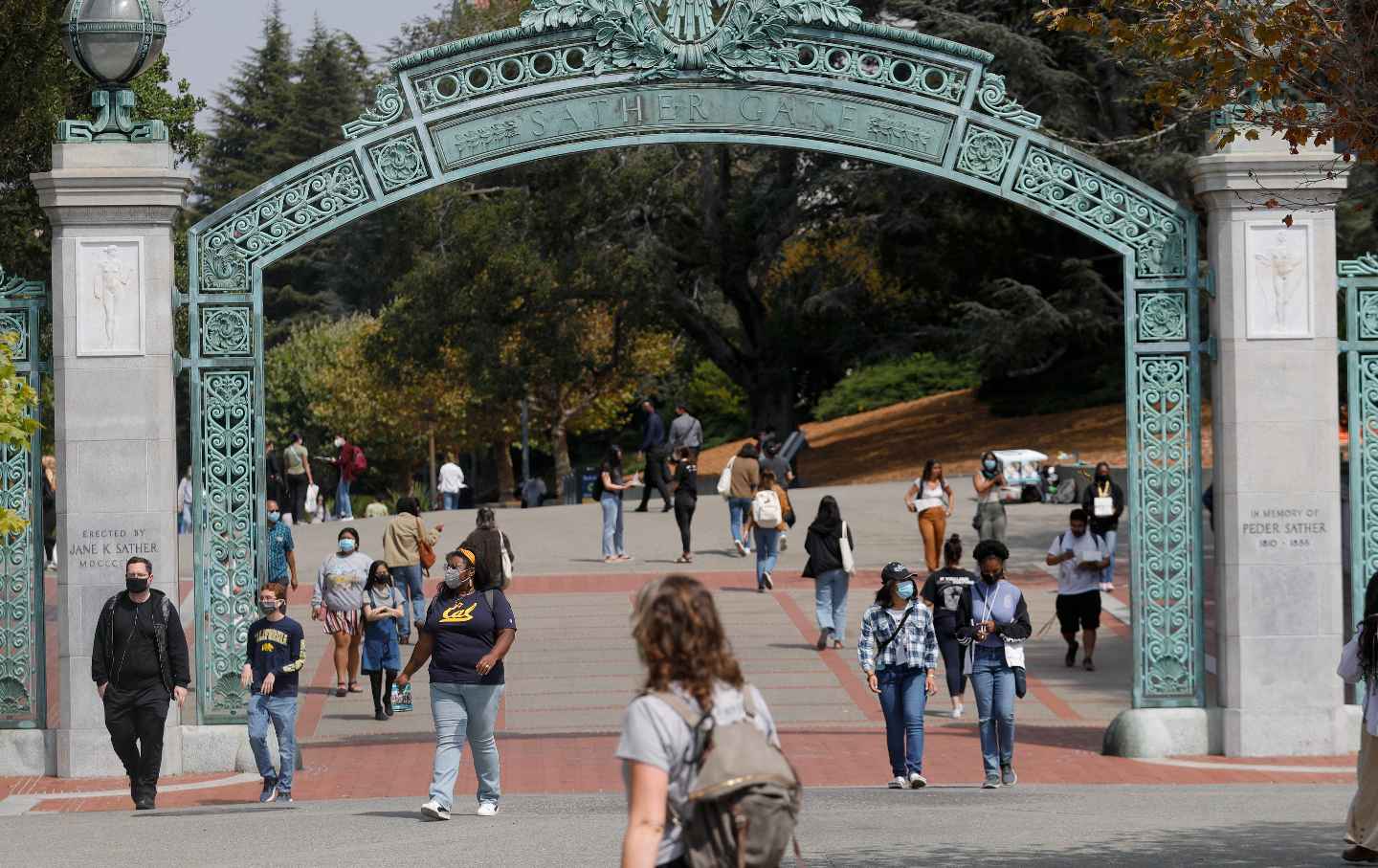
Students walk near the Sather Gate on the UC Berkeley campus.
(Jane Tyska / Getty)In November 2020, Survivors + Allies, a group of University of California students that advocates for and with survivors of sexual violence, met with the Systemwide Title IX office. The participants asked whether a feedback form could be incorporated into Title IX complaints to give students a vehicle for suggesting improvements.
The administrators dismissed the proposal, saying that a feedback form would be demoralizing for Title IX employees. “We weren’t even asking for accountability on how they use the forms. We simply were asking for the opportunity for survivors to give feedback on their experience,” said Sara Wilf, a UCLA doctoral candidate in Social Welfare and cofounder of S+A. Instead, S+A decided to conduct its own study in May 2021, receiving over 1,200 responses from all 10 UC campuses.
Despite the UC system’s touting some of the best universities in the world, many students say that it is failing its survivors of sexual violence and sexual harassment. “We thought if we did a survey, then they would have to listen to us,” said Wilf. The survey found that, overall, student awareness of confidential resources for survivors is low. Only 68 percent of students had heard of Campus Assault Resources & Education—or CARE—which is the only survivor-centered confidential resource on UC campuses, while 80 percent of survivors reported feeling safe interacting with CARE staff. The survey also highlighted sharp disparities in awareness that all students—regardless of citizenship or documentation—could utilize Title IX services. The vast majority of international and undocumented students, for example, did not know they were covered under Title IX.
In the survey, the University of California Police Department and Title IX received poor reviews from survivors, and LGBTQ+ and gender-diverse students noted that they were especially uncomfortable reporting sexual violence to campus police. Specifically, LGBTQ+ students were 40 percent less likely to report to UCPD than heterosexual students.
Although the UCs have instituted a Community Safety Plan to improve students’ relationships with campus police, the plan fails to center survivors in its training and data collection efforts and doesn’t go nearly far enough. For survivors, soliciting such feedback is crucial.
It’s unclear how CARE funding is determined and allocated across the UC campuses, and the number of advocates varies widely. While PATH to Care at UC Berkeley had 12 staff members in the 2021–22 academic year, UCLA has just one full-time CARE advocate—compared with four Title IX investigators.
Students deserve to have confidential, trauma-informed, and identity-based resources available to them. The University of California spends just $56 per student on mental health care on average, and unsurprisingly struggles to provide its students with adequate and identity-based mental health services. “The study found that more survivors go off-campus for therapy than to UC-based counseling,” read a summary from Wilf.
While Black and Latinx students reported higher rates of anxiety, depression, and trauma-related symptoms than their white counterparts, they also face higher waiting times to meet with counselors of color or identity-based counselors. A CARE advocate could be hired at each UC international center who shares identities with international students and can better understand their unique experiences, along with publishing the annual budgets for CAPS and CARE, including how budgets are allocated across the different campuses.
If the UC wants to protect its marginalized students and survivors navigating mental health challenges, it needs to hire more people of color, queer people, and first-generation immigrants, as well as those who are experts in working with victim-survivors. “When I needed to go to the counseling center for help, it was really important for me to find someone that would understand my cultural background, that I was mixed and all these different things about my identity,” said Kalani Phillips, an S+A report fellow and UC Irvine doctoral student in Public Health. “It just made it really easy to talk to someone who would already understand those things.” Currently, UC Davis is the only campus in the system that has a confidential LGBTQ+ resource center.
Over the summer, the S+A policy team met with California legislators and UC administration to present the study’s findings. S+A is also distilling the results of their study into a public-facing report and academic paper. According to Leila Chiddick, a UCLA undergraduate and research fellow at S+A, the paper is one of the first to explore students of color’s experiences with Title IX. After presenting their research at public events such as the Society for Social Work Conference and a teach-in event at UCLA, S+A received funding from the UCLA Center for the Study of Women to deepen the project.
In the upcoming school year, Wilf noted that S+A is focused on finalizing the report, which will be presented in January at a public webinar. She also added that S+A plans to conduct outreach to student survivor advocacy groups nationwide and continue to work closely with CARE. Stephanie Kathan, a UCLA doctoral candidate in social welfare and S+A research fellow lead, is grateful to be working on the fellowship, as advocating for survivors does not get enough attention. “No one else is really doing work like this,” said Emma Tolliver, a recent graduate from UC Davis and a policy fellow at S+A. “Survivors and Allies took it into their own hands to create a trauma-informed survey so they could really understand student experiences, attitudes and awareness of sexual violence sexual harassment resources.”
The survey shows how critical it is that the UC system increases funding and availability of confidential, identity-based student support services for survivors. The UC should develop system-wide requirements for pre- and post-test evaluations for Title IX staff, along with investigator training so that student organizations like S+A don’t have to conduct their own research studies evaluating campus resources.
With the UC’s prestige, it has the opportunity to influence other universities. If the University of California system is truly home to some of the best universities in the world, they must act now to provide their student survivors with the best support resources to navigate their experiences of harm.
Become a Sustaining Donor This September
Between the reemergence of right-wing red-baiting and Donald Trump’s use of the chilling National Security Presidential Memorandum–7 to criminalize left political organizing, we’re seeing McCarthyism reborn before our eyes.
This assault on democracy cannot be ignored or wished away. Resisting it requires bravery in the face of threats and repression, a steadfast commitment to the truth, and the unwavering belief that we can—and will—overcome this darkness.
We must have an independent media that sets the record straight, unearths corruption and abuses of power, and advances a politics of justice and dignity for all if we’re to win this fight.
That’s why I’m writing to you today. This September, The Nation needs to add 100 monthly donors to sustain our progressive journalism. Your contribution makes the next investigative report, the next truth-speaking column, and the next pathbreaking essay all possible.
I hope you’ll support our work with a recurring donation today. If you donate $10 or more a month, we’ll send you a brand new “Hands Off the Free Press!” sticker to recognise your commitment to our cause. Please, donate today.
Onward,
Katrina vanden Heuvel
Editor and Publisher, The Nation
More from The Nation
The Promises and Compromises of the University of California The Promises and Compromises of the University of California
I grew up in a neighborhood manufactured by the University of California, Irvine. It felt like a utopia for academics—until the university forsook its mission of serving the publi...


The First Amendment Lives for Another News Cycle—Maybe The First Amendment Lives for Another News Cycle—Maybe
In this week’s Elie v. U.S., our justice correspondent parses Trump’s attacks on CNN, MS NOW, and Politico. Plus: it’s time to impeach the judges!

Netanyahu Came to New York. New Yorkers Were Ready for Him. Netanyahu Came to New York. New Yorkers Were Ready for Him.
Scenes from the defiant protest against the genocidal leader’s UN speech.

A Message From Prairieland Prisoner Autumn Hill: “Don’t Be Afraid” A Message From Prairieland Prisoner Autumn Hill: “Don’t Be Afraid”
I talked to the political prisoner about the politics of love, her case, surviving as a trans woman in a men’s prison, and how she makes it through the day.

Susan Collins Is Corrupt. She Still Might Be Reelected. Susan Collins Is Corrupt. She Still Might Be Reelected.
Despite being embroiled in scandal, the Maine senator is benefiting from Democratic Party divisions.

