Resisting Russian Imperialism: 2 Socialists—a Ukrainian and a Russian—on Ukraine’s Struggle for Self-Determination
A Nation interview with Hanna Perekhoda and Ilya Budraitskis.
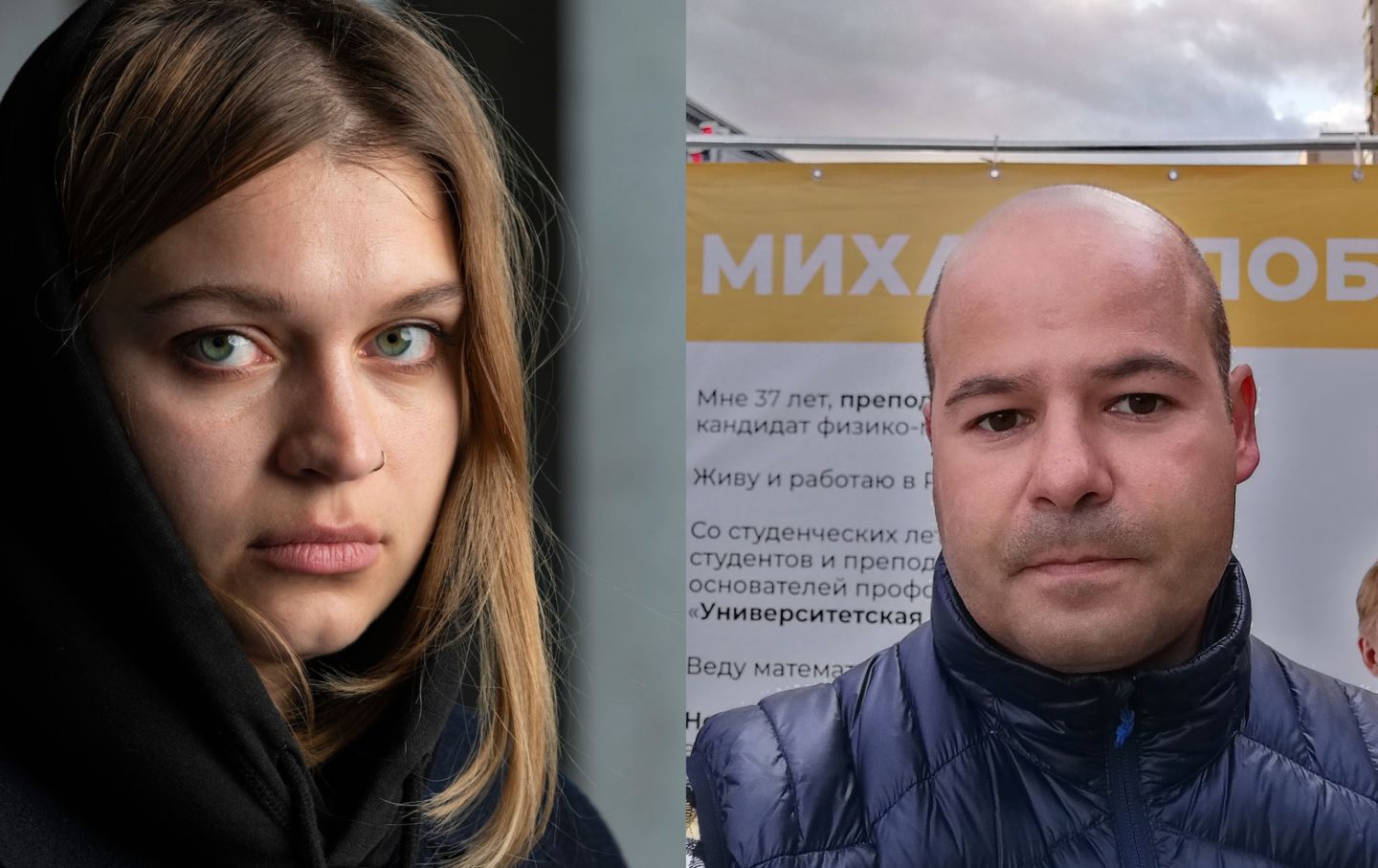
Russia’s war in Ukraine is at the heart of world politics. Ukrainian socialist Hanna Perekhoda and Russian socialist Ilya Budraitskis, who are currently on a national speaking tour in the United States sponsored by the Ukraine Solidarity Network, talk about the war, the resistance, and international solidarity.
Ashley Smith: What are conditions in Ukraine and Russia amidst this horrific war?
Hanna Perekhoda: Everything in Ukraine today is shaped by Russia’s attempt to annex our country. Russia is waging terror against the civilian population, bombing residential areas throughout the country. People are dying every day, especially in the occupied areas.
The Russian Army subjects them to murder, rape, and forced displacement. But all of Ukrainian society is engaged in resistance. Despite all the horror of this war, Ukrainians overwhelmingly support and organize for the liberation of the entire country.
Ilya Budraitskis: Since the start of the war, Putin has crushed all opposition in Russia and driven it underground and abroad. He’s been successful in creating an atmosphere of fear and obedience.
But only 20 percent of the population support the war enthusiastically, while about 20 percent oppose the war. The latter is, of course, repressed. Most of the rest of the society is passive and depoliticized, tolerating the status quo.
Nevertheless, as Prigozhin’s attempted coup proved, Putin’s regime is fragile. Any serious defeat in the war could destabilize his rule and open space for social change within Russia.
AS: What are the reasons for this war?
HP: Russia’s war was not a response to an objective military threat from NATO. It is a response to subjective threats against Putin’s regime from within Russia and regionally.
His dictatorship oversees extreme inequality. To enforce that, it suppresses any democratic tendencies at home and abroad. That puts Ukraine, which has deep connections with ordinary Russians, in Putin’s crosshairs.
He fears that if Ukraine becomes a free, democratic, and prosperous state, it will spread dangerous ideas among Russians. That’s why Ukraine’s popular revolution in 2014 was a nightmare for Putin.
In response, he sent troops to seize Crimea and Donbass to incapacitate the country. He expanded the war in 2022 to eliminate Ukraine as a democratic alternative to the Russian autocracy.
IB: I agree. For Putin’s regime to survive, he must impose full control over Russian society, including crushing all democratic forces in the post-Soviet space, especially in Ukraine.
He has repeatedly justified this in speeches about Russian empire and the multipolar order. He stresses the need for a sovereign power to rule great nations and their civilizational sphere of influence. It is a deeply reactionary worldview like that of Samuel Huntington.
This project is not unique but an example of authoritarian trends in countries around the world. That’s why the war in Ukraine is of great concern to all democratic, progressive, and leftist movements everywhere.
A victory for Putin would strengthen other reactionaries like Trump and the far right as a whole. That’s why we must support Ukraine; its liberation would be a victory for the international progressive movement.
AS: What are you and your fellow activists in Ukraine demanding?
HP: As Ukrainian socialists, we are demanding all the military, financial, and diplomatic aid we need to win. At the same time, we are organizing against our own government’s attempt to dismantle labor laws and push through neoliberal reforms.
We are also working to make sure that postwar reconstruction serves the interests of workers and oppressed peoples, not the corporations, oligarchs, and international financial institutions like the IMF and World Bank. As part of that, we are calling for the cancellation of Ukraine’s odious debt.
The needs of ordinary Ukrainians, who keep everything from hospitals to schools functioning and are fighting on the frontlines, must be at the center of reconstruction. The liberated country must meet the demands of the vast majority for justice, democracy, and equality.
AS: What can the international progressive movement do to help?
HP: We are asking for solidarity. We want you to call on your governments to impose sanctions on Russia, confiscate his oligarchs’ assets, and provide all the aid Ukraine needs to win and rebuild itself.
We want to build links between Ukraine’s unions, feminists, and leftists and progressives throughout the world including the Russian left and anti-war movement. We want this because we believe we are part of an international struggle for a better world.
As part of that solidarity, we ask progressives to feature the voices of the Ukrainian people, not Western so-called experts, many of whom know little about Ukraine and Russia.
IB: Solidarity with Ukraine is a fundamental issue for the international left. We must do everything in our power to support the Ukrainian people’s struggle for liberation.