
In 2011, then–New Hampshire Speaker of the House Bill O’Brien, a Republican from Mount Vernon, explained why he wanted to eliminate election-day registration and prevent college students from voting where they attended school. “The kids [are] coming out of the schools and basically doing what I did when I was a kid, which is voting as a liberal,” he told a Tea Party group. “That’s what kids do—they don’t have life experience, and they just vote their feelings.”
O’Brien is now the New Hampshire co-chair for Ted Cruz’s presidential campaign. He failed to block election-day registration and student voting, but New Hampshire Republicans did succeed in passing a new voter ID law—which will be fully implemented for the first time in Tuesday’s primary.
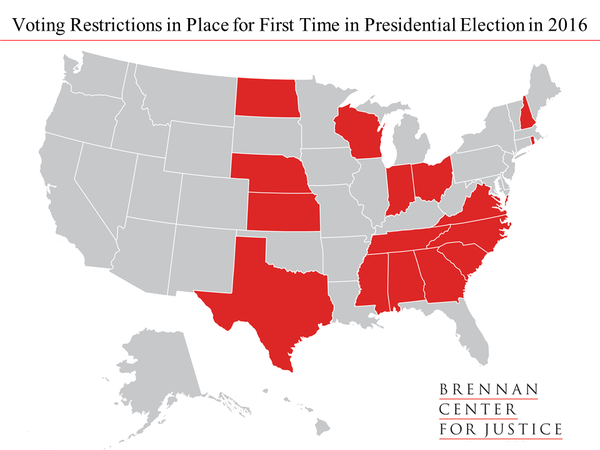
New Hampshire is one of 16 states with new voting restrictions in place for the first presidential election cycle in 2016, according to the Brennan Center for Justice, accounting for 178 electoral votes. New Hampshire voters will be asked to show government-issued ID when they cast a ballot. Those without the required ID can still cast a regular ballot by signing an affidavit, but they will have to let poll workers take their pictures, which is raising alarms among voting-rights activists.
“This is meant to intimidate people, there’s no question about that,” says Joan Flood Ashwell of the New Hampshire League of Women Voters. “It’s saying to voters, ‘We suspect you of being a criminal.’”
“It may seem to some like a mug shot,” says Devon Chaffee of the New Hampshire Civil Liberties Union.
It could also lead to longer lines at the polls. Wait times increased by 50 percent when the voter-ID law was partially implemented, without the camera requirement, during the 2012 election, the fifth-largest increase nationwide according to the Pew Research Center. “Reports to voter protection hotlines and reports in newspapers after the election showed that at least 29 cities and towns experienced serious problems with lines,” found the New Hampshire League of Women Voters.
In May 2015, 150 election officials from every county in the state called for the camera mandate to be repealed. They wrote:
The NH polling place camera mandate is unprecedented, and we remain concerned it will create confusion among poll workers and voters leading up to Election Day, as well as create election administration problems during and after Election Day.
Towns and cities are already underfunded and our election administration budgets are already at an all-time low. Most towns will have to hire people to handle cameras while election workers and volunteers are busy with other Election Day duties. This bill will exacerbate our local budget shortfalls
No other state in the country has attempted to take photos of lawful voters at the polls. We consider this legislation unfounded, unnecessary, and untested.
The photos taken by poll workers will be affixed to the affidavits, but will not be stored electronically for future purposes, and it’s not clear how they’ll be used or why they’re necessary. During the 2012 election, 5,609 people signed affidavits at the polls in order to vote.
New Hampshire Republicans like O’Brien say the voter-ID law is necessary to prevent voter fraud, but there have been only six cases of fraud from 2000 to April 2015, according to the League of Women Voters, and only one case of voter impersonation. Ironically, it was committed by the son of a Republican state legislator in 2004 and caught well before the passage of the voter-ID law. (In another irony, O’Brien’s son confessed to having been registered to vote in New Hampshire when he ran for office in Maine in 2010.)
State Republicans pushed for voter ID after regaining a majority in the New Hampshire House in 2010, following Democratic control of the chamber for the first time since 1911. Although the state remains overwhelmingly white and historically Republican, the demographics are changing to benefit Democrats. “More than 30 percent of potential voters this year were either not old enough to vote in 2008, or resided somewhere other than New Hampshire,” according to the University of New Hampshire’s Carsey School of Public Policy. “The Democratic primary voter base has grown significantly, but the Republican primary base has not.”
That explains why New Hampshire Republicans are making it harder to vote.

