
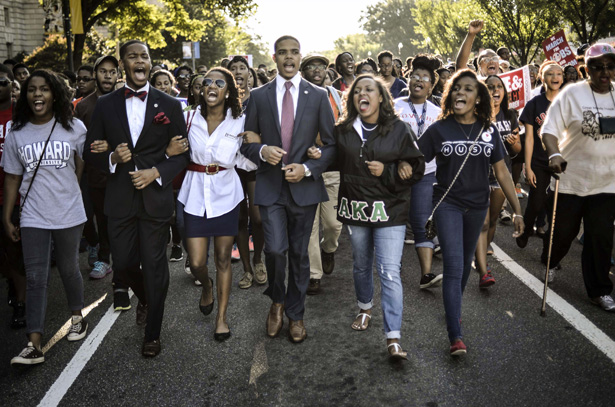
Students of Howard University march from campus to the Lincoln Memorial to participate in the Realize the Dream Rally for the fiftieth anniversary of the March in Washington, August 24, 2013 Reuters/James Lawler Duggan
There were marquee names like Eric Holder and great speeches by civil rights icons like Congressman John Lewis at the Lincoln Memorial. But the most important people at the rally and march commemorating the fiftieth anniversary of the March on Washington spoke earlier in the day, with little fanfare, when many had yet to arrive.
They included the likes of Rev. William Barber, president of the North Carolina NAACP and leader of the state’s Moral Monday movement, and Philip Agnew, executive director of the Dream Defenders. These two groups, in particular, represent the new face of a twenty-first-century civil rights movement, one that is desperately needed to fight new battles in defense of issues like voting rights and racial justice. Barber represents the latest iteration of the Martin Luther King–inspired prophetic tradition; Agnew embodies the new activism of the hip-hop generation. (The Advancement Project, one of the most innovative civil rights organizations, has provided indispensable support to both groups.)
“We are the forgotten generation,” said Agnew, 28, early in the morning at the Lincoln Memorial, wearing the group’s trademark “Power” cap. “We are the illegals. We are the apathetic. We are the thugs. We are the generation that you locked in the basement while movement conversations were going on upstairs.”
Following the acquittal of George Zimmerman in the killing of Trayvon Martin on July 13, Agnew and other young Floridians held an impromptu sit-in at the Florida capital to protest the state’s Stand Your Ground law. It lasted thirty-one days and captured national attention, with visits from civil rights veterans like Jesse Jackson, Julian Bond and Harry Belafonte. Now the Dream Defenders have launched a new campaign to register 61,500 voters—the margin of victory for Florida Governor Rick Scott in 2010.
Popular
"swipe left below to view more authors"Swipe →
Fifty-five Dream Defenders took a twenty-five-hour bus ride from Miami to attend the March on Washington anniversary. “This march is important to draw the bridge from young people to generations before us,” Agnew told me. “I do see a resurgence of civil rights activism and a willingness to engage in nonviolent conflict.” Added Steven Pargett, the group’s communications director, “This is a very exciting time for young people to come together.”
In North Carolina, Barber’s Moral Monday coalition has sparked a multiracial, multi-issue political movement unseen since the 1960s, when the state became the birthplace of the Student Nonviolent Coordinating Committee and the Greensboro lunch counter sit-ins. Moral Monday activists have led the fight against the slew of radical policies passed by the state’s GOP legislature this year, including the country’s worst voter suppression law. “The greed, the meanness and the extremism of the far right has created a space for us to come together,” Barber told me. “This evil is producing a good.” For example, as a result of the GOP’s outrageous attacks on student voting, “we’re going to be able to organize these college campuses like never before,” Barber says.
Barber’s friend, Bob Zellner, a former field secretary of SNCC, attended the 1963 March on Washington when he was 24. “The most important thing about today is that grassroots organizing still works and that millions of people around the country are interested in it,” he told me. He called the march “an example of the new upsurge in the civil rights movement.” But Zellner was also upset that Barber was only invited to give a prayer early in the morning, rather than speak later in the day when more were paying attention.
In his “I Have a Dream” speech, King called on civil rights activists to “go back to Mississippi, go back to Alabama, go back to South Carolina, go back to Georgia, go back to Louisiana, go back to the slums and ghettos of our northern cities, knowing that somehow this situation can and will be changed.” Barber says those concerned about civil rights must now do the same, at a time when state fights in places like North Carolina have once again become national battles. “We have to have state strategies to change the nation,” Barber says.
Also at the March was Dave Zirin, who asks, what would Dr. King, Ella Baker, Fannie Lou Hamer or Malcolm X think about the 50th anniversary celebration?

