
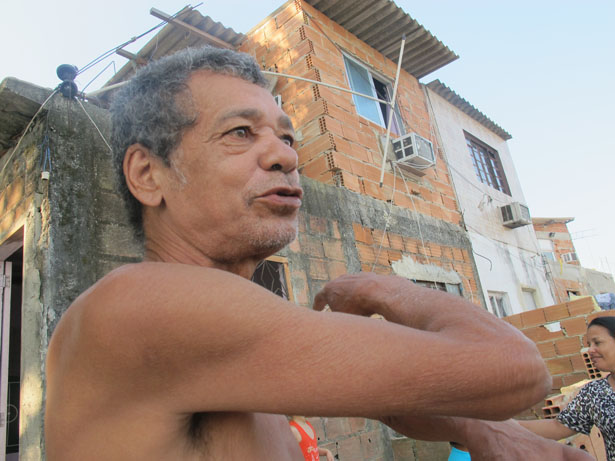
Vila Autodromo resident Armando shows us his house, which the city government of Rio de Janeiro wants to demolish for a 2016 Olympic site.
You can’t understand what the 2016 Olympics are going to do to Rio de Janeiro, unless you understand what went into building Armando’s house. Armando is a diesel mechanic who lives in a community known as Vila Autodromo, so named because it sits right outside the city’s famed Formula 1 racetrack. Armando built his home from scratch over the course of fifteen years. Now it’s two stories high with plumbing, electricity, and his own sweat and handiwork in every square inch. The fixtures, the tile, even the wire to a lamp stretched tightly so it hangs behind a framed picture of his son and gorgeous twin grandchildren, bear the marks of toil and love.
His home has also been targeted for demolition by the city government of Rio for the good of the next Summer Olympic games.
As his six toddler grandchildren played underfoot, Armando expressed his frustration:
“We are fighting for our right to survive here. Our right to live. Do you know how many years I’ve worked my butt off to build this house? I did it for my kids and for my grand kids so we would have a place to live and be a family, so days like today we could all have space to be together.”
Armando’s situation isn’t unique. The 3,000 people of Vila Autodromo are all facing forced eviction.
Vila Autodromo is a target for several reasons. First and foremost, it’s a favela. “Favela” is commonly translated as “slum”, although that really doesn’t do places like Vila Autodromo justice.
All favelas share a common history as squatter settlements that were developed autonomously by Brazil’s working poor and unemployed—with minimal government support. Today, many of them are quite large—sometimes 100,000 people or more—and contain within them a wide range of income levels and employment statuses, as well as churches, schools and small businesses. Many, if not most, favela houses are solidly built with materials not commonly associated with slums, and usually have electricity, running water, as well as Internet access.
The Olympic preparations have put these “slums” in the cross hairs of city officials, President Dilma Rouseff and the International Olympic Committee. But to enter a favela like Vila Autodromo is to see a place that could teach the powers that be something about civilization. I don’t want to romanticize the poverty and very real day-to-day struggles to survive many in Vila Autodromo face. But I saw a community where people keep their doors open and children play joyously with each other in the streets. It’s a place where people like Armando’s build and develop their homes over decades to fit their changing families.
It’s a peaceful, beautiful community, and herein lies another obstacle to Armando’s keeping his house. It’s too beautiful. The land on one side of Vila Autodromo faces the F1 track, but the other side rests right on a large picturesque lagoon—Lagoa de Jacarepaguá—that looks like it was plucked from a postcard. That means the developers and real estate speculators, according to many residents, drive through salivating at the thought of taking it over. The Olympics provide the pretext. Across the lagoon stand luxury condominiums.
The neighborhood ringing the lagoon as well as Vila Autodromo is Barra da Tijuca, one of the fastest-growing middle- and upper-income parts of the city. Think parts of Northern Virginia: strip malls and a car culture so intense you need to drive to get from one side of the street to the other. Theresa Williamson, founder of the nonprofit Catalytic Communities that aims to raise the visibility of the favelas, said to me, “People on the other side of the lagoon see Vila Autodromo and they see an eyesore. But people here as well as sympathizers look at the pollution, development, the high rises, and see the same.”
The plans for Vila Autodromo are always shifting. On one master plan, it will become a parking lot. On another, a bizarrely serpentine superhighway. The shape-shifting goals obscure the real objective: take over Vila Autodromo.
Jane Nascimiento, who is a director of the neighborhood’s association, said to me:
“You can’t have an Olympic legacy that hurts the very people who built the city. To them this is like covering trash with a red carpet. They want to walk all over the carpet and not look at what is underneath.”
If they look underneath, they’ll see something worth preserving. It’s not too late. We’re going to save Armando’s home. I asked him if there was anything anyone could do to help and he said, “Just let people know that we’re here…and we don’t want to leave.”
For more on the impact of Olympic construction in Rio, see Zirin’s report on the hundred-year-old Indigenous Cultural Center that will be demolished for Maracanã Stadium parking.

