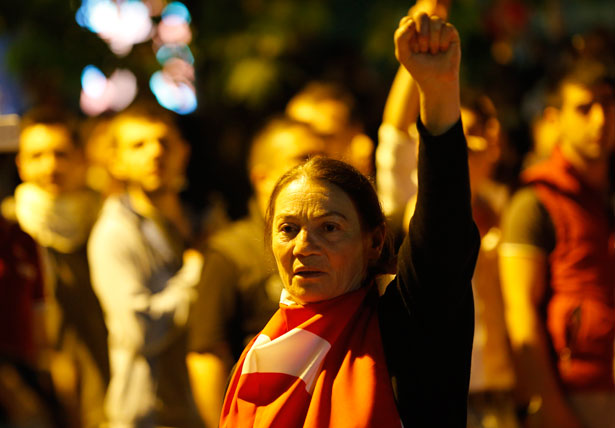
An anti-government protester raises her fist during a demonstration in central Ankara June 3, 2013. Reuters/Umit Bektas
There ought to be a word for the kind of irony that attends a culture convulsing over the massacre on the latest episode of Game of Thrones just as a blossom of real-life political dissent is appearing in Turkey, don’t you think? (Which isn’t even to mention that yesterday and today are the twenty-fourth anniversary of the Tiananmen Square massacre.) One doesn’t want to scold people for paying attention to pop culture—as a person who writes about it, I would be a giant hypocrite if I did. But the way these two things have met in time at the very least raises the question: Why don’t we care, in quite the same way? I somehow doubt it’s because Americans haven’t the heart for real political conflict. Nor do I think the whole explanation is that Americans feel powerless. It’s not like any of us could have stepped in front of the sword that ran through Robb’s gullet on Sunday night.
Rather, I suspect it’s mostly the power of narrative that’s missing here. The truth is that most people have no idea what the story of Turkey is, and only the vaguest sense of Erdogan’s failings. This seems to go for the leftist friends we all have posting links to Occupy Gezi on Facebook; they see the word Occupy and know they support it, but called upon to articulate the precise problem, they refer to the link. By contrast, the ten or twelve episodes a year of Game of Thrones make Robb and Catelyn Stark practically our next-door neighbors. They get the advantage of names and faces and histories. It’s more affecting than the aerial shorts we get of crowds of protesters, who lack much impact other than their large, anonymous character.
Narrative reporting on foreign affairs—i.e., the kind of long-form piece that identifies characters and histories in the crowd—is awful slim in the US at the best of times. Instead we have the citizen journalism of Twitter and Facebook, which has its advantages in volume, and in the slightly more democratic makeup of the people who are bringing the news to us. But what it seems to lack is anyone drawing it together in a coherent whole, making it clear what all the human costs are.
Perhaps it’s never possible to do this at the same time that the “revolution” is ongoing. Elif Batuman, at The New Yorker, points out that even within Turkey itself, the television is ignoring the matter. And yet: In Tiananmen, we had that iconic photo of the man in front of the tank to do it. It said: watch and learn. At the moment, I’d be happy if I could better accomplish the “watch” part.
Fuck the high road, Jessica Valenti writes. Sometimes, you’ve got to feed the trolls.

