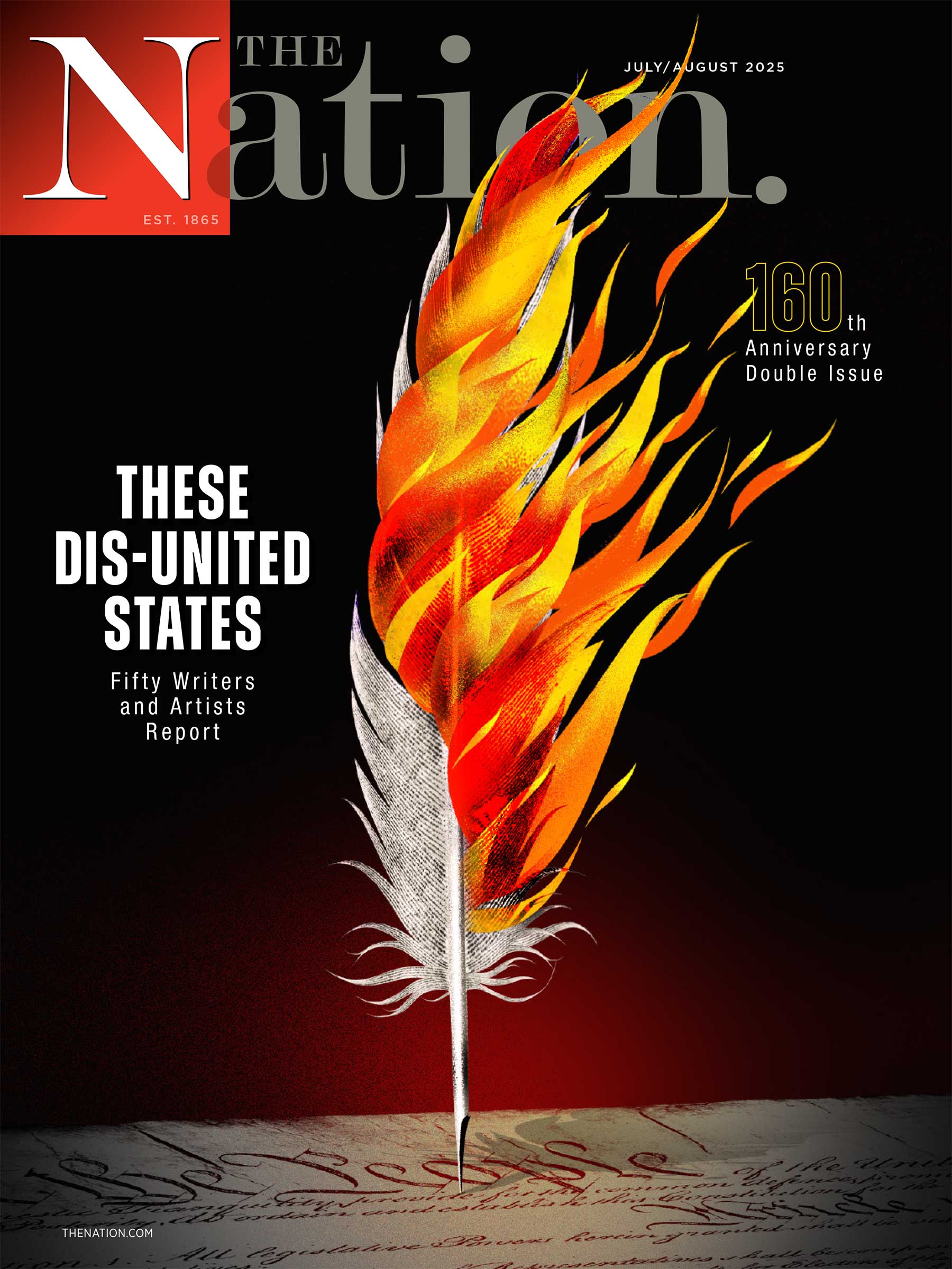
Ahmed Rashid, Praful Bidwai, Graham Usher and Ana Uzelac report from around the world; Chalmers Johnson explains the history of Blowback; Ellen Willis balks at the idea that September 11, for all its horror, may have leveled a salutary blow to our purported national complacency; and John Nichols surveys the peace movement.
How the right is using trade law to overturn American democracy.
It is unfortunate that with such serious issues to attend to, Christopher Hitchens insists on wasting time on irrelevant and fanciful diatribes against assorted enemies, the latest being his "Rejo
Several individuals have attributed to me certain statements on the issue of the situation known as the "Pacifica Crisis." As I am quite capable of speaking for myself without easy-chai
Moving to exploit a shifting political landscape in the aftermath of the September 11 terrorist attacks on the World Trade Center and the Pentagon, President Bush's Congressional point man on free
Another Pearl Harbor! That was the reaction of many after hijackers
managed to turn airliners into low-tech cruise missiles and kill 6,000 people.
I have been asked to respond to recent Nation articles by Christopher Hitchens (website, September 24; magazine, Oct.
With downtown Manhattan below 14th Street initially closed off to the public after the terrorist attacks of September 11, people began to gather spontaneously in Union Square Park, the largest pub
US actions abroad have repeatedly led to unintended, indefensible consequences.
The events of September 11, viewed from abroad.
To imagine that this national emergency is good for us is a dangerous mistake.
We regret that space considerations permit us to print only a few of the many letters we received on Martin Duberman's "A Fellow Traveling," his review of Ronald Radosh's Commies, and Victor Navasky's "Cold War Ghosts," an essay on the new McCarthyism, both in the July 16 issue. Among those we're unable to print (but which may be read on our website) are letters from victims of McCarthyism, letters on the merits (demerits, actually) of the Hiss and Rosenberg convictions, scholarly letters filling in missing pieces of cold war history (including one from a Navy veteran who served in the Office of Strategic Services) and a letter finding a "cold war ghost" in the actions of "those who rule the National Pacifica Radio Board." Radosh invites readers to his website to read his answer to Duberman's review. We accept, and we invite readers to our special website letters page to read more on this topic. --The Editors
Brookeville, Md.
I would like to thank Martin Duberman for trying to be evenhanded and fair in his discussion of my memoir, Commies: A Journey Through the Old Left, the New Left and the Leftover Left. I suspect that many Nation readers will be angry that he did not deliver the hatchet job expected by so many of them. Nevertheless, I have many points of difference with both him and Victor Navasky, whose piece appeared in the same issue. Rather than take up the limited space allotted in the letters column, which would not allow for a substantive answer, I refer interested readers to my archive at frontpagemag.com, where they will find my answers to both Duberman and Navasky.
RONALD RADOSH
Albuquerque
I thank Victor Navasky and Martin Duberman for their sane and cogent analyses of the new anti-Communism. As a veteran of union organizing during the Great Depression and of military service in World War II, I long ago concluded that Communism and anti-Communism are equally absurd. They are absurd in being essentially theological, in the outdated mode of the Crusades or of Cromwell's Puritanism. Both Communism and anti-Communism derive tests of faith syllogistically from shaky first principles. Thereupon their opposing heresy-hunters are off and running. Heretics are judged to violate vague notions called loyalty and security. Our nation's Founding Fathers omitted these notions and defined treason narrowly and precisely. Later the notion of loyalty tests died with rejection of the Alien and Sedition Acts; died again with revulsion against the Palmer Raids; and died a third time with the deserved unpopularity of Joe McCarthy. (Espionage is another matter. Insofar as there really are national secrets, they must be protected, but only with strict observance of due process.) I began to recognize Stalin's paranoia and cruelty with Trotsky's murder and the "treason" trials. Nevertheless, I must raise a query about Sidney Hook's dictum that "the first priority" of our time has been "the defense and survival of the West." Did not the Red Army, despite Stalin's crimes, help to meet that priority?
JOHN M. PICKERING
Emeryville, Calif.
Martin Duberman and Victor Navasky leave out one important point. During the cold war many anti-Communist liberals and leftists, with some very few honorable exceptions, spent more time inveighing against "domestic totalitarianism" on the left than they did agitating for peace and social justice. For all of their well-meaning ideals, those anti-Communist liberals did no more to advance progressive causes than did the right-wingers who were using anti-Communism to impede those causes.Meanwhile, rank-and-file Communists, as well as other leftists, without regard to who did or did not do what and with which and to whom, were among the most dedicated, passionate and successful people working for peace and social justice. And they and their political descendants remain so today.
ELIOT KENIN
Chevy Chase, Md.
The Soviet Union is no more, nor, effectively, is the CPUSA; yet the indefatigable experts on the Red Menace keep clambering over old battlefields and, with the help of such imperfect tools as the Venona Project, constructing new ones.
Victor Navasky and Martin Duberman adumbrate admirably the pathological nature of this quest, the dishonest methods employed by its practitioners, the absurdity of regarding Communism solely as a security threat and the American CP as just a tool of Soviet foreign policy. But both writers are guilty of some serious inaccuracies. Thus, while Irving Howe objected to Ronald Radosh's portrayal of the Sandinista regime as composed of "ultrarevolutionary Marxist-Leninists," it is absurd to suggest, as Duberman does, that Howe would warn Radosh not to criticize the Sandinista regime while they were "under attack by the American empire." I happen to know something about it, as I was close to Howe and wrote a few pieces for Dissent after visiting Nicaragua and interviewing some of its leading players.
In general, terms like "Marxist-Leninist" and "Stalinist" are often used incautiously vis-à-vis Central American revolutionary parties. There were certainly Marxist-Leninists among the Sandinistas, but the Sandinistas were a motley lot, and "anti-imperialism" or "anti-Yankeeism"was more relevant to their collective ideological makeup than the verities of Marx and Lenin: It could hardly be otherwise. Nor is it true that the Sandinistas simply followed the "Castro model." Rather, they tried to combine it with those of Eastern Europe's "people's democracies" and, curiously, with more authentic stress on democratic principles. Even the Polish elections of 1989, which brought Solidarity to power, stipulated that 65 percent of all seats in the new Parliament would be held by Communists and their allies.
As for the American CP, however small the number of members Moscow tried to recruit--successfully or not--few of them were starry-eyed idealists fighting for social justice, organizing unions (as long as they could control them) and joining Pete Seeger in singing "We Shall Not Be Moved." Almost all desperately believed that the Russian CP was always right and that frequent changes in the party line were explainable by the Russian comrades' superior wisdom. (Doubts and hesitations would be suppressed--though luckily not altogether banished.)
Hence the outrageous justifications of Stalin's heinous crimes, hence the inquisitorial means used against suddenly out-of-favor figures, and the groveling mea culpas by those who had, poor souls, defended the new enemies when they were still revered leaders.
During my many years as a Sovietologist, I got to know not a few ex-Communists, some of whom (Joe Starobin, for instance) became good friends. It was precisely their original commitment to a noble cause that made many realize that they had been serving false gods. Still, for a long time they had belonged to a party that was, in the words of French CP head Maurice Thorez, "unlike any other political party," a description that fits the American CP as well as the French. Exposing one set of simplifications is no reason for espousing another.
ABE BRUMBERG
Washington Township, N.J.
Victor Navasky's "Cold War Ghosts" was as cogent and historically focused as anything I have read on this topic in a very long while. The old left, social idealists like me whose beliefs were contoured by the Depression and World War II, made mistakes, but we were never ideological "shills," as a Nation essayist recently called us. We believed in fundamental human rights for all Americans and, yes, in peace, and we put our youthful energies and our hearts into trying to move our country toward those goals. Espionage was never part of it. We bore harsh criticism for our efforts and some of us suffered severe punishment. It was not that we were wrong but that we underestimated the enormous power of the right wing, which distorted and misrepresented who we were to the American people. By raising the specter of espionage, they were able to successfully market their own antihumanist agenda and have been doing it ever since.
Misjudging the right was a mistake as destructive as the misplaced trust we put in our own demagogues, but at least our efforts were honest. That is not true, I believe, of most of this era's facile-tongued critics with their skewed hindsight, dishonest representations and scrambled historiography.
MIRIAM MOSKOWITZ
Philadelphia
Victor Navasky is right that historians obsessed with Communist Party espionage have been unable to offer a convincing answer to the question, What was the essence of the Communist Party USA? The Comintern, Profintern (Red International of Labor Unions) and CPUSA archives in Moscow are vast, and are perhaps even more riddled with difficult problems of evidence and verification than most historical archives. It still seems to me, as someone who has done extensive research in those archives, that to focus selectively on some documents implicating certain CP leaders in espionage seems wildly misdirected and disproportionate. Even at the level of leadership cadre, the emphasis on espionage does not hold up very well. After all, even CP leader William Z. Foster (whom Harvey Klehr himself identified in his book Communist Cadre as the single most influential leader in the party throughout its history because of his degree of involvement with its everyday governance) has not been identified as connected with the espionage apparatus, nor has he been implicated in the Venona dispatches. Significantly, Foster, despite his shortcomings as a party spokesman, was primarily involved in labor organizing, the party's self-declared most important mission. Productive research into the party's goals and mission must begin by rejecting the functionalist and unilluminating "spies or dupes" dichotomies of the McCarthy era.
ED JOHANNINGSMEIER
Pine Plains, N.Y.
The Haunted Wood was formed under conditions that should be known: The co-authors are not really co-authors. There was the researcher, Alexander Vassiliev, who spent two years in the KGB archives gathering the material, and the editor, Allen Weinstein, who put the book together. Vassiliev had virtually no say on what went into the book. It wasn't supposed to be that way. Vassiliev, an ex-KGB colonel, seems to have been overwhelmed by Weinstein's reputation, his rhetoric and by the prospect that Weinstein kept dangling in front of him of making big bucks from the book. Also, he was in England, and Weinstein was in the United States, dealing with editors and publishers.
The uneven collaboration unfortunately weakens the book in more ways than one. The heavy anti-Hiss slant is pure Weinstein; the substitution of Hiss's name wherever Vassiliev wrote "Ales" was not Vassiliev's idea. Victor Navasky (and everyone else) should know that Vassiliev told me that in the KGB files "I never I saw a document where Hiss would be called Ales or Ales may be called Hiss. I made a point of that to Allen. It might be important for you." Ah, yes. Just slightly.
Left out of the final copy is the list of code names that Vassiliev found in the archives. It is, according to Vassiliev, a list of names and code names of US sources and Soviet operatives who worked in the United States. Besides names that have been noted in various other books, such as Silvermaster, Bentley and Golos, the following appear: Alger Hiss, given the code name Leonard, noted as a former official of the State Department; Harry Dexter White, "Lawyer," noted as dead; Whittaker Chambers, code-named Karl. A measure of the limits of Vassiliev's understanding of US political history (and this underscores how Weinstein took control of the book) is that, according to Vassiliev, this list "was composed in connection with Bentley's defection," and of course Bentley defected in 1945, Hiss resigned from the State Department in 1947 and White died in 1948.
Also on the list, according to Vassiliev, is Noel Field, code-named Ernst, an idealist of whom much has been written, most of it wrong. Field was an authority on disarmament, an idealistic "Quaker communist" who, offered the German desk at the State Department in 1936, turned it down to work for the League of Nations in Geneva (not exactly the smartest thing to do if you are a Russian spy). By the late 1940s Field was in Europe working for world peace and by 1949 had been picked up by the Russians and thrown into a Budapest prison, accused of being an American spy.
But back to The Haunted Wood. Accompanying a photo there's a caption that reads, "Three high-ranking Soviet agents in policy-making position in the wartime Roosevelt Administration--Laughlin Currie, Alger Hiss and Harry Dexter White--all provided Moscow with crucial documents...." Vassiliev says he never saw a document, or reference to a document, supplied by Hiss in the files.
SUSAN BUTLER
Nantucket, Mass.
Am I the only one who thinks that "Ales" might be almost anyone except Alger Hiss? Without any special knowledge of the field, it seems unlikely that any competent espionage organization would assign a code name so easy to decipher. (Not to mention Alger's willingness to identify himself this way.) Have the readers of the Venona files found other cases of similarly transparent anagrams? If not, maybe they should wonder why an exception was made in this one case, or if in fact "Ales" continues successfully to conceal the true identity of the real spy: Bill Buckley, perhaps, or Fala.
ROBERT M. FLANAGAN
Edinburg, Tex.
I make no claim to be either a historian or an intellectual. But after reading Victor Navasky's "Cold War Ghosts," I wondered, Why would Hiss's name be mentioned at all in the Venona communications if he were innocent? To excuse that use of his name by saying the spies were not supposed to use real names is begging the question.
THOMAS BRYAN WARREN
Birmingham, Mich.
Another "cold war ghost" occurred to me while reading Victor Navasky's article: To this day, civilian federal government agencies spend millions each year on security clearances that invade the privacy of career federal employees who have absolutely no access whatsoever to national security information. These costly and intrusive investigations are based on an Eisenhower executive order that created a cottage industry for the FBI and the OPM, who conduct the background checks.
RALPH DEEDS
NAVASKY REPLIES
New York City
Thanks to all who sent their thanks. Here I'll only say to Thomas Warren that my point was not that "spies were not supposed to use real names" but rather that under the informal rules of Venona, real spies were never referred to by their real names, only their code names. Thus the cryptic Venona reference to "Hiss" by his real name gives rise to the inference--to be weighed along with other evidence pro and con--that he was not a spy.
And to Abe Brumberg, whom I admire, I'll say only that while I may indeed be guilty of "serious inaccuracies," I can't find them in his letter. I didn't suggest that hard-core Stalinists and Moscow-recruited spies sang along with Pete Seeger (although they may well have), but rather that 99.9 percent of the CPUSA were not spies, and many of them did row the boat ashore (Hallelujah!) with Peter. I don't doubt that some of them were apologists for the party line.
Victor Navasky
DUBERMAN REPLIES
New York City
To John M. Pickering: In insisting that "Communism and anti-Communism are equally absurd," you're equating Communism with Stalinism and ignoring communism with a small c. Those who did and do believe in lower-case communism are part of a complex lineage--an intertwined, shifting mix of Fourierist, anarchist, Marxist and socialist traditions--whose first principles, far from being "shaky," as you blithely state, are solidly rooted in the belief that (to employ one common formulation) the "highest social priority should go to the needs of the least fortunate." Nothing theological about that: It's about the distribution of opportunity and wealth right here on earth.
To Abe Brumberg: I knew Irving Howe only slightly, but through the years I read (and agreed with) his extended, sophisticated critique of Stalinism--which makes me suspect that you're right in saying it would have been out of character for him to warn Ronald Radosh (as Radosh claims) against attacking the Sandinista regime while it was "under attack by the American empire"; but I can't prove it one way or the other.I also accept your corrective that the Sandinistas combined a "Castro model" with that of the Eastern European "people's democracies," though I'd still question how much "democracy" that represented.
We agree that only a small number of those who joined the American CP became spies for Moscow, but I don't share your certainty that among them only a "few...were starry-eyed idealists fighting for social justice." How can you know that for sure? Where is the evidence to back your claim that "almost all...believed that the Russian CP was always right"? I doubt we'll ever have the documentation needed to prove or disprove such statements, given how many CP members are dead and how inordinately difficult it is to measure and quantify human motivation. In saying this, I acknowledge that my own opinion is also impressionistic--based, that is, on a selective list of readings and interviews that I could never prove are "representative."
And finally, to Ron Radosh: Yes, I've caught some hell from fellow leftists for being "too soft" on you in my review. That didn't bother me overly much until I went, as you directed, to your far lengthier response online. It contains so many startling misstatements about what I believe that I have to wonder, after all, whether I didn't give you too much credit for veracity. I never thought I'd have to set this particular record straight, but here goes: I've never believed, let alone "still" believe, that the Soviet Union was on the "right side of history." Nor do I believe, as you suggest, that "only apologists for Stalinism are true black people." Really, Radosh, that is a bit much!--even for someone who can claim that the Somoza dictatorship in Nicaragua "was comparatively moderate and merely authoritarian" when compared with the Sandinistas! To prepare me for your kind of "history," I'd better start reading more novels.
MARTIN DUBERMAN
At a time when the economy needs vast and purposeful help from the federal government, America faces a peculiar handicap: Neither political party really believes in liberal economic intervention or knows how to do it. Democrats are still not over their infatuation with Hooverite fiscal austerity--embracing budget surpluses, bemoaning deficit spending. Other than serving their wealthy friends, Republicans work at dismantling government's ability to steer and stimulate the private economy. Both parties are enthralled by the most conservative advisers, Federal Reserve Chairman Alan Greenspan and former Treasury Secretary Robert Rubin (now at Citigroup), who counsel caution. Democratic Senate majority leader Tom Daschle expressed doubts about any stimulus program, fearful that next year's budget might go into deficit.
This reluctance to act boldly will have to change very quickly. The economy was already in contraction before September 11. It needs hundreds of billions in new federal spending--yes, deficit spending--to counteract the great shrinkage under way in consumption and business investment. No one knows the severity of what's unfolding, but false optimism will make things much worse. Acting too fast and spending too much have economic risks, but none compare to what can unfold if Washington is too timid.
Back to basics. As John Maynard Keynes and American originals like Marriner Eccles, FDR's Fed chairman, taught, when the economic engine starts to seize up, government is the only force capable of jump-starting it--pulling idle capital into real investment while bolstering the incomes and confidence households need to buy things. It does this by borrowing the money from private sources--running large federal deficits financed by Treasury bonds--and spending the money in ways that generate waves of collateral economic activity. Deficit spending is not an unfortunate side effect. It is the necessary cure. America is especially vulnerable now to a deepening contraction because Washington is flush while companies as well as households, particularly those in the bottom half, are mired in debt. An aggressive government stimulus program is essential to regenerate the wherewithal--and the motivation--for business and families to renew their spending. If we are truly at war, the government must also do this in ways that renew social trust and a sense of equity. Patriotism cannot endure if the reigning ethos continues to be "winner takes all."
The $15 billion bailout for the airlines is a disgraceful start. Washington couldn't avoid aiding these terribly mismanaged companies, but it demanded nothing in return for the taxpayers or the workers being laid off by the tens of thousands. When Congress bailed out Chrysler twenty years ago, Lee Iacocca volunteered to work for $1 a year, labor got a seat on the board and the government took warrants in exchange for its cash infusion, later redeemed in full. This time hapless Democratic Party leaders refuse even to demand that the CEOs stop ripping up union contracts. The insurance industry is next in line for a handout, and there will be others. If more bailouts follow the same pattern, America's newfound unity will swiftly curdle into bitter resentments.
The agenda must be of sufficient scale to make a difference--and pump out money quickly. Top-end tax cuts, the Republican answer to all questions, are particularly inappropriate; companies and capitalists aren't likely to invest when consumers are cutting back. Particularly laughable is the reflexive Republican call for a capital gains tax cut, as if investors need an incentive to sell stocks.
The government's $40 billion emergency appropriation for reconstruction and the military is only a hesitant start. Washington should immediately ship $40 billion or $60 billion (or more) in revenue sharing to state governments that are being forced by balanced budget requirements to cut spending or raise taxes. And rather than cut domestic spending to pay for the huge bundle just approved for the Pentagon, Congress should fully fund domestic programs--particularly those in education, nutrition, housing and health. Congress should also act immediately to aid those workers being laid off through no fault of their own. A sensible program would extend unemployment insurance to thirty-six weeks and raise the average benefit to $300 a week. Special provisions are needed for short-term, contract and part-time workers, who would otherwise not be eligible for assistance. The Economic Policy Institute estimates that a decent unemployment insurance program might cost $30 billion a year.
On a grander scale, America has huge unfilled public investment needs that can easily cost more than $1 trillion over the next five years. The money can buy things people and society want and need:
§ Education. School boards have a backlog of thousands of desperately needed school construction and repair proposals. A $40 billion school fund could generate construction jobs and contracts across the country in a matter of weeks.
§ Health. One essential defense against terrorist attack with biological or chemical weapons is to rebuild our decayed public health infrastructure--laboratories, public hospitals and clinics, and properly staffed public health departments with modern computer and communications systems.
§ Transportation. To counter highway congestion and the nightmare of air travel, the country needs to develop alternatives like high-speed trains. This takes planning and time, but many projects are ready to go. For example, MAGLEV Inc., a Pittsburgh consortium, has been seeking federal funds to demonstrate a high-speed train that could get to Philadelphia in ninety minutes.
In addition, Congress can swiftly get money into the hands of those most likely to spend it. The next tax rebate can be targeted to low-wage workers who got nothing from the Bush tax cut; it would pump about $10 billion into the economy. The government could require all contractors to boost pay to a living-wage level. Aggressive new wage standards should be part of the government's quid pro quo for corporate bailouts. Indebted families need "stretched out" payment terms so they can keep spending.
After decades of conservative government, the list of needs and possibilities is long. Alert citizens must understand that it's time for Washington to act boldly, on a scale commensurate with the challenge. They must awaken Washington politicians from the stupor that suffocates imagination.
In May 2000, Louis Mizell Jr., a terrorism and security expert in Washington, received a call from Jake White, an acquaintance who was a bouncer at a strip club in Omaha. White told Mizell a disturbing story he had heard from a dancer at the club and another bouncer. Several nights earlier, they claimed, the dancer had been asked by two customers who, she believed, were Middle Eastern or Indian to perform privately for them at their home. She agreed and took the other bouncer along for protection. There was almost no furniture in the men's duplex, and on the wall was a picture of a man the dancer and bouncer took to be a religious figure from the Middle East. While in a bedroom with one of the customers, the dancer noticed a shoebox full of cash and items she took to be explosives. The bouncer meanwhile spotted automatic weapons and explosives in the kitchen and watched the other man look at cut-away diagrams of commercial airliners on a computer.
Neither the dancer nor the bouncer wanted to go to the authorities, White says, so he phoned Mizell, a former special agent and intelligence officer for the State Department. Mizell says he "quickly called the FBI and was passed from one agent to another. I then called the FBI in Omaha. They said to call headquarters." Mizell ended up giving the details to the FBI in Omaha, which, according to White, did not contact him, the dancer or the bouncer.
White's version of the tale told by the dancer and bouncer cannot be
independently confirmed. A few days after the attack, the dancer appeared to
have left town and was unreachable, and the bouncer was demanding to be paid
for recounting his story. After September 11, the FBI twice interviewed
White. Larry Holmquist, a spokesman for the FBI in Omaha, says the Bureau
found no connection between the episode related by the dancer and the bouncer
and the World Trade Center and Pentagon assaults. But this is the crucial and
troubling point: The FBI apparently did not initially act on the lead
provided by Mizell, a credible source of information.
Was the FBI action--or lack thereof--in this matter unusual or representative? This is an important question, for in the aftermath of September 11, many politicians, pundits and national security experts have called for expanding the powers and prerogatives of intelligence and law-enforcement agencies, including the FBI. Attorney General John Ashcroft asked for quick passage of legislation that would expand the ability of federal investigators to conduct secret searches (including wiretaps and the interception of computer communications), to seize assets in nonterrorism cases and to allow for the indefinite detention of noncitizens without judicial review. Members of Congress have urged a boost in the intelligence budget and demanded increased efforts to penetrate terrorist groups.
There is certainly a need to review and strengthen programs and agencies that aim to detect and defuse terrorism. But in order to do so effectively--and without unduly weakening civil liberties--Congress and the federal government ought to examine thoroughly what went wrong in the days, weeks and years preceding September 11. The public record of what may have been missed opportunities (or missed indications) keeps growing. In 1995 US investigators learned that Osama bin Laden's operatives had hatched a plan to bomb eleven US airliners simultaneously and crash another airplane into CIA headquarters. The FBI did nothing after learning that an Islamic extremist suspected of ties to terrorist camps in Afghanistan had been trying to learn how to fly passenger jets. For years law-enforcement officials have known that several people linked to bin Laden attended flight schools in the United States. Assorted warnings and threats against the United States issued this spring and summer were not quickly reviewed by US intelligence, due partly to the lack of analysts and translators. After August 23 the FBI sought two suspected bin Laden associates but failed to find them before they boarded the airliner that was piloted into the Pentagon. The San Francisco Chronicle reported that the week before September 11, India's intelligence apparatus intercepted a bin Laden communication referring to the coming assault. According to the Washington Post, the FBI has tracked four or five Al Qaeda cells in the United States--none of which have yet been connected to the World Trade Center and Pentagon attacks--but has failed to discern their goals.
Was there a "massive intelligence failure," as Senator Richard Shelby, the ranking Republican on the intelligence committee, declared? (Since the attack, the most prominent critics of the intelligence community have been Republicans.) If Shelby is right, should Congress and the President rush to hand more money and more power to the bureaucracies that messed up? Even if some changes must be implemented quickly in order to locate and punish the mass murderers of September 11 and to discover and thwart immediate threats of terrorism, the mistakes of the past should be carefully raked through before determining how best to improve and reform those agencies charged with protecting Americans. Can it be that a mere phone call to a stripper might have led to the undoing of the September 11 plotters? Probably not. But how sad that it is even a possibility.
This article is the first of a series of entries in a sort of reflective public diary that will chronicle and comment upon the crisis set in motion by the attacks on the United States on September 11. It will address the issues that are flying in profusion out of this new Pandora's box while seeking to preserve as much as possible the continuity of a single unfolding story.
Of course there can be no such thing as a literal letter from ground zero--neither from the ground zeros of September 11 nor from the potential nuclear ground zero that is the origin of the expression. There are no letters from the beyond. (By now, "zero" has the double meaning of zero distance from the bombardier's assigned coordinates and the nothingness that's left when his work is done.) As it happens, though, I live six blocks from the ruins of the north tower of the World Trade Center, which is about as close as you can be to ground zero without having been silenced. My specific neighborhood was violated, mutilated. As I write these words, the acrid, dank, rancid stink--it is the smell of death--of the still-smoking site is in my nostrils. Not that these things confer any great distinction--they are merely the local embodiment of the circumstance, felt more or less keenly by everyone in the world in the aftermath of the attack, that in our age of weapons of mass destruction every square foot of our globe can become such a ground zero in a twinkling. We have long known this intellectually, but now we know it viscerally, as a nausea in the pit of the stomach that is unlikely to go away. What to do to change this condition, it seems to me, is the most important of the practical tasks that the crisis requires us to perform.
It takes time for the human reality of the losses to sink in. The eye is quick but the heart is slow. I had two experiences this week that helped me along. It occurred to me that I would be a very bad journalist and maybe a worse neighbor if, living just a few blocks from the catastrophe, I did not manage to get through the various checkpoints to visit the site. A press pass was useless; it got me no closer than my own home. A hole in the storm-fence circling the site worked better. I found myself in the midst of a huge peaceable army of helpers in a thousand uniforms--military and civilian. I was somehow unprepared by television for what I saw when I arrived at ground zero. Television had seemed to show mostly a low hillock of rubble from which the famous bucket brigade of rescuers was passing out pieces of debris. This proved to be a keyhole vision of the site. In fact, it was a gigantic, varied, panoramic landscape of destruction, an Alps of concrete, plastic and twisted metal, rising tier upon tier in the smoky distance. Around the perimeter and in the surrounding streets, a cornucopia of food, drinks (thousands of crates of spring water, Gatorade, etc.) and other provisions contributed by well-wishers from around the country was heaped up, as if some main of consumer goods on its way to the Trade Center had burst and disgorged its flood upon the sidewalks. The surrounding buildings, smashed but still standing, looked down eyelessly on their pulverized brethren. The pieces of the facade of the towers that are often shown in photographs--gigantic forks, or bent spatulas--loomed surprisingly high over the scene with dread majesty. Entry into the ruins by the rescue workers was being accomplished by a cage, or gondola, suspended by a crane, as if in some infernal ski resort. When I arrived at the southern rim, the rescuers were all standing silent watching one of these cages being lifted out of the ruins. Shortly, a small pile of something not shaped like a human being but covered by an American flag was brought out in an open buggy. It was the remains, a solemn nurse told me, of one of the firemen who had given his life for the people in the building. And then the slow work began again. Although the site was more terrible even than I had imagined, seeing was somehow reassuring. Unvisited, the site, so near my home, had preyed on my imagination.
A few days later--one week after the catastrophe--I took my dog for a walk in the evening in Riverside Park, on the upper West Side. Soft orange clouds drifted over the Hudson River and the New Jersey shore. In the dim, cavernous green of the park, normal things were occurring--people were out for walks or jogging, children were playing in a playground. To the south, a slender moon hung in the sky. I found myself experiencing an instant of surprise: So it was still there! It had not dropped out of the sky. That was good. After all, our local southern mountain peaks--the twin towers--had fallen. The world seemed to steady around the surviving moon. "Peace" became more than a word. It was the world of difference between the bottom half of Manhattan and the top. It was the persistence of all the wonderful, ordinary things before my eyes.
Curiously, it was only after this moment of return to confidence in the continuity of life that the shape and size of the change that had been wrought in the world a week before began to come into view. The very immensity of that change--and, what was something different, the news coverage of that change--was itself a prime fact of the new situation. In an instant and without warning on a fine fall morning, the known world had been jerked aside like a mere slide in a projector, and a new world had been rammed into its place. I have before me the New York Times of September 11, which went to press, of course, the night before the attack.It is news from Atlantis. "Key Leaders," were talking of "Possible Deals to Revive Economy," a headline said, but who was paying attention now? Were "School Dress Codes" still in a struggle with "A Sea of Bare Flesh"? Yes, but it was hard to give the matter much thought. Was "Morning TV" still a "Hot Market" in "a Nation of Early Risers"? It was, but not for the reasons given in the article. Only one headline--"Nuclear Booty: More Smugglers Use Asia Route"--seemed fit for the day's events.
Has the eye of the world ever shifted more abruptly or completely than it did on September 11? The destruction of Hiroshima of course comes to mind. It, too, was prepared in secrecy and fell like a thunderbolt upon the world. But it came after years of a world war and ended the war, whereas the September 11 attack came in a time of peace and--so our President has said--started a war. The assassination of Archduke Ferdinand on June 28, 1914, starting the First World War, is another candidate. Yet the possibility of war among the great powers had long been discussed, and many previous crises--in the Far East, in the Mediterranean, in the Balkans--had threatened war. It was not the event but the aftermath (we are still living in it)--the war's ferocity and duration and the war-born horrors that sprang out of it to afflict the entire twentieth century--that changed the world. Also, whereas the guns of August touched off a chain of events--the invocation of a web of treaty agreements, the predetermined mobilization schedules of great armies--that statesmanship and diplomacy seemed powerless to prevent, today little seems predetermined, and the latitude of choice, ranging from international police work to multifront major war, seems exceptionally wide.
All the more important, then, is the character and depth of the first public reaction. Today, when it comes to reactions in general, there is a new structural factor of the first importance to keep in mind. This, of course, is the news media, whose very nature it seems to be to magnify stories. These stories can, like coverage of the Gary Condit drama, be trivial and ridiculous or, like the Monica Lewinsky scandal, half serious and half ridiculous, or, like the September 11 attack, wholly serious. There are many hundreds of thousands of journalists in the world today.I think of them--us--as a kind of army, indeed, a very large one, as armies go. It is an army that terrorists almost always seek to recruit. Their deeds seek to influence public opinion, which is to say public will. The terrorist act of September 11, though costing more lives than any other, was no exception. As so many have observed, it was, probably by evil design, a disaster film--even a comic book or video game--brought sickeningly to life: horrific "infotainment" or "reality TV." The use of real life and real lives to enact a plot lifted out of the trashiest entertainments was an element of the peculiar debasement of the event. (The terrorist's use of the disaster genre has of course left Hollywood groping for some new stock-in-trade to amuse us with.)
The media army has thus been faced with an old dilemma on a new scale: If it carried out its responsibility of covering the news, it at the same time risked advancing the agenda of the terrorists. Of course, the terrorists can miscalculate the consequences of recruiting the media army. If the hijackers' hope on the 11th was to weaken the will of the United States to oppose their cause, obviously their plan backfired. American will to defeat them could scarcely be stronger. On the other hand, weakening American will to lash out may not have been their goal. Just the contrary may be the case. If I were a terrorist leader, there is nothing I would be praying for more ardently than an attack by the United States on one or more Islamic countries leading to the death of many innocent Muslims. If this happened, then, having successfully recruited the media army, I would have recruited the armed forces of the United States as well and would be well on my way to creating the war between America and Islamic civilization that at present I could only dream of.
Last week, it looked as if the United States might fall into this trap. Of course it was not media saturation alone that created the possibility. The wish to retaliate on the scale of the injury, an ageless instinct, would have been running powerfully in the country in any case. In his speech before the joint session of Congress, President Bush issued an ultimatum that the Taliban government of Afghanistan was bound to reject (and did reject): It must, among other things, deliver up its "guest" Osama bin Laden and all other terrorists in Afghanistan to American justice, and open its country to full inspection. If the Taliban refused, Bush said, they would "share the fate of the terrorists." Here was a clear declaration, if there ever was one, of an intention to overthrow a government.
By this week, however, there were signs that the effects of the President's high-proof rhetoric, which press and public alike gulped down eagerly, were wearing off, and greater sobriety was setting in. Secretary of Defense Donald Rumsfeld, reported to belong to a hawkish faction in the Administration, eager to topple not only the Taliban but also the regime of President Saddam Hussein of Iraq, was surprisingly asking, "Is it likely that an aircraft carrier or a cruise missile is going to find a person?" He thought not, and suggested instead that "this is going to happen over a sustained period of time because of a broadly based effort where bank accounts are frozen, where pieces of intelligence are provided." As for Afghanistan, it was "not as though there is a front, and that there are good guys and bad guys," he surprisingly opined. In the clearest indication of a reversal of course, President Bush himself said, "We're not into nation-building." Countries that aren't into nation-building are ill advised to get into nation-toppling. However, American forces continued to pour into the Middle East, and the Administration could at any time switch back to a war policy.
Among the public, too, there were signs of cooling fever, if not of lessening resolve. Atlantis--the world of happenings other than those of September 11--began to poke above the waves. Among the recommendations that the Red Cross made for dealing psychologically with national crises was to avoid watching the news all the time. This is sound advice--as good for national policy as for mental well-being. A will to do justice that burns with a steady, low flame will be more useful than one that flares up all at once and then gutters out.
Vaclav Havel once invoked the "power of the powerless," by which he meant the power of the nonviolent weak to defy and defeat totalitarian regimes through unarmed acts of noncooperation and defiance. But the powerful have some power, too. Terrorism is jujitsu, by which the violent weak use the power of the powerful to overthrow them. Nineteen men with plastic knives and box cutters (so far, investigators have been unable to identify a larger network that supported the act) used some of the United States' biggest and most sophisticated aircraft to knock down some of its biggest buildings, all in the apparent hope of enlisting the world's media army to provoke America's real army to commit acts that would rally opinion in the terrorists' part of the world to their own side. But the powerful can refuse to cooperate. Tom Friedman of the Times advised that the United States, like the Taliban, should act "a little bit crazy." But the Taliban are a poor model. That way lies our undoing. When all is said and done, it is not in the power of America's enemies to defeat us. Only we can do that. We should refrain.
With the news media playing such a pivotal--and questionable--role during the current crisis, we have asked Michael Massing, a contributing editor at the Columbia Journalism Review, to comment on the coverage in the coming weeks.
--The Editors
A few minutes into ABC's World News Tonight on September 21--the night after George W. Bush's speech to Congress--Peter Jennings somberly noted that it was "time for all Americans to begin learning more about Afghanistan." I immediately perked up. Since the calamitous events of September 11, the networks had focused heavily on the human and physical toll of the attacks and on the nation's fitful efforts to come to terms with them. And they performed admirably in those initial days, consoling and comforting the public even as they were informing it. But as the days passed, and as the government prepared to strike at Osama bin Laden and his Afghan hosts, the need for some sharp political analysis became urgent, and here, on cue, was Jennings, promising a mini-tutorial.
Leaning forward, I looked expectantly at my TV screen--only to find it filled with the pale, bespectacled face of Tony Cordesman. Cordesman, of course, was a ubiquitous talking head during the Gulf War, and now he was back, holding forth in the same nasal monotone. He dutifully recited some basic facts about Afghanistan--the small size of the Taliban army, the limited number of tanks and aircraft at its disposal, the scarcity of bombing targets on the ground. "The job is extraordinarily difficult if not impossible if you set deadlines and demand instant success," Cordesman burbled. Then he was gone, and the program was back to its ongoing coverage of victims, heroes and terrorists. We learned nothing about the level of support for the Taliban, about the strength of the opposition, about America's long history of involvement in the region.
The segment was typical. As the nation prepares to go to war, the coverage on TV--the primary source of news for most Americans--has been appallingly superficial. Constantly clicking my remote in search of insight, I was stunned at the narrowness of the views offered, at the Soviet-style reliance on official and semiofficial sources. On Meet the Press, for instance, Tim Russert's guests were Colin Powell and (as he proudly announced) the "four leaders of the United States Congress"--Dennis Hastert, Richard Gephardt, Trent Lott and Tom Daschle. "How did the events of September 11 change you?" the normally feisty Russert tremulously asked each. Seeking wisdom on the question of Why They Hate Us, Barbara Walters turned to former Bush communications director, now senior White House counselor, Karen Hughes. "They hate the fact that we elect our leaders," Hughes vacuously replied. On NBC, Brian Williams leaned heavily on failed-drug-czar-turned-TV-consultant Barry McCaffrey ("Americans are natural fighters," McCaffrey fatuously informed us), while on The Capital Gang Mark Shields asked former Middle East diplomat Edward Walker, "Can the antiterrorism coalition really count this time on Saudi Arabia?"
To a degree, such deference reflects TV's customary rallying around the flag in times of national crisis. Such a stance is understandable; in light of the enormity of the attack, even atheists are singing "God Bless America." But the jingoistic displays on TV over the past two weeks--the repeated references to "we" and "us," the ostentatious sprouting of lapel flags, Dan Rather's startling declaration that "George Bush is the President, he makes the decisions and, you know, as just one American, he wants me to line up, just tell me where"--have violated every canon of good journalism. They have also snuffed out any whiff of debate and dissent; the discussion taking place within the Bush Administration is no doubt more vigorous than that presented on TV.
But there's more than simple patriotism at work here. The thinness of the coverage and the shallowness of the analysis seem a direct outgrowth of the networks' steady disengagement from the world in recent years. Since the end of the cold war, overseas bureaus have been closed, foreign correspondents recalled and the time allocated to international news sharply pared. Having thus plucked out their eyes, the networks--suddenly faced with a global crisis--are lunging about in the dark, trying desperately to find their footing.
No outlet has seemed more blinkered than CNN. The network that once emulated the BBC has instead become another MSNBC, and while it can still count on Christiane Amanpour to parachute into the world's hot zones, and on the game efforts of such on-the-ground assets as Nic Robertson in Kabul, the network has seemed thoroughly flummoxed by the complex political forces set in motion by the events of September 11. Consider, for instance, that famous brief clip showing a clutch of Palestinians celebrating the attack on the World Trade Center. Within days, word began circulating on the Internet that the footage had actually been shot during the Gulf War. The furor became so great that CNN eventually had to issue a statement describing where it got the tape (from a Reuters cameraman in East Jerusalem who insisted that he had not encouraged the celebration, as some claimed).
The real scandal, though, is that CNN repeatedly showed the clip without commentary, without attempting to place it in the broader context of reactions from the Islamic world. What were people in Gaza and the West Bank actually saying? Where were the interviews with clerics in Cairo, editorial writers in Amman, shopkeepers in Jakarta and schoolteachers in Kuala Lumpur? It was certainly not hard to obtain such views--witness Ian Fisher's sparkling dispatch from Gaza in the New York Times ("In the Gaza Strip, Anger at the U.S. Still Smolders") and Peter Waldman and Hugh Pope's excellent front-page roundup in the Wall Street Journal: "Some Muslims Fear War on Terrorism Is Really a War on Them; West Undercuts Islam, They Say, by Backing Israel, Autocratic Mideast Rule."
Not all was bland on CNN. Jeff Greenfield, for one, made some genuine efforts to probe the Islamic world's complex love-hate relationship with the United States. On September 20, for instance, he had a spirited discussion with Afghanistan hands Barnett Rubin of New York University and Shibley Telhami of the University of Maryland, along with Farid Esack, a Muslim scholar at Auburn Theological Seminary. Far more representative,though, was "What Do We Know About Islam?" an exceedingly brief Sunday segment in which a Christian minister and a Muslim cleric offered very vague observations about relations between Christianity and Islam. It was followed by an interview with a Muslim-American who assured us that "Islam means peace." Shot in Boston and New York, the segment drove home how CNN has lost that precious journalistic ability to work the streets of the world and discover what's really taking place there. Given CNN's critical part in keeping the world informed, one can only hope that it will soon regain its bearings.
As this is written, we wait and wonder what the military response will be to the inchoate enemy the President summoned up in his speech to the nation on September 20. Despite the near-unanimous celebration of it by the mainstream media, we were left with troubling questions. The President told the nation it was at war, "a lengthy campaign unlike any we have ever fought," its aim the total "disruption and...defeat of the global terror network." But he failed to clearly identify the enemy or specify any limits on the means to be employed, including avoidance of unnecessary civilian casualties. Osama bin Laden was denounced as the prime suspect, but no evidence of his guilt was adduced that night, and the Administration has yet to produce it.
Bush said that this war would bring to bear "every resource at our command"--diplomacy, intelligence, law enforcement, finance. But the military option overshadowed all. And there was no mention of applying international law or working with the United Nations, which could lend international legitimacy to the fight against terrorism, giving political cover to Islamic nations who join it.
The President pledged not to wage war on Islam but then proclaimed, "Every nation in every region now has a decision to make. Either you are with us, or you are with the terrorists." He thus broadened the scope of his war to include, potentially, sanctions or even attacks on nation-states deemed not to be "with us," although state-sponsored terrorism has not been implicated in the World Trade Center attack. Since most of the countries thought to harbor terrorists are Islamic, the possibility of action against them sparking a backlash in the Muslim world remains.
A wider war against Afghanistan will heap more misery on that war-ravaged theocracy without fostering the secularization and democratization it so desperately needs. The threat of war has already unleashed a flood of refugees that could destabilize other shaky states in the region, primarily Pakistan, a nuclear power. Bush's black-and-white worldview could justify eliminating Saddam Hussein, a project pushed by Defense Secretary Donald Rumsfeld and his deputy, Paul Wolfowitz.
We support an all-out but carefully targeted effort to neutralize identified terrorist networks. This may involve a limited military response, like attacks on terrorist bases, but primarily it should rely on such nonmilitary means as exchanges of intelligence among nations, coordinated investigations by law-enforcement agencies in affected countries and pressure on financial institutions and governments to cooperate in cutting off terrorist-group funding.
Beyond this kind of international campaign, the United States should re-examine the role its foreign policy has played in creating the pools of anti-Americanism that breed terrorists. Not that reciting the dismal litany of US interventions and realpolitik "explains" this tragedy; or that America somehow deserved to be attacked on September 11 because of past policies. Rather, such a re-examination should lead to a more humane and truly internationalist foreign policy that recognizes a responsibility to other nations. Chris Patten, European Union external affairs commissioner, called for dealing with such persisting evils as "the whole relationship between poverty, degradation and violence, between drugs and crime and violence, and trade and development and violence." America must moderate the parochial unilateralism that is branded arrogance. It must step up efforts to defuse the festering Israeli-Palestinian dispute and encourage democracy in Saudi Arabia, Egypt, Jordan, Syria and Algeria.
In a sudden--and expedient--conversion to internationalism the Administration pressed Congress to pay long-overdue UN assessments and called on the Senate to ratify two UN conventions dealing specifically with terrorism. That's a start, but more could be done to align US diplomacy with international bodies, including joining the International Criminal Court to help make it an effective tribunal for bringing terrorists to justice; reversing the decision not to sign the biological warfare protocol; ratifying the test ban treaty and curbing nuclear proliferation, thus diminishing terrorists' access to weapons of mass destruction.
On the home front, the newly created Office of Homeland Security should coordinate the overlapping efforts of the two dozen federal departments and agencies that deal with domestic security. The nature of the attack on US soil has blown to bits any possible rationale for national missile defense. That money should go instead to infrastructure and transportation improvements (including railroads) and for training "first responders"--police, fire departments, hospitals, emergency medical services--to deal with the kind of mass disasters terrorists may inflict.
Enhanced homeland defense, constrained by strict protection of civil liberties, could justify a rollback of the US military presence overseas and undercut a rationale for inflated military spending and military interventions. It could also channel the spirit of civilian volunteerism that recently flowered in New York City.
We do not accept the notion that patriotism precludes politics. If waged sensibly, the fight against terrorism will be long, low-level and sustained. Politics can't be suspended during that time. More than a million people have been laid off in this country since July 2000. US trade policies are wiping out industries here and increasing poverty around the world. Millions live without health insurance. The President has called upon us to resume our normal lives. Surely that includes implementing policies to make America better, not suspending vigorous debate and civil liberties for a decades-long fight against terrorism.
Tatyana Samoilova is running up the staircase, wrapped in smoke from the fire following a German bombing, jumping over the pulsating hoses. A fireman with a blackened face, looking like a coal miner, tries to stop her, but she slips from his hands and pushes open the door of the apartment, where she had left her parents...
The floor has vanished. After the threshold, an abyss--only a half-burned lampshade is swaying, and from the ticking ancient wall clock, a small mechanical bird is sounding a farewell "cuckoo." Only a week before the terrorist attacks in New York and Washington, my young students in Oklahoma, at the University of Tulsa, were watching this bombing of Russia on the screen as I showed them the famous 1957 Russian film The Cranes Are Flying. (This film symbolized "the thaw" in Russia and won many international prizes.) The students were watching, holding their breath, some of them with tears in their eyes.
I was shocked when one girl wrote in her paper that she was glad my course helped her discover so much kindness in the Russian people "despite the fact that Russia during WWII fought together with the Germans against America." To be honest, I was no less bitterly surprised in my homeland when some Russian teenagers answered in a questionnaire that they didn't know who Yuri Gagarin was. Sometimes in teaching cinema and poetry, it seems that I also teach history.
I was glad that The Cranes Are Flying, together with the beloved Italian film The Bicycle Thief, was so highly appreciated by my American students. But one wrote that it was very bad, even for a completely desperate unemployed man, to steal a bicycle in the presence of his little son. "Why didn't the father of the boy, instead of stealing, buy a new bicycle?" the student asked. How happy they are, I thought. They have always been able to buy new bicycles, and they have never seen a war on their land, only in the cinema.
But now war has come to their land. Empires with borders on the map are less dangerous than ones without geographical and moral borders. A new Air Empire of global terrorism unexpectedly turned the sharp noses of American planes against American skyscrapers. The scriptwriters and producers of this war created it in full Hollywood style, like a grandiose world show with visual and sound effects, and they didn't need to direct tens of thousands of involuntary "extras" to show horror in their eyes. But these scriptwriters miscalculated something. They didn't understand that non-ketchup blood in their real-life thriller could not make enthusiastic fans, except among the brainwashed. This tragedy in the United States happened, to the month, on the sixtieth anniversary of the Nazi massacre at Babi Yar--the ravine near the city of Kiev where they killed tens of thousands of Jews, together with some Russians and Ukrainians. (It is also the fortieth anniversary of my poem "Babi Yar" and nearly that of Shostakovich's Symphony No. 13, based on my poetry.) But even in my worst nightmare, I did not imagine a new Babi Yar in the heart of Manhattan. Today, Russia is crying together with America--I haven't seen anything like it since President John Kennedy was killed. I hope that these common tears can wash away everything that still divides us.
Planes stuffed with innocent victims, including children, ripped through more than skyscrapers. They ripped through the greatest books: the Bible, the Koran, Dante, Shakespeare, Goethe, Hugo, Dostoyevsky, Whitman. Many of the world's museums, dedicated to World War II, warn us of the potential catastrophe of culture by exhibiting books pierced by bullets. But where could we show skyscrapers pierced by planes? These planes were exploded inside us, and their fragments forever will wander under our skin. For a very long time, in our dreams we will see people jumping from inflamed floors to the asphalt. One of them, falling down, with his own body killed a would-be savior. For a very long time in our delirium, we will listen for signals of cellular phones under the ruins, even after all the debris has been trucked away. Something inside us has become ruined forever.
Thank God if it is only the ruins of our superiority over others. Thank God if it is only the ruins of our self-confidence, our boasting, our criminal carelessness. But God save us if it is to be the ruins of our kindness, on which we'll dance savagely with an evil vindictiveness that is always blind and always punishes those who are not really guilty.
To defend civilization we can act only in a civilized way. Otherwise we will look like those morally uncivilized, cruelly unreasonable fellow earthlings, transformed into aliens by fanaticism and desperation, who instead of sharing the grief of so many American mothers, triumphantly showed, with their fingers, before the TV cameras, the letter "V." Poor creatures, they don't understand that the cursed sunny morning of that Black Tuesday was also the darkest day for themselves.
The slogan "Terror Against Terror" is dangerous, because our wish to catch criminals as soon as possible, to point our finger at the first suspect, could lead to unforgivable mistakes. Using more and more terror as our only response, we'll have less and less pity, compassion and kindness inside us. I am not talking about pity toward the terrorists--they don't deserve it. It would be stupid to consider the walls of our houses hospitably inviting cheeks out of a mistaken Christian impulse--"If they strike one wall,turn to them the other." But, it will be terrible if instead of burning down terror we burn down our souls with our white-hot hatred, and become indistinguishable from those we fight against.
Today, terrorists invented a way to transform passenger planes into giant gas bombs. What if tomorrow, terrorists are equipped with atomic mini-bombs, or chemical or biological weapons, and other countries become the next targets? World evil has quick legs, but the legs of goodness are tired. New kamikazes--for whom will be reserved, their criminal teachers promise, the best virgins in the other world--will be ready, even tomorrow, thinking that they are messengers of the highest justice, to rip through the Eiffel Tower, the Kremlin, the Sistine Chapel, the Cathedral of Cologne, Big Ben. Aggressive fundamentalism begins with the explosion of the main foundations of humanity.
I grew up during Stalin's terror against our own people. Marxist fundamentalism justified that terror. But if Marx could have seen the nightmare of our concentration camps--the gulag archipelago--he would himself have become an anti-Marxist. Nazi fundamentalism shaped the idea of the gulag into the gas chambers of the Holocaust. Marxist fundamentalism used the explosion of churches, afterward transformed into potato stores or horse stables,to explode the Christian morality and spiritual testament of Dostoyevsky: that no ideals are worth one tear of an innocent, tortured child. (Despite their confrontation, Marxist fundamentalism was very close to Western right-wing fundamentalism in shamelessly cynical politics.) Marxist fundamentalism, crushing with tanks the spring of Prague, switched the idealist Dubcek for the opportunist Husak, and Western right-wing fundamentalism switched liberal-socialist Allende for dictator Pinochet, by the common principle "Yes, he is a bastard, but he is our bastard." Maoist fundamentalism tried to cross out all Western culture, trapping the best translators of literature in foreign languages into so-called camps of improvement. The Russian Orthodox Church's fundamentalism, a hundred years ago, cursed Leo Tolstoy with anathema, and until recent days our humanist patriarch hadn't found time to cancel it. The official Soviet fundamentalist writers expelled Pasternak from the Writers' Union, in what became his civic death. Iranian fundamentalism simply condemned Salman Rushdie to death with no need of adjectives. Fundamentalism is the transformation of earthlings into aliens.
If we want to finish terrorism, we must not become terrorists to all others who are simply different. We must not stoop down to the level of complete suspicion of other political views and religious beliefs. Tough policy toward terrorism must not become a police conglomerate of the richest countries against the Third or Fourth World of pariahs. As long as there is hunger and poverty on our planet, there will also be desperation and terrorism. If you hide a bomb in a pocket with many holes, there are many chances that it will slip out.
Are the professional politicians of the world ready to solve such problems? Don't some of them waste too much time on election rallies? Don't they, too quickly after being elected, immediately begin to prepare for the next election or for a comfortable retirement? Don't they pay too much attention to their own security at the expense of the security of those who elected them?
A 23-year-old student of mine in Tulsa, Christopher Fitzwater, wrote: "Our 'cold wars' turn into wars against people instead of an ideology. People are basically all the same: our similarities far outweigh our differences. It takes politics, money and other intangible things to tear us apart. It is a pity that they do it so well." And another student, 24-year-old Ahmad Al-Kaabi, from United Arab Emirates, counsels that when it comes to aggression, we learn from nature: "In a world where humans stupidly fight to kill millions, cranes fly together in harmony and look for better choices."
We can be sure of the future if it belongs to such young people. Unfortunately, in too many countries, the young and talented squeamishly avoid politics, thinking it an unwashable, dirty kitchen, and they dive into business, into technology, into university teaching, sarcastically criticizing their governments. But politics, like all the rest of nature, won't tolerate a vacuum. As a result, those with negative energy and skill in its use are able to jump into politics and rule those more intelligent and honest than they. Now is a prime time to change this greasy deck of political cards. We need a wide movement of young, unstained people into politics, otherwise we will never untie or cut the Gordian knot of so many problems, one of which is the problem of mutual creation of aliens from each other. Israelis make aliens from Palestinians; Palestinians, from Israelis. Serbs from Albanians; Albanians from Serbs. Basques from Spaniards; Spaniards from Basques. Irishmen from Irishmen, simply because some are Protestants and others are Catholics. And we Russians, having made so many aliens from other Russians, killed them in the past and continue to kill them now.
Imagine two young Russian soldiers from the same village, bunked together fearfully in a cold tent somewhere in the mountains of Chechnya. (Chechens, to these Russian soldiers, have been made aliens.) One of the soldiers leaves the tent, not going far--just to the first little bush. The second soldier wakes up, looks for his friend and, finding him gone, crawls outside. He stands in horror, seeing near his boots the bloody head of his childhood friend, cut off by a Chechen dagger. This soldier is not a coward, and he has a machine gun in his hand. What is he going to do? He runs to find the killers, outraged by madness after his loss. Then he shoots at two uncertain figures that suddenly sway before him, speaking Chechen in the milky fog. Immediately he is seized by a Russian patrol, for he has blindly killed two peaceful peasants. But how do you understand who is peaceful and who is not in such fog...?
Only twenty-five miles from the city of Grozny, which is full of debris after ground battles and bombings, is the Cossack village of Starogladovskay, where there stands only one undestroyed monument to a Russian--to Leo Tolstoy, who was here in the military service many years ago. The museum of the great writer is guarded by a Chechen family, who have only one old hunter's rifle to do their job. Can you imagine that nobody has touched, even with a finger, this village or this museum? "War couldn't be there, where Tolstoy is," says the head of the family. Probably more than anything else, mankind needs now a people with such compassion and dignity, who could paralyze with their words the mutual hatred, like the words of Tolstoy.
Over our wounded mother Earth are flying not only terrorist planes. Cranes still fly, too...
Translated by the author with Marcia Farrell and Irene and Frank Letcher.
"It looked just like a movie." Need I say which? Independence Day, for sure. The Towering Inferno, for those who remember it. Or Titanic, the ship gone up instead of down, with no Kate Winslet to offer succor. Escape From New York. Or Batman, with the Joker set loose and no Batman to protect Gotham. Hollywood has perfected the art of the fictional disaster to such an extraordinary degree that life itself, even at its most real and most heinous, can end up looking like an imitation. Until, that is, the moment of impact is over and the happy ending goes missing, no credits roll across the screen and, worst of all, no dead spring back to life.
When real-life disasters hit, American movies tend to leave the hard work of analysis and healing to television docudramas, cable presentations and independent documentaries. Unfit for the big screen, headlines become fodder for the small one; important subjects are scorned as "movie of the week" fare. Calamities like the AIDS epidemic, for example, were covered by independent videos and films years ahead of the movie industry.
When Hollywood does move from fictional violence to the real stuff of national crisis, it usually relies on two formulas to animate its scripts: biopics of fallen heroes and the epic battlefields of war. For peacetime dramatizations of national heroes, Oliver Stone and Spike Lee fill the bill. JFK and Malcolm X explored old wounds and prompted national soul-searching. Both directors have delved into the muck of social conflict in search of new answers (Born on the Fourth of July, Bamboozled), but they are the exception in an industry more reliant on recasting its own past hits and genres.
At its best and worst--Apocalypse Now and Pearl Harbor--Hollywood loves a good battle. Even when the United States has been militarily inactive, the impulse for war has been kept alive onscreen by repeating past victories (over the Nazis and Japanese in WWII) and defeats (in Vietnam). During the cold war, spy missions captured the imagination--hence the rise of Tom Clancy's Jack Ryan and the reinvention of James Bond. And when the end of the cold war created a short-term shortage of enemies, the deficit was filled by the introduction of drug lords and smugglers. With the narcotraficante cast as the new antagonist, movies were good to go, and a whole new chapter was about to begin, with Traffic as its likely opener. Now that, like the rest of life, will change.
The press has already reported that studios are hurriedly shelving or postponing the release of films on which they've already spent millions for fictional disaster sequences. Instantly notorious is the new Arnold Schwarzenegger film, Collateral Damage, which won't be in theaters any time soon. Nor will Big Trouble, an ill-timed comedy based on the Dave Barry novel of the same name about a man whose life is transformed by a (ha-ha) bomb in a suitcase. Men in Black II has switched its climactic showdown from the World Trade Center to the Chrysler building. And the Spider-Man trailer has been pulled because of its sensational shot of Spiderman spinning a web between the Twin Towers. Pity LA's midlevel execs, busy screening dailies and purging scripts, recutting trailers and shuffling opening dates. Out of respect for the American people's great loss, yes. But equally out of fear of their own impending box-office calamity.
Keep in mind that the narrowly averted Screen Actors Guild and Writers Guild strikes of this spring have already resulted in a huge stockpile of films that were rushed into production and now await release. What are those films and their stories? And how will they play, if released into this scared new world? It's too early to know whether they'll be able to soothe the soul, just end up irrelevant or, worse yet, be offensive.
But one thing is sure. The aftermath in which we now find ourselves demands new scripts entirely, something that an entertainment industry more attuned to disaster simulation than disaster relief may have a hard time providing. Certainly it will try. You can be sure that at this very moment Hollywood is working hard to determine the mood of the public. Short-term, reports tell us that folks are returning to the movie theaters and concert halls. People want to feel community, to find solace, to employ denial for a moment's peace.I would guess that romantic comedies, easygoing family dramas and any films that go down smooth will do well in the short term. Here are some thoughts and suggestions on what could happen next.
First up, diversion: We'll be reminded of just why Busby Berkeley was so successful in the Depression era, designing ostentatious musicals to take people's minds off their troubles. Expect escapism for shot nerves.
Second, revision: Hollywood will know how to fit the new stories into its existing formulas without blinking an eye. The heroism of the men who may have wrested control from the hijackers over the skies of Pennsylvania is a natural for the big screen. And surely the harrowing stories of people who made it out of the towers, and the tragic tales of those who didn't, will be the stuff of scripts for years to come. This is no cynical complaint, either; they deserve to be films. But it may take a while for an audience to be able to sit through any replay of the events of September 11, 2001.
Third, reinvention: Film history offers a host of examples of what gifted filmmakers living in times of national catastrophe can produce. Postwar Europe, devastated by the ruins of cities, populations and economies, gave birth to one of the most influential film movements of the past century, Neorealism. It was a totally new cinematic approach that brought the grit of documentary into the passionate narratives of fiction. After it, the movies were never the same. Latin American cinema followed Italy's example: The first Cuban directors studied in Rome with the Neorealist masters, Brazil and Argentina took note and a new vision of cinema was shaped.
Today our filmmakers once again have to help audiences imagine the previously unimaginable. And, again, there's new technology to supply the immediacy and freshness that the new aesthetics, as well as audiences with a desperate need to make sense of an unprecedented set of experiences, will demand. There are some useful precedents. In Britain Michael Winterbottom captured the humanity in the new global conflicts with Welcome to Sarajevo. In 1974 Canadian filmmaker Michel Brault made the searing Les Ordres to tell the world the story of 400 Montrealers rounded up under the War Measures Act. And Jean Renoir's Grand Illusion is a necessary revival, for its message of recognizing both the humanity of your enemy and the insanity of war.
Fourth, a worst-case scenario, the cinema of paranoia: Just imagine The Manchurian Candidate as the model for a new genre. I fear a widespread retooling of film noir, spliced together with the old Commie-threat scripts, into a new terror noir in which every stranger is a dangerous enemy, where community has broken down, civil liberties lie in tatters and no haven beckons in a world run amok. Something like I Was a Teenage Terrorist. Touch of Evil, recast for the East-West borderline.
Film noir flourished during the cold war, so it's ready-made to rise again. Its subtextual message of masculinity in crisis will play well too, to those generals enraged by impotence in the instant of the Pentagon hit. Paranoia can be fun as a plot device. As national policy, however, it is extraordinarily dangerous, leading to the worst sort of demagogy and extremism. Let's hope screenwriters resist the urge, and studios the desire, to take us on that kind of cinematic ride.
Finally, let's hope independent filmmakers of honor and conscience can find the financial backing in these dark times to give us documentary and dramatic visions of coexistence, humanity and peace. We need films that can project hope and internationalism onto the screen, and fast. As a film critic, I know well the power of images. Now, more than ever, we need the right ones.
Every good hunter is uneasy in the depths of his conscience when faced with the death he is about to inflict on the enchanted animal. He does not have the final and firm conviction that his conduct is correct. But neither, it should be understood, is he certain of the opposite.
(Meditations on Hunting
José Ortega y Gasset)
My bloodthirsty stage, the warrior phase of a developing manhood, lasted from age 6 until age 12. At 6, I was the first little boy on my block, in Washington, DC, to have a Lone Ranger atomic bomb ring. You peeked in at a color photograph of the mushroom cloud. In fact, owing to a mixup of breakfast cereal boxtops in Battle Creek, Michigan, I had four Lone Ranger atomic bomb rings, one for every other finger on both hands. I only wish I could have quoted Sanskrit.
At age 12, in 1952, I found myself wearing a WIN WITH KEFAUVER T-shirt in Joe McCarthy territory, at a hunting and fishing lodge in northern Wisconsin, when one of the black Labrador retrievers came back with a nose full of porcupine quills. Grim men in checkerboard motley took up arms in the forest primeval. I found the fierce porcupine, hiding up a tree. I shot it twice with a .22 rifle. It fell at my feet, not exactly a sweet kill. I can't remember if we ate it. But no bird sang, and neither did a Hemingway.
Robin Williams has since explained: "Kill a small animal, drink a lite beer." My son, who was born so fortuitously in 1962, describes himself today as the first Berkeley antiwar protest, or a draft dodge. I tell you this so that you will know just who's thinking out loud about Weatherman, the Days of Rage and the Greenwich Village townhouse explosion. In my opinion, they were all a bunch of Lone Ranger atomic bomb rings.
Bill Ayers takes a different view. He was himself a street-fighting Weatherperson, a rock-and-roll Tupamaro, a social bandit out of Hobsbawm, like Rob Roy, Pancho Villa, Jesse James and the Opportune Rain Sung Chiang. He was in love with another Weatherperson, Diana Oughton, a former Peace Corps Quaker, who died making bombs on West 11th Street. He then married a third Weatherperson, Bernardine Dohrn, a University of Chicago law school graduate feared by J. Edgar Hoover ("the most dangerous woman in America") and American Rhapsodized by Joe Eszterhas ("our real babe in bandoliers"). And he's foster father to the child of a fourth, Kathy Boudin, who remains in prison for the 1981 stickup of a Brink's truck that killed four people. How he got to American Berserk, carrying a poem by Ho Chi Minh in his pocket, tattooed on his neck with the rainbow-and-lightning logo and playing with the sticks of dynamite they nicknamed "pickles," is the subject of this unrepentant retrospection.
Up to a point, Fugitive Days is the frazzled story of almost any white middle-class 1960s activist in the civil rights and antiwar movements, written with a speed-freak rush between embarrassing apostrophes to Mnemosyne--memory "is a delicate dance of desire and faith, a shadow of a shadow, an echo of a sigh" when it isn't a twig "tossed like a toy from crest to trough" on a murky "wine-dark, opaque, unfathomable" sea, or the "ghosts and fears that haunt us, floating desires and falsifying dreams more powerful and more compelling than hard reality will ever be," or "a mortuary," or a "mystification," or maybe even "a motherfucker"--but at least true to the kids we were. At that OK Corral point, however, when a movement devolved into a vanguard,when participatory democracy turned into a tantrum of the Leninist cadres, when Isaac Babel's Red Cavalry started looking like Don DeLillo's alphabet killer cult, Bill Ayers blinks.
Such swaddled beginnings: The middle child of well-heeled Midwesterners--his "rising executive" father became CEO of Commonwealth Edison of Chicago--young Bill grew up in comfortably suburban Glen Ellyn, Illinois, playing football almost as soon as he could walk, catching crayfish and sticking frogs in the Du Page River, summering at YMCA camp or on Cape Cod, reading books like The Runaway Bunny and Catcher in the Rye, going to movies like Flying Leathernecks, prepping at Lake Forest Academy and, upon discovering in Ann Arbor that he was too small to cut the mustard on Michigan's Big 10 football team, dropping out to play instead for social justice.
Well, not immediately. He auditioned in Detroit for the Rev. Gabriel Star, who sent him to New Orleans, where Father Peter Paul Streeter couldn't figure out what to do with him, so he signed up as a merchant seaman on a freighter to Piraeus full of "Food for Peace." Rome was where he first read about Vietnam, in the International Herald-Tribune. Back then to Ann Arbor and Students for a Democratic Society, being radicalized by his first bonfire, teach-in, sit-in and jail time: "anarchists and street people, radicals and rockers." Not to mention Diggers, Wobblies, dope, hair and his first tattoo, a red star on the left shoulder. Like his heroes Bob Moses and Martin Luther King Jr., he would be "a nonviolent direct action warrior, in the spirit of the civil rights struggle. I was about to personally disrupt this war, and I tingled all over."
What this meant, at age 20 in 1965, was teaching young children in a freedom school and learning from a local leader of Women's Strike for Peace "the fine points of female orgasm." By age 21, he was director of the Ann Arbor school and setting up a similar one in Cleveland--food and lodging paid for by church groups and labor unions, $2 a week in spending money and an expanding agenda that included a rent strike committee and a healthcare project--when he met his first urban riot: "The strange thing was to live in an atmosphere simultaneously terrifying and deeply energizing." Alas, when Stokely Carmichael and Black Power came along, "I [had to] get out of the way"--which meant leaving both Cleveland and Jackie, the young black woman with whom he slept. (Among other things, Fugitive Days is an anthology of ass. This aspect of Ayers got a turgid airing in a Weather Underground communiqué from Jane Alpert in 1974; you can look it up online in the Duke University archives.) But he had seen enough:
Night after night, day after day, each majestic scene I witnessed was so terrible and so unexpected that no city would ever again stand innocently fixed in my mind. Big buildings and wide streets, cement and steel were no longer permanent. They, too, were fragile and destructible. A torch, a bomb, a strong enough wind, and they, too, would come undone or get knocked down.
So it was back to Ann Arbor, where he met Diana, just returned, herself, from Guatemala. Not only could she worm dogs, can fruit and drive a motorcycle, but she was as blond as Bill. About Bill, Diana wrote to her sister: "I'm afraid he's going to be a boy forever--he's got a Peter Pan complex, and no Wendy Girl in sight."Together, they "wanted to teach the children, feed the hungry, shelter the homeless, fight the power, and end the war." And yet, as the war worsened, so did their behavior. If Diana began to identify with Simone Weil, longing to parachute behind enemy lines, even cutting her long hair, Bill seemed to channel the BY ANY MEANS NECESSARY Malcolm X poster on the wall in their kitchen. In Washington for the 1967 demonstration, he told TV reporter Peter Jennings, who had paid for the steak he ate: "I'm not so much against the war as I am for a Vietnamese victory. I'm not so much for peace as for a US defeat." Even before the assassinations of Dr. King and Bobby Kennedy, the Mexico City Olympics or the Chicago Democratic Convention, "everything seemed urgent now, everything was accelerating.... It fell to us--and we were just kids--to save the world."
You already know more than you want to about Chicago 1968. But Ayers makes clear the determination of student radicals, wearing red headbands, toting backpacks with Vaseline and goggles to protect themselves against tear gas, hammers to smash windows, slingshots, blackjacks, cherry bombs and marbles (for scattering any cavalry charge), to bring down capitalism, racism and imperialism by kicking butt. After which "smoke and rage," there was "fear, then naked panic," and, finally, "sheer joy and wild relief to be there cherishing every lovely blow." For those in need of an epiphany:
The serpent of rage was loosed in the wide world, and it sank its passionate fangs deep into our inflamed hearts, power and corruption lying in the tall grass side by side along the pathway of wrath.
Uncontrollable rage--fierce frenzy of fire and lava, blowing off the mountaintop, coursing headlong, in an onslaught of unstoppable chaos--choking rivers, overwhelming the living things in its disastrous path, consuming to exhaustion.
Purifying fury, white-hot and cutting laserlike through illusion, burning a fine, straight tunnel to the very soul of things. Illuminating anger, passionate and perceptive, eliminating all distraction and doubt, our bright shining pinpoint of lucid, absolute certainty at last.
This doesn't sound to me much like Bob Moses, Grace Paley, Allen Ginsberg or Joan Baez. It sounds more like Big 10 football.
The sky was blue and the whips were black. (Isaac Babel)
Nor, trust me, do you really want to hear about the takeover of SDS by its Maoist faction, Progressive Labor, which scowled upon the "revisionism" of the North Vietnamese. It wasn't necessary to be a member of any wing of the Revolutionary Youth Movement, all of them waving their Little Red Books, to want to secede in 1969 from a lunatic state of mind. But Ayers and his buddies took up citizenship in a system almost equally delusional--with its rhetoric of "wargasms" and "an American Red Army," its ideology of pothead group sex and rubbishy machismo, and its dorky four-fingered fork salute. They brought the war home by invading high schools, trashing supermarkets, going to kung fu movies, hassling autoworkers on a beach, passing out leaflets at a Hell's Angels rally, burning an effigy of Henry Ford III at a Davis Cup tennis match, springing Timothy Leary from prison, accusing one another of reading poems or eating ice cream, blowing up statues and each other.
Diana had to be identified from the print on a severed fingertip.
This isn't hindsight. Even at the time, and much quoted since, the Wisconsin SDS observed, "You don't need a rectal thermometer to know who the assholes are." Ayers quotes a friend fed up "with what he saw as our increasingly self-righteous pose within the movement, and especially with our newfound appetite for sharpening the political line. Fuck your political line, he'd say, laughing. A fishing line might feed someone, a line of poetry might fire an imagination here and there, but a political line?" Don't tell me, as Ayers does, that you had to be there to feel Weather's rage. We were there, and most of us thought they were bonkers. Renegade splinters of the fractured New Left, imagining themselves to be samurai or Sioux, Boxers or Bolsheviks, turned violent at the end of the 1960s,and the media adored them for it. It meant that everybody underneath, in the rice paddies or on the streets, was the same sort of Crazy Horse, sun-dancing himself to death after a dusting of wild aster seeds and a chaw of dried eagle brain. Ever since, the 1960s have been written off as nutcase excess.
Ayers might have told us why, looking back, he now thinks so many smart kids shape-shifted their shamanic selves from Dr. King to Dr. Strangelove or Baader-Meinhofs and the Red Brigades. There is even reason to suspect that he knows things about himself he would prefer to blame on Harry Truman and Hiroshima than to analyze out loud. For instance, even before he read Dickens, Twain and Hemingway, Ellison and Kerouac, Rousseau, Thoreau and Marx, even before his favorite films turned out to be The Battle of Algiers and Bonnie and Clyde, he seems to have had a crush on boom-boom. The Fourth of July was his favorite holiday because of cherry bombs--"and the rocket's red glare." At age 14, hanging with the neighborhood pool sharps and bumper tags, he proved himself an honorary "Italian" by keeping silent after he was accidentally set on fire by an exploding zipgun/pipe bomb, whose ingenious construction from match heads, firecracker fuses, threaded bolts, cotton wadding and ball bearings he lovingly describes. To pass the time at Lake Forest Academy, overprivileged preppies "trapped small animals in the woods and blew them up with candle bombs late at night." As early as page 21 of Fugitive Days, young Bill has already asked a poignant question:
Could there ever be a really good bomb? It could not be built to hurt or kill. Maybe it could extract minerals from the ground. Maybe it could knock over an abandoned building, or maybe the Pentagon after everyone goes home. Simple earth-works, performance art, everyone standing back. Bombs away.
But Looking for Mr. Goodbomb will not entirely explain his memoir's prurient interest in pressure-trigger, alarm clock, magnifying glass and nipple time bombs, in Bangalore torpedoes and homemade grenades, in nitroglycerin, ammonium nitrate, mercury fulminate, chloride of azode and dynamite, not to mention hat pins, brass knuckles, garrotes and saps, or, even after the death of Diana, his training in the desert with high-powered rifles and 9-millimeter pistols. The once-upon-a-time "nonviolent direct action warrior" has become his very own free-fire zone.
Now listen to his Days of Rage paean to army surplus helmets, gas masks, heavy boots, steel pipes, war whoops, piercing whistles and "rolls of pennies to add weight to a punch"; the hot blood, the ice-cold forehead and the sparks leaping from his skin: "I'm not kidding--I looked at the backs of my hands then and little blue and white electric currents danced wildly across them." Breaking the windows of hotels and cars, "we shrieked and screamed as we ran, ululating in imitation of the fighters of the Battle of Algiers. I saw us become what I thought was a real battalion in a guerrilla army, and it felt for that moment like more than theater, more than metaphor. I felt the warrior rising up inside me--audacity and courage, righteousness, of course, and more audacity." And: "My feet were a spinning blur, and I hardly touched the ground. I saw fire in the firmament, and vengeance in the faces of my pursuers." And: "I was scared but still exhilarated, swept along in the darkness, hunched over, gliding with a cosmic energy coursing through me, something large and mysterious powering my fateful rush." Until, finally, a Chicago graveyard, "a fugitive city" of wrecked and abandoned cars and buses:
This bizarre and violent time, this ritual of combat, this surreal setting combined with ferocious demons vomited into the dark-eyed night, pursuing me now with anonymous, deadly hatred. I was sure of only one thing: whatever happened next, I was choosing with eyes wide open, and while I might be wrong or foolish, limited and inadequate, mine would not be the suffering of the hapless victim. I might get crushed, but I would never complain and I would never bring suit. Life's tough. Get a helmet.
This is the cuckoo sprung from the clock of a Sumerian warrior-king, a Butch Cassidy and the Sundance Kid psychology of masculine triumphalism. So it's no surprise, just lousy timing, that on the very morning of the terror bombings of the World Trade Center and the Pentagon, Bill Ayers should be quoted, in a smirking interview in the New York Times, as saying of his Weatherman days: "I don't regret setting bombs. I feel we didn't do enough." Maybe he's joshing again, as he assures the Times he must have been if he actually said in 1970, "Kill all the rich people. Break up their cars and apartments. Bring the revolution home,kill your parents, that's where it's really at" (intended, he now says, as "a joke about the distribution of wealth"). His wife, Bernardine Dohrn, must likewise have been joking when she said in 1969, after the Manson gang murders: "Dig it! First they killed those pigs, then they ate dinner in the same room with them, then they even shoved a fork into a victim's stomach. Wild!" (Dohrn hastens to tell the Times that "we were mocking violence in America. Even in my most inflamed moment I never supported a racist mass murderer.") And Jerry Rubin told me in 1977 that he'd only been joking in 1968, after Robert Kennedy's assassination, when he declared that "Sirhan Sirhan is a Yippie!"
We Fascisti are violent when it is necessary to be so, but this necessary violence of ours must have a character and style of its own; it must be aristocratic; it must be surgical.
(Benito Mussolini, April 3, 1921)
After the Village townhouse explosion, when all the Weather balloons went underground, they resolved to be more careful: "No one at that safe house in those white hot days wanted to surrender, and no one argued for surfacing or disbanding. No one even thought that we should turn away from violence on principle. There was, however, a consensus growing that our actions would be strongest as symbols...a kind of overheated storytelling." So, while the last half of Fugitive Days is devoted mostly to the tradecraft of hiding out from the FBI--the "doubleness" of collecting dead-baby birth certificates and switching identities, the code names from rock songs and rules against food stamps, the odd jobs building swimming pools and slaughtering chickens, writing Prairie Fire, reading Amilcar Cabral, being filmed by Emile de Antonio, the Che posters, the chopsticks and Dr. Bronner's Magic Soap--mention is also made in passing of the occasional bombings of ROTC buildings, Selective Service offices and the "corporate giants most clearly identified with U.S. aggression and expansion," like Standard Oil, United Fruit, Chase Manhattan and IBM.
Each, Ayers tells us, was "hugely magnified because of the symbolic nature of the target, the deliberate and judicious nature of the blow, and the synchronized public announcements suggesting the dreadful or exhilarating news that a homegrown guerrilla movement was afoot in America." He insists that "I thought about the justification for each action.... [We] did our best to take care, to focus, to do no harm to persons and no more damage than we'd planned." I'm sure that all the other kamikazes of Kingdom Come say pretty much the same thing just before they bomb another abortion clinic. Later, speaking of the Pentagon, Ayers tells us: "Because nothing justified their actions in our calculus, nothing could contradict the merit of ours." We've heard this before, too, from everybody in Belfast, Sarajevo and Beirut who ever killed a child because his Higher Power told him to.
Somehow, it all just happens: Bill dreams of falling overboard while crossing the Atlantic, the ship steaming off without him and his feelings "of total abandonment, of utter loneliness," as the waters close overhead. He is overcome by a sensation that "the train was racing headlong downhill without regard to flashing lights or warning bells as the locomotive of my heart switched tracks. I didn't know where I would stop, or where I might be stopped, but there was already blood on the tracks and you could see it." He feels himself "drawn to the escalating fight, to the need to hurl myself into war in solidarity and in sacrifice" but also "evicted...we could never go home." Finally: "Circuit complete, compass in motion, disruption under way. Upside down. And so it ends, and so it begins, and we were, all of us, short-circuited, going under." Notice how passive this is, so innocent of will or choice, all momentum or inertia, all drag, all fall, never my fault.
In his terribly moving last pages, Ayers imagines that Diana in the townhouse had a change of heart and was moving to disconnect the bomb when it exploded. Of course, he thinks this wishfully, but one likes him for it, as one likes him for returning, after the underground years, to the teaching of children, with which he began. I was going to argue that it's too late, after so many pages of slimy apologetics. And then I would razzle-dazzle the somnolent with the quaint warrior ways of the Dani, the Yanomamo and the Jivaro headhunters of Ecuador; the blood sacrifice of the Scythians, the ritual pederasty of Sparta and Crete, and the agaric mushrooms and fermented honey of the carnivorous Celts; Boudicca, Scathach and Chang San-feng, who left no snowy footprints; bombs in Thomas Pynchon and Robert Coover; and, of course, Gilgamesh waiting around till the worm fell out of the nose of his dead buddy Enkidu. But then bombs really did come down, and I no longer have the heart.
Let's leave it simple. Let's valorize, instead of Weatherman, those who strung along with Gandhi on his Salt March to decolonize the Indian mind in 1930. And the Dutch doctors who refused, during the Nazi occupation, to screen for genetic "defects." And the Danes who declined to build German ships, feed the German Army or honor the Nazi racial laws, while whisking away their Jewish fellow citizens to Sweden. And the Fisk students who desegregated Nashville's downtown lunch counters in 1960 and thereby launched a second American revolution. And the Polish workers in Solidarity who occupied a shipyard in 1980and, by insisting on their right to strike, began, without firing a single shot, the dismantling of the nonprofit police states of Eastern Europe. And those disenfranchised citizens of martial-law South Africa whose economic boycott spread from the black townships to the conscience-stricken West, paralyzed the apartheid state and led eventually to free elections. And those Chileans who ended Pinochet's dictatorship with street festivals, protest songs, union activity, vigils by the mothers of the disappeared and a surprise plebiscite. Not to forget the women of Manila who shamed the tanks of Marcos with a fusillade of yellow flowers, the Chinese students in Tiananmen Square or what Daw Aung San Suu Kyiis apparently accomplishing under Rangoon house arrest.
Everywhere it is written--in bullet holes and amputations, in shell shock and mushroom clouds, in brainwash and shrink-wrap--that political science is a clenched fist, that power flows from the mouths of guns, that bloodlust and servitude are coded in our genome and that obedience or death is the inevitable trajectory of narrative. But there is another way to read this atrocious past century: the view from Gandhi's spinning wheel, in which, against tyranny, exploitation, occupation and oppression, popular movements of tens of thousands withhold their consent. They refuse, secede, mobilize, challenge, humiliate, disrupt and disobey. And their principled civil disobedience--tactical, strategic, improvisatory, sometimes even whimsical--creates the very wherewithal of a civil society. When Vaclav Havel and his friends wrote a new social contract in 1989 in the Magic Lantern Theater in Prague, on a stage set for Dürrenmatt's Minotaurus, they weren't reading Prairie Fire. Nor were the students from Charles University, dressed comically as Young Pioneers in red kerchiefs, white blouses and pigtails, calling themselves the Committee for a More Joyful Present, who joined these jailbird intellectuals when they were weary and depressed: "We have come," the students said, "to cheer you up--and make sure you don't turn into another politburo." And the students gave to all the members of Havel's plenum little circular mirrors to examine themselves as they wrote the future of the Czech Republic to the music of the Beatles--in order to be on the lookout for you know whom.
Antonio de Herrera, the royal chronicler of Philip II, writing about the conquest of the New World in Historia General, included these lines:
The nations of New Spain preserved the memory of their antiquities. In Yucatán and Honduras there were certain books in which the Indians recorded the events of their times, together with their knowledge of plants, animals and other natural things. In the Province of Mexico, they had libraries of histories and calendars, which they painted in pictures. Whatever had a concrete form was painted in its own image, while if it lacked a form, they represented it by other characters. Thus they set down what they wished.
The image of a lost library, of graphs, codices and, subsequently, alphabetical transcriptions of oral tales, is suitable in the quest to imagine, even partially, the wealth of knowledge and spirituality that the Spaniards sought to dismantle. For what is a library if not a depository of memory? The past was important for the Nahua and Maya people, among other pre-Hispanics. They fathomed the need to record their inner thoughts, to make "history," to reflect on the nature and impact of human existence. That they "set down what they wished" is accounted for in the myriad inventories of colonization left to posterity.
As a teleological arrow, History, of course, is an invention of the nineteenth century. The lost library was a myth in the early stages of the conquest, heavily inflected by a somewhat twisted sense of nostalgia. In Mesoamerica--understood as the stretch of land that includes a large portion of Mexico today as well as Central America, with a population influenced by Olmec culture--the accounts of that loss were colored by a Zeitgeist that was unstoppable and merciless. In particular, the destruction of both the magisterial metropolis Tenochtitlán, by Hernán Cortés, and the Aztec empire were delivered with a sense of inevitability.
The events come to us mainly through Cortés's own correspondence with Charles V and also through Bernal Díaz del Castillo's True History of the Conquest of Mexico. The natives might be portrayed at best as generous and allowable. But the reader is biased toward the mighty Iberian army--only 600 men, who, even if faulty, are seen as fateful in their determinism. It wasn't until Europe began to pay attention to the vanquished that an elaborate cognizance of the epic period emerged. But it took time and a decision to go beyond an easy racial favoritism. To historians like William Hickling Prescott, the choice of heroes in the epic was unquestionable. In his The Conquest of Mexico, it is not Moctezuma, the Mexican leader, but Cortés, the brave, white, adventurous knight, who was the appropriate figure to describe in a view that fit the embrace of the "civilized" by a barbarous, idolatrous empire.
Then came Salvador de Madariaga's Hernán Cortéz. In a tone sensitive to the age of anti-imperialism that swept Europe in the early twentieth century, his biography is decidedly humane, aware of Cortés's self-righteous acts of immolation. The Iberians are still at center-stage, though, and remained thus until after World War II, when other historians, such as Maurice Collis, pondered the deprivation of life and the degradations of memory in a more evenhanded fashion.
How did the Indians preserve their own interpretation of the conquest? Is it possible to unravel the way in which the pre-Columbian mind approached the universe? What were its ethos and pathos? Which obsessions was it overwhelmed with? How did it use language to explore its own condition? These questions were initially asked, albeit obliquely, by Alexander von Humboldt around 1813. Interest awakened in Italy, France, Germany and the United States, inspiring a solid tradition of archeologists, ethnographers and philologists, such as Léon de Rosny, Eduard Seler and Franz Boas, to explore the pre-Columbian condition.
In Mexico per se, influential work to open up the pre-Hispanic mind was done by Manuel Gamio, Pablo González Casanova, Angel María Garibay K. and Fernando Horcasitas Pimentel. This tradition, seeking to give voice to a voiceless people, has at present its most distinguished practitioner in Miguel León-Portilla. Since 1956, when his doctoral dissertation was published as La filosofía náhuatl estudiada en sus fuentes (in English in 1963: Aztec Thought and Culture: A Study of the Ancient Nahuatl Mind), onward to the ever-popular Broken Spears, and up until the Cantares Mexicanos, edited with the help of Librado Silva Galeana and Francisco Morales Baranda, he has produced more than three dozen books that help us decipher the labyrinthine inner and outer paths of Mesoamerica.
The apex of his contribution--and a testament to its depth and entanglement--is In the Language of Kings, the most authoritative and inspiring anthology of pre-Columbian cultures to appear in any language other than Spanish. In browsing through its pages, I had a disconnected thought: León-Portilla resembles GershomScholem, a scholar of Kabbalah and a friend of Walter Benjamin, whose books provided an unexpected door to the hermetic theories of the divine at the heart of Judaism. Like Scholem, León-Portilla has shown that other viewpoints have persisted, beneath the surface of our Eurocentrism, from the time of contact. He too has unearthed documents that were within our reach but that needed a lucid, patient mind to be explained in full. He has made use of a silent, comparatively marginal field of study that, in his hand, acquires unparalleled importance.
The difference between the two is clear: Scholem was a paradoxical figure. How else to explain the lifelong effort of so enlightened a scholar to make every effort to uncover a heritage whose secrets have survived in a sealed form? In contrast, León-Portilla's quest is unambiguous: to delineate, coherently and forcefully, the map to a psyche eclipsed by the accidents of history, not by its own metabolism. Furthermore, the delineation is performed not in Nahuatl, a variety of Mayan, or in Spanish, but in English, the lingua franca of academic debate today and irrefutably the only language that holds the key to ending the eclipse.
To that end he is helped by the educator and writer Earl Shorris, whose work in the former field has won presidential recognition and whose writings include an elegy for the American Indian and a polyphonic history of the Latino population in the United States. This time around his job is to shape the material in lucid, inspiring English. Shorris, in turn, is aided by his wife, Sylvia, whose knowledge of Spanish and Ladino--also known as Judesmo and Spanioli, which is close to medieval Spanish--proved an essential resource in the translation process. (Others responsible for this anthology are Jorge Klor de Alva and Ascensión H. de León-Portilla, and countless interpreters, archivists, folklorists and village memorialists both north and south of the Rio Grande.)
I met León-Portilla some fifteen years ago at a Jewish wedding in Cuernavaca, Morelos, and we had a brief conversation about his quest. He struck me as a subtle person whose great erudition is not paraded ostentatiously. Subtle, too, is how I would describe the perspicacious message of this anthology, delivered patiently, in installments, the way León-Portilla himself has been accomplishing his objective over the years: Pre-Columbian civilization, the book proclaims, is neither dead nor gone, and it ought not to be seen as a museum curio, a set of frozen items on display for curious, uncommitted eyes to observe.
In a section titled "The New Geography of Mesoamerica," León-Portilla and Shorris suggest that after the Spanish invasion, the spread of Nahuatl and other pre-Columbian cultures occurred through mass immigration, across a vast expanse of land. A connection is made here to the Chicano movement, especially with figures like Los Angeles Times journalist Ruben Salazar, whose columns in 1970 on what it means to be a Chicano incorporated aspects of "Indian" pasts. (One of my few minor complaints is that this connection with Mexican-Americans might have been developed further: Other Latino authors, and a handful of Chicano activists in the 1960s--Rudolfo "Corky" González, author of the poem "Yo soy Joaquín/I Am Joaquín," comes to mind--also tackled the issue. And then there is Carlos Castañeda, the UCLA-trained anthropologist whose oeuvre, from The Teachings of Don Juan onward, is in desperate need of re-evaluation and rescue from New Age hands.)
In the Language of Kings makes some unpredictable connections between the past and prominent political leaders that spring from, or have found a source in, the pre-Columbian Weltanschauung. The impact is sometimes startling. Perhaps most significant is the emulation of the indigenous revolutionary hero Emiliano Zapata. A couple of manifestos of April 27, 1918, are included here. In one, Zapata states that "our great war will not come to an end" until the dictator Venustiano Carranza is defeated and until "Christians [i.e., hacienda owners and caciques], those who have made fun of us, who hate us," allow the Mexican people to reconnect with their ancient roots. The anthology also highlights the endorsement of Zapata by Subcomandante Marcos and other insurgents in Chiapas, as well as the fear that these guerrilla fighters create in the aboriginal population.
A prayer to Kajaval (Lord) by the Chamulas, who are fearful of the Zapatistas for past sins, is excerpted; it shows the religious syncretism that permeates the Indian population:
Have Mercy, Kajaval,
Have Mercy, Jesus.
Make yourself present among us, Kajaval,
Make yourself present in our incense,
Jesus with us, your daughters,
With us, your sons...
What sins have we, Kajaval?
What guilt have we, Jesus?
Anthologies are cut-and-paste artifacts. To survive, they depend on the voices of a handful of luminaries, whose light enables other minor voices to speak out as well-- and even their empty, forgettable spots, as Henry James suggested was true of structure in novels, help establish a sense of continuity. Six-sevenths of this volume's contents are devoted to Nahuatl and Mayan literatures; the remaining seventh covers Mixtec, Otomi, Purepecha and other Mesoamerican languages. I read parts of it with disinterest and others, whose echoes resonate in my mind, excitedly. The section on Nahuatl letters I found especially inspiring: It contains metaphysical poetry, sacred narratives, huehuetlahtolli (discourses of the elders), proverbs, historical narratives, diaries and Christian proselytizing literature. Some of the proverbs, mostly taken from the Florentine Codex by Bernardino de Sahagún, I recall from my school years in Mexico. They brought back to mind the cryptic forms of wisdom Indian friends of mine used in daily language: Among the Nahuatl people, for instance, "a page is sent" is an aphorism used to refer to a person who is asked to deliver a message and fails to return with a response; and the maxim "a word is his meal" describes a person who is wounded easily and immediately starts quarreling with others.
Here and elsewhere one gets the impression that León-Portilla is enamored with the knotty paths of language--paths that ought to be appreciated not only for their literal meanings but also for their conjectural value. More than anything else, he gives us the language of dignity by going beyond the politics of compassion; there is never an attempt to generate pity in us. Pityarises from a slight contempt, and contempt involves a sense of superiority that is thankfully absent here--our technological superiority is only that, after all. This anthology also rejects the naïve suggestion that pre-Columbian civilization was somehow "purer" than ours, as well. The collection's overall effect is breathtaking precisely because it doesn't force judgments about its object of scrutiny. It tells us that the material it contains was conceived in a milieu radically different from ours, and that our awareness of time and space, of life and afterlife, makes us foreigners to it. What León-Portilla provides us with is the set of tools necessary to appreciate--and yes, to understand--this complement reality.
In his general introduction, León-Portilla gives us a quick sketch of the Mesoamerican ethos. The reader is told, for instance, that in the pre-Hispanic pantheon gods came in pairs, such as Tlaloc, the god of rain, and Chalchiuhtlicue, the goddess of the terrestrial waters. Tonalli (or destiny) depended on what the gods chose to concede to a person at the moment of birth. And to live attuned to the rhythms of nature was thought to be of primary importance. The skein of ideas León-Portilla lays out--the way pre-Hispanic Mesoamerica "read" itself, in rich detail, free of the false sense of "primitiveness" forced upon it by Western civilization--allows us to follow the traces of aboriginal thought in Mexico's postcontact intelligentsia. From Carlos de Sigüenza y Góngora to José Vasconcelos to Andrés Henestrosa, an embrace of the Indian legacy, from lukewarm to operatic to emphatic, has been unavoidable: The aboriginal face is in the mirror at all times, even after repeated attempts to blur it; it is as ineradicable as its European counterpart, an essential component of the mestizo self.
Many but not all of Nahuatl poets of the past are anonymous, in part because the pre-Columbian civilization wasn't permeated by a sense of individualism. Still, there are recognizable names, like Axayacatl, Nezahualpilli and Cacamatzin. The most talented of them, the one capable of extreme varieties of feeling and thought, is Nezahualcoyotl, king of Tezcoco. This poet alone justifies In the Language of Kings. A product of a mix of Chichimeca and Toltec cultures of the early fifteenth century, he is a proto-existentialist who might remind the modern reader of Kierkegaard--yet at the same time he remains a power-drunk warrior and tortured political leader.
The education of Nezahualcoyotl was that of a prince; he witnessed the assassination of his father at a tender age. His poetry is ingrained with a philosophical inquisitiveness that makes it surprisingly modern. Not that he was a likable person--among other things, he is known to have arranged the death of his loyal follower Cuacuauhtzin in order to marry that friend's wife. But he was also a promoter of the arts and a strategist whose energy was devoted to the construction of a gathering place for artists and intellectuals, as well as an aqueduct that brought spring water to Tenochtitlán. Consider his poem "I Shall Never Disappear":
I Shall Never Disappear
I am intoxicated,
I weep, I grieve,
I think, I speak,
within myself I discover this:
I shall never die,
never disappear.
Let me go to the place
where there is no death,
where death is overcome:
I shall never disappear.
Or "Song of the Flight":
Live peacefully,
pass life calmly!
I am bent over,
I live with my head bowed
beside the people.
For this I am weeping,
I am wretched!
I have remained alone
beside the people on earth.
How has Your heart decided,
Giver of Life?
Dismiss Your displeasure!
Extend Your compassion,
I am at Your side, You are God.
Perhaps You would bring death to me?
Is it true that we are happy,
that we live on the earth?
The time of Nezahualcoyotl was bloody yet unapocalyptic. After all, he lived before the arrival of Cortés, seen by the Indians as a reincarnation of their god Quetzalcoatl. It is that encounter that changed forever the world of its participants. (Barbara Tuchman has a lucid, unforgettable chapter on it in The March of Folly.) León-Portilla, in the section on historical narrative, includes the visión de los vencidos, a Nahuatl representation of the conquest of Tenochtitlán, that begs to be read against Cortés's correspondence and the chronicle of Bernal Díaz. It is in this section that the reader is fully and unreservedly exposed to the other side of the coin: the arrival of the Iberian knights from the viewpoint of the natives. Descriptions of how Moctezuma sent witches, wizards and sorcerers to face the Spaniards abound, along with a scene in which Moctezuma is found crying, a chronicle of the Tlaxcalan conspirators who helped Cortés, the epidemic of smallpox ("an illness of pustules of which many local people died") that broke out after the Iberians left Tenochtitlán, the use of a catapult at the top of an altar to hurl stones at the population and the surrender of Moctezuma.
Where the focus is on the Maya, León-Portilla and Shorris include the Popol Vuh (an astonishing sixteenth-century work written in Latin script, which records the secrets of Mayan civilization) and Chilam Balam of Chumayel (in which a Mayan priest delivers astrological reckonings). They also collect the drama of war, sacrifice and loyalty known as Rabinal Achi; this work was part of oral tradition "found" in Guatemala by a French priest and first staged to Westerners in 1856. There is also discussion of myths, legends, songs and incantations. Though the translations feel fluid, I was less enchanted with this portion of In the Language of Kings, though perhaps this is because my Mexican upbringing in the capital and my friendships were influenced by Nahuatl folklore, not Maya.
León-Portilla includes a version of the conquest recorded in Chilam Balam of Mani, a Chontal version of the death of the king Cuahtemoc, some songs of Dzitbalche discovered in Merida in 1942 that were drafted in Yucatec Maya, as well as a bunch of kennings (the poetic form called difrasismos by Leon-Portilla). Selections by various contemporary Mayan poets also appear, and one worthy of attention in particular, for his commanding voice, is Humberto Ak'abal. He is a representative of Indians not only linked to the past but to the word processor too. A handful of the authors featured in In the Language of Kings were students of León-Portilla in a seminar on Nahuatl culture. Their inclusion signals a literary revival that is, as much as anything, a manifestation of the way Mexico as a nation is repositioning itself in this millennium. Here is Ak'abal's poem "Learning":
In these "spurts"
the urge to write comes upon me,
not because I know something, but
because doing and undoing
is how I learn this craft,
and in the end
something stays with me.
The knolls,
the hills,
the canyons,
the old villages
have bewitching secrets
and I wish to extract these
to transfer them
to sheets of paper.
I must treat this beautiful craft
like an avocation although it pains me,
because I cannot give it as much time as I would like.
(I must work at something else in order
to survive.)
My verses are as wet as rain,
or the tears of the evening dew,
and it could not be otherwise,
because they have been taken from the mountain.
On occasion the entries in the anthology seem incomplete, even fractured. The reader, dumbfounded by the sheer abundance of substance, might get lost. But volumes such as these are preambles to further explorations. The ambitious, chimerical aspect of In the Language of Kings makes me think of it as León-Portilla's Book of Creation. It is also a summa of his oeuvre: Through the hundreds of entries we are allowed, magically, a rendezvous with the past and an appreciation of the future. The reader sees the Indians eat, love, fertilize the earth, go to war and dream. That Cortés makes merely a cameo appearance and Moctezuma fares only slightly better is a plus, for the actual protagonists of this odyssey are the aboriginal people as a whole. Indeed, the book's publication--its heft and scope--is a historic occasion that allows for a glimpse of the sunken wealth of pre-Hispanic civilization. It is an invitation to reconsider as a whole the scholarly tradition since Humboldt, and to re-evaluate the modes of history that permeate our worldview. More important, perhaps, it is a declaration that the object of such study, the civilization in focus, should not be looked at as a fait accompli; that the pre-Columbian past lives in the postcolonial future. The lost library was never lost, yet bears revisitations such as this.
The two related questions before the house are these. Can the attacks
of September 11 be compared to an earlier outrage committed by
Americans? And should they be so compared?
Are we losing it? Have the recent acts of terrorism caused us to cut our moorings in a flood of outrage and frustration?
I've been surprised, here in Petrolia, listening to some people say they're afraid. Afraid of what? I ask. Remember, even in the days when the imminent possibility of nuclear holocaust was dinned into schoolkids, ducking and covering, California's North Coast was held in high esteem as a possible sanctuary. It's a reason many nutsos like the Rev. Jim Jones headed up to Mendocino and Humboldt counties in the years when Mutual Assured Destruction seemed just around the corner.
In this case, after that crime against humanity known as the September 11 attacks, the fearful folk amid the daily scrum round our post office and local store were concerned about further terrorist attacks, dire onslaughts on the Bill of Rights, war or a blend of all three.
We may yet see just such a dread combo, but to be honest about it, I've been somewhat heartened, far beyond what I would have dared hope in the immediate aftermath of the awful destruction. Take the pleas for tolerance and the visit of President W. Bush to mosques. Better than FDR, who didn't take long to herd the Japanese-Americans into internment camps.
Of course, President WB has been dishing out some ferocious verbiage about dire retribution and an endless war against terror, but what do you expect? You can't kill 6,000 or so, destroy the World Trade towers and expect soft talk. And of course there's been plenty of waving of the Big Stick, with B-52s taking off and aircraft carriers churning across the oceans of the world, but again, what do you expect?
In times of national emergency there are always those who see opportunity. The Justice Department has been trying to expand wiretapping and e-surveillance for years. The Pentagon and State Department have long chafed at the few puny restraints on their ability to arm and fund tyrants and train their torturers. So far as the Office of Homeland Security is concerned, we needn't expect Governor Tom Ridge, who presided over the savaging of constitutional protections during the demonstrations in Philadelphia at the GOP convention in July 2000, to be sensitive to constitutional issues. But even here let me offer a grain of encouragement.
The reaction in Congress to Attorney General John Ashcroft's wish list has been considerably better than that single voice of courage a few days earlier, when Representative Barbara Lee stood alone against the stampede of all her colleagues to give the President full war-making powers. At this juncture I never would have expected to cheer Representative Bob Barr of Georgia, as he thundered his indignation at Ashcroft for presuming to use this emergency as the pretext for every DoJ attempt over the past years to savage further the Bill of Rights.
War fever? Maybe, but I can't say I feel that crackle in the air. Plenty of flags, naturally, but they seem to symbolize national togetherness more than dire national purpose. When I drove into Eureka, the nearest town to Petrolia, the shopkeepers and customers were mostly making cheery jokes about the presidential command to keep the economy afloat by shopping. On the way home I listened to Dan Schorr lamenting the lost language of national sacrifice, but over Churchillian "blood, toil, tears and sweat," I'll take "shop till you drop" any day.
In times like these the role of the press is to beef up national morale, instill confidence in the leader, pound the drum. Here, too, things aren't nearly so bad as they might have been. Two weeks after the attacks I got an e-mail from Bill Blum, who's written masterful records of the crimes wrought in America's name by the CIA and other agencies down the years.
"I think," Blum wrote, "that if this article can appear in USA Today, then some good may come out of the tragedy yet. And it's one of many I've read, in the a and elsewhere, the past two weeks that mention truths about the US role in the world that are normally filed by the media under 'leftist propaganda garbage.' The Post quoted Castro at length about American imperialism, without putting him down. To us leftist propagandists, it's all old stuff, but to the American mass mind, it's 'huh?'"
Then Blum attached an article by Sandy Tolan, published on September 20, 2001, in USA Today, titled "Despair Feeds Hatred, Extremism." Tolan wrote, "The men in the four doomed airliners were filled with hatred and a twisted interpretation of Islam. But this explanation alone is not sufficient. It does not account for the flammable mix of rage and despair that has been building up in the Middle East since the Gulf War's end." Tolan vividly described the "humiliation and anger of a population living under decades of occupation: Israeli bulldozers knocking over families' ancient stone homes and uprooting their olive groves; military checkpoints, sometimes eight or 10 within 15 miles, turning 20-minute commutes into 3-hour odysseys; the sealing off of Jerusalem and the third-holiest shrine in Islam to Muslims across the West Bank; the confiscation of Jerusalem identification cards, and hence citizenship, from Palestinian students who'd been abroad for too long; the thirst of villagers facing severe water shortages while Israeli settlers across the fence grew green lawns and lounged by swimming pools; U.S. M-16s used to shoot at stone-throwing boys."
Easy, concluded Tolan, to dwell only on the madness of Wahabbite Islam, but "much harder is to understand that our own failure to witness and address the suffering of others--the children of Iraq, for example--has helped create fertile recruiting ground for groups seeking vengeance with the blood of innocents." This, mind you, in one of the largest-circulation papers in the country.
How truly terrible it would be if Americans utterly declined to think about their history, even if only to reject the notion of its relevance. That would imply a sense of absolute moral and historical self-assurance equivalent to that of bin Laden. In no way do I sense this to be the case today, and that's the most heartening omen of all.
Footnote: The Nation's editorial directors decree no inter-columnist disputes. It's obvious that I differ utterly with Christopher Hitchens's "Against Rationalization," printed last week. For specific reflections on Hitchens's recent Nation pieces, please visit the CounterPunch website, www.counterpunch.org.
Nine times the Space that measures Day
and Night
To mortal men, he with his horrid crew
Lay vanquisht, rolling in the fiery Gulf
Confounded though immortal: But his doom
Reserv'd him to more wrath...
--John Milton, Paradise Lost, Book I
As a million impoverished Afghans flee toward the borders of Iran and Pakistan, as the reconfiguring of civil and human rights is debated in Congress, as the CIA considers reinstating the kinds of training camps in which Osama bin Laden and Saddam Hussein learned so much before they Fell From Grace, as rumor and disinformation swirl through our media and the Internet, and as the world readies itself for war against murkily located and confusingly defined enemies, I find no words for this great sadness. I offer instead cautionary notes from my clippings of the Gulf War ten years ago, during the presidency of George Bush the Elder.
January 8, 1991: The New York Times reports that the Defense Department, "in obtaining permission to give experimental drugs to American troops in the Persian Gulf, is about to violate the Nuremberg Code, one of the primary moral documents to emerge from World War II.... Since Nuremberg, no government has officially attempted to justify research on competent adults without their informed consent--that is, not until our government said exceptions would be permitted so that specific unapproved drugs and vaccines could be administered to the troops without their consent.... Under the new regulation, whatever experimental drug or vaccine military commanders and the FDA think is in the soldiers' best interest becomes obligatory 'treatment.'"
January 17, 1991: The airstrikes have numbered more than 1,000 in fourteen hours. No word about Iraqi casualties. On TV there are reports of massive anti-American demonstrations throughout the Middle East. A Washington expert on the Near East says that provided we look like the winner, he doesn't think the "Arab street" will matter. He says that these countries aren't democracies, so their leaders don't have to listen to popular opinion, though if it becomes drawn out, then the "Arab street" will be "more of a factor." This is followed by an interview with the publisher of something called Petroleum Intelligence Weekly, who explains the war from "an oil policy point of view."
On another channel, a newscaster describes the bombing of Baghdad as a "star-spangled reign of terror." A foreign policy expert hails Desert Storm as ushering in a new period in which "there will be no more wars," and in which it will be clear that "America's sword is the mightiest."
January 18, 1991: At least 2,000 sorties every day. In today's New York Times [p. A9], there is an interview with Colin Powell: "Q.: 'Do we have any estimate how many Iraqi soldiers might have been killed in the bombings?' Powell: 'No, I'm not able to answer that at this time. It is a comprehensive campaign with, as I've said many times, air, land and sea components. And we have thought it out. It will unfold over a period of time. But I can't answer your question directly...'" On TV, President Bush says war is "never cheap or easy." In response to concern about the protests in "the Arab world," Bush says that there is no single Arab world, and that most of the Arab world is behind the United States.
January 20, 1991: The Gulf War costs between $150 million and $1.6 billion a day, depending on the intensity of fighting. Dick Cheney is going to ask Congress for $20 billion more for next year's budget, in addition to the $295 billion already in next year's defense budget.
January 21, 1991: A press conference at the Defense Department. I guess the questions don't matter when the answers are: "You're into a delicate area." "I'd like to be more forthcoming." "I can't tell you." "I will absolutely not talk about submarines." "We can't say with certainty." "The answer to that is militarily insignificant." "I can't quantify that for you." "I would like to answer that for you, I truly would, but it would be inappropriate." "I can't confirm that." "All I can do is give you the official position." "It would lead one to believe..."
February 3, 1991: The New York Times reports that "after more than two weeks of war in the Persian Gulf involving the heaviest sustained bombing in history, the Pentagon is avoiding any estimate of Iraqi deaths so far.... The overall death toll could be as low as a few thousand or more than 10,000.... [According to Loren Thompson, deputy director of the national security program at Georgetown University] 'General Schwarzkopf's main concern is that when you get into the body-count business, you end up perverting the bomb damage assess.... You have a talisman, a single measure of success that really isn't related to whether you are winning the war.' At the same time, he said, when damage is listed in terms of tanks destroyed or airfields cratered, as the Pentagon has done, 'you avoid talking about lives lost, and that serves both an esthetic and a practical purpose.'"
March 15, 1991: The Washington Post reports 70 percent of the bombs dropped on Iraq and occupied Kuwait missed their target.
March 22, 1991: The Pentagon lists 148 American deaths (thirty-five of those from "friendly fire"), but omits any mention of Iraqi deaths. The Wall Street Journal reports that General Schwarzkopf has "privately given" President Bush estimates that "at least" 100,000 Iraqis lost their lives in six weeks of fighting.
In the hushed wake of all the luminous, precious lives snuffed out in the World Trade Center, I believe a so-called body count neither adds to nor subtracts from the greatness of our grief--nor will it always even be the only moral measure if our end is justice. On the other hand, ignoring altogether great human cost in deference to the "aesthetic" of efficient war--that is a great wrong, not easily forgiven, and one whose price could keep us spiraling in infinite bouts of vengeance and revenge with those who wonder, like Milton's Stygian Counsel: "Will he, so wise, let loose at once his ire,/Belike through impotence, or unaware,/ To give his Enemies their wish, and end/ Them in his anger, whom his anger saves/ To punish endless...."
PEACEFUL JUSTICE In every region of the country, a movement for a "justice, not vengeance" response to the September 11 terrorist attacks on the World Trade Center and Pentagon is growing rapidly. Among the first to act were students at Connecticut's Wesleyan University. "People were still crying, but they were also asking, 'What can we do to break the cycle of violence?'" says Sarah Norr, a junior. Wesleyan students who had been mobilizing against sweatshops and World Bank policies joined Arab-American students to create a movement for "peaceful justice." They e-mailed campuses nationwide, created a website (www.peacefuljustice.cjb.net) and tapped into Students Transforming and Resisting Corporations (STARC), Student Peace Action Network (SPAN) and 180/Movement for Democracy and Education networks to organize a "National Student Day of Action" around four principles: unequivocal condemnation of the terrorist attacks, a call for US officials to seek justice rather than revenge in order to avoid loss of more innocent lives and to work toward a lasting peace, resistance to scapegoating of Muslims and Arab-Americans and defense of civil liberties. "Wesleyan really got the ball rolling," says STARC co-founder Terra Lawson-Remer. The September 20 Day of Action saw teach-ins and rallies on 140 campuses. Now, Wesleyan students are working with STARC to take the movement off campus. "The polls say 85 percent of Americans want a war, but when we ask local businesses to put up our signs, we're finding a longing for dialogue," says Norr. "When we say, 'We're all against terrorism; now let's talk about the best way to respond to it,' people don't reject the opportunity, they embrace it."
NO MORE VICTIMS It is tough to talk peace when your phone lines have been disrupted after a terrorist attack, but the War Resisters League did. Despite phone and Internet troubles at its New York office, the seventy-eight-year-old organization issued a statement within hours of the attack and helped organize a vigil for peace in New York's Union Square. The American Friends Service Committee, while dispatching volunteers to help victims of the World Trade Center attack, launched a "No More Victims" campaign urging Bush to "look for diplomatic means to bring to justice the people who are responsible for this crime against humanity." Peace Action, while continuing its activism against Bush's National Missile Defense plan, made the case for treating the attackers as criminals rather than embarking on military actions. Said Peace Action's Kevin Martin, "A great nation does not punish the innocent to assuage its anguish." New groups such as the Seattle 911 Peace Coalition, as well as old peace and social justice organizations, mobilized to arrange teach-ins and rallies in cities from Boston to San Diego.... After the Mobilization for Global Justice called off planned protests against the IMF and World Bank, coalition partners began organizing marches and rallies in the Washington, DC, area to criticize Bush's handling of the crisis.... An interfaith statement signed by more than 1,500 Christian, Jewish, Muslim and Buddhist leaders was delivered to Congress and posted on the websites of the National Council of Churches (www.ncccusa.org) and Sojourners (www.sojo.net). The statement reads, in part, "Those culpable must not escape accountability. But we must not, out of anger and vengeance, indiscriminately retaliate in ways that bring on even more loss of innocent life."
VOICES OF EXPERIENCE Arab-Americans facing threats of violence and discrimination after the attacks found defenders among Japanese-Americans who recalled the abuses they suffered during World War II. "We're seeing a chilling echo of what happened sixty years ago," warned actor George Takei, one of 120,000 Japanese-Americans interned by the US government. Takei damned attackers of Arab-Americans, saying, "The fanatics are no better than the terrorists." The Japanese American Citizens League made common cause with the American-Arab Anti-Discrimination Committee in urging federal action to protect Arab-Americans, Muslims and immigrants. Democratic Representative Mike Honda of California, another former internee, is trying to convince the professional sports leagues to broadcast a statement condemning bigotry toward Arab-Americans. Warning against the "abandonment of our most cherished ideals when blinded by rage," Honda said any US response to the attacks must "make sure that we do not repeat the injustices visited upon one ethnic group in 1941."
FREEDOM OF INFORMATION? Members of Congress have been warned by Defense Secretary Donald Rumsfeld to keep mum about what they learn in briefings, the Voice of America was censored and Pentagon aides are restricting the flow of information about US military responses to the September 11 attacks. "I'm having flashbacks to Richard Nixon," says Lucy Dalglish, executive director of the Reporters Committee for Freedom of the Press. Recalling battles over media access during the Vietnam War, Dalglish says, "Everything tells me this new fight will be the most covert war we have ever seen. If it drags on, as I think it will, we are very likely to see new Pentagon Papers situations where the government tries to prevent citizens from learning what is going on. That's dangerous in a democracy. People need to know whether a war is being pursued justly, or whether it is just cruel annihilation." Dalglish is pushing watchdog groups to reactivate a coalition that pressed for openness during the Gulf War.