George Zimmerman’s Trial Could Become Racial Flashpoint

George Zimmerman’s Trial Could Become Racial Flashpoint

George Zimmerman’s Trial Could Become Racial Flashpoint

Like trial of OJ Simpson and the Rodney King case, the Zimmerman trial may reveal very different visions of justice.

Copy Link
Facebook
X (Twitter)
Bluesky
Pocket
Email


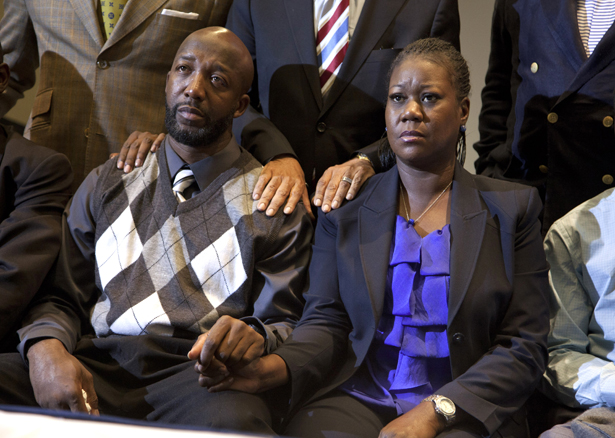
The parents of Trayvon Martin, Sybrina Fulton, right, and Tracy Martin hold hands as they watch a news conference in Washington with special prosecutor Angela Corey in Sanford, Fla., announcing charges against George Zimmerman on Wednesday, April 11, 2012. (AP Photo/Evan Vucci, Pool)

Editor’s Note: This article first appeared at The Guardian. Read the full text here.

George Zimmerman is behind bars. Six weeks after he shot Trayvon Martin, the state of Florida has been pressured, from above and below, to at least contemplate the notion that a man who killed an unarmed child might have a case to answer. He has now been charged with second-degree murder.

What follows from here has the potential to be every bit as divisive as the OJ Simpson trial and every bit as inflammatory as the Rodney King case—only this time there’s a black president in an election year. Blacks and whites already understand this case differently. A recent Newsweek poll showed that 80% of black Americans thought Martin’s death was racially motivated and 78% thought Obama’s comments about the shooting were appropriate. The figure for whites was 35% and 28% respectively. In the caffeinated, disaggregated world of cable news and blogs, where people feel entitled to their own facts, the details that emerge will only deepen these fissures.

Given that it was political pressure that made the trial possible, it would be naive to suggest that, now Zimmerman is in the hands of the law, his fate is now merely a legal matter. The "stand your ground" law was political, as are the lax gun laws, and the issues of race that have propelled this case to international news. This is the state where the courts decided the presidency in 2000. The law is already politicised.

….

Editor’s Note: This article first appeared at The Guardian. Read the full text here.

Support The Nation’s June Fundraising Campaign

With the midterm elections now firmly upon us, the question is whether Democratic candidates will do more than merely occupy ballot lines as mild alternatives to the red-hot crisis that is Donald Trump.

As Trump spends over $1 billion a day on a globally destabilizing war on Iran and admits that he doesn’t “think about Americans’ financial situation,” millions across the country are struggling with the surging costs of essentials. Democrats must seize this moment and advance bold, small-“d” populist ideas—not settle for cynical caution that once again snatches defeat from the jaws of victory.

The Nation elevates progressive ideas, movements, and elected officials achieving real change across the country into the national conversation. At the same time, our journalists are exposing how crypto and AI-funded super PACs are spending hundreds of millions of dollars to knock out candidates they oppose, reporting on the devastating impact of the Supreme Court’s evisceration of the Voting Rights Act, and sounding the alarm on attempts by red states to quickly redraw electoral maps, disenfranchising Southern Black voters.

We can play this critical role because of support from readers like you. This June, we’re raising $20,000 to power The Nation’s independent journalism in the run-up to November’s immensely consequential elections.

It’s in our power to build a more just society, and your support at this critical moment brings us closer to that bold vision. I hope you’ll donate today.

Onward,

Katrina vanden Huevel
Editor and Publisher, The Nation

Ad Policy
x
