
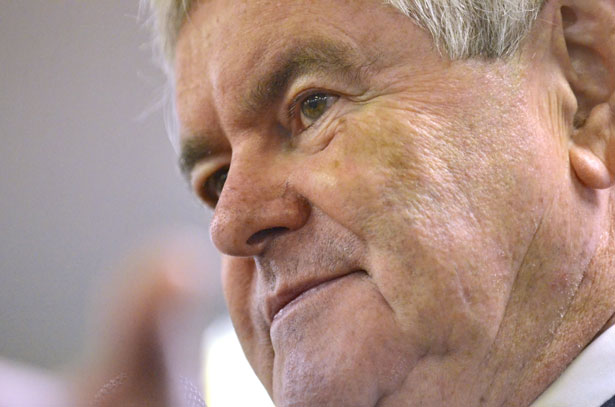
Newt Gingrich speaks at Tommy’s Ham House, in Greenville, S.C., Nov. 30, 2011 (AP Photo/Richard Shiro, File)
As a political scientist trained in the late twentieth century, I believe in certain political truths. I trust my colleague David Mayhew’s insight that “congressmen are single-minded seekers of reelection” as the organizing principle of Congressional behavior. From the co-sponsorship of bills to the practice of earmarking, all can be understood as serving the re-election goals of members. I am also persuaded by the much debated but popular theory that every thirty to forty years the United States experiences a critical election that shifts partisan power and realigns the electorate.
These ideas inform some of my foundational beliefs about how the American political system works. They help me feel less panicked about short-term volatility in policy or election outcomes because they make the system seem more orderly in the long view. It’s the kind of optimism expressed by President Obama in sentiments borrowed from Martin Luther King Jr.: “The arc of the moral universe is long, but it bends toward justice.” I see the arc of American political history as long, but tending toward discernible and predictable patterns. This predictability includes a reassuring lack of permanence. Conservative eras give way to decades of progress. Backlash emerges but movements march forward.
However, the 2012 Republican primary season has challenged some of my core beliefs. Not only has it gone against the GOP’s reliable behavioral tides; the Republican presidential race thus far appears to be significantly altered by the Citizens United decision. And while there were certainly reasons to dislike the Republican establishment, what stands to replace it is far more frightening.
Along with many political observers, I have long assumed that the populism of the Republican Party is more symbolic than actual. Since the Southern Strategy was implemented in the 1960s, Republican presidential hopefuls have talked the talk of racial exclusivity, or evangelical fervor, or militaristic nationalism, while mostly walking the walk of enriching the party’s moneyed establishment. Populist barnstorming kept many voters tied to the Republican Party when their pocketbook interests objectively lay with more progressive taxation and social legislation. This was mostly for show; in the end, presidential nominees would inevitably be chosen by elite decision-makers who put their collective financial resources behind their front- running fiscal friends.
The 2010 midterm wins of insurgent Tea Party candidates did little to shake my faith in this process. The Republicans did have a class of unruly freshmen; however, I presumed that the Mayhew principle of re-election–seeking behavior would swiftly bring them in line. But the debt ceiling fiasco this past summer undermined this expectation. House Speaker John Boehner’s inability to rein in his party members was extraordinary. Republicans can be accused of being many things, but being undisciplined is rarely among them.
Then came the primary season, and suddenly every tool in my toolbox feels woefully inadequate for understanding the outcomes of this election. Republicans follow certain rules in their primaries. They nominate the next guy in line. Being boring or insincere has rarely been a stumbling block for their nominees. Being fabulously wealthy and well connected has only been an asset. A little noise-making, cage-rattling and resistance from the base is to be expected early on, but if the sun still rises in the east, if Wednesday still follows Tuesday and if financial elites are still in control of the party, then Republican primary voters should be making their peace with Mitt Romney right about now and turning their focus to defeating the incumbent Democratic president. That’s just how things are done.
Except apparently that’s not how things are done in 2012. It is unprecedented in the contemporary Republican primary system for the first three races to go to three separate candidates: Rick Santorum in Iowa, Mitt Romney in New Hampshire and Newt Gingrich in South Carolina. The Republican establishment has been surprisingly upended by Citizens United. Super PAC attacks on Gingrich sent conservative voters to Santorum in Iowa. The whims of a single billionaire kept Gingrich in play in South Carolina. The new rules unleashed by the Supreme Court have set loose the possibility that insurgent candidates armed with one rich donor can seize control from a once stable Republican power elite.
For the past forty years the battle between the parties shared some aspects of the cold war: the stakes were high, the differences were real, but each side was constrained by its interest in perpetuating the existing system. If the dissolution of the Soviet Union changed the balance of power so that “rogue states” had access to weapons of mass destruction, the Citizens United ruling shows that today’s rogue candidates have the potential to threaten the existing electoral order.
A challenge to the status quo could be a good thing, of course. It is what animates both the Tea Party and the Occupy movement. And as a media observer, I find it exciting to watch the Republicans behaving so erratically. But I am more than a little concerned that no one seems to be steering the GOP ship anymore. Democratic loyalists may gleefully herald the Republican disarray, but they should be concerned that the populism of the right is coalescing around the race-baiting, divisive extremism of Newt Gingrich, which seems likely to prove more rabid than that of the existing elite. A new Southern Strategy, fueled by the multimillion-dollar weaponry of Citizens United, could be enough to make me yearn for the good ol’ days of the Republican establishment.

