

A Q&A With Marilynne Robinson A Q&A With Marilynne Robinson
The novelist discusses religion, history, language and the importance of moral scrutiny.
Mar 23, 2015 / Books & the Arts
Home Home
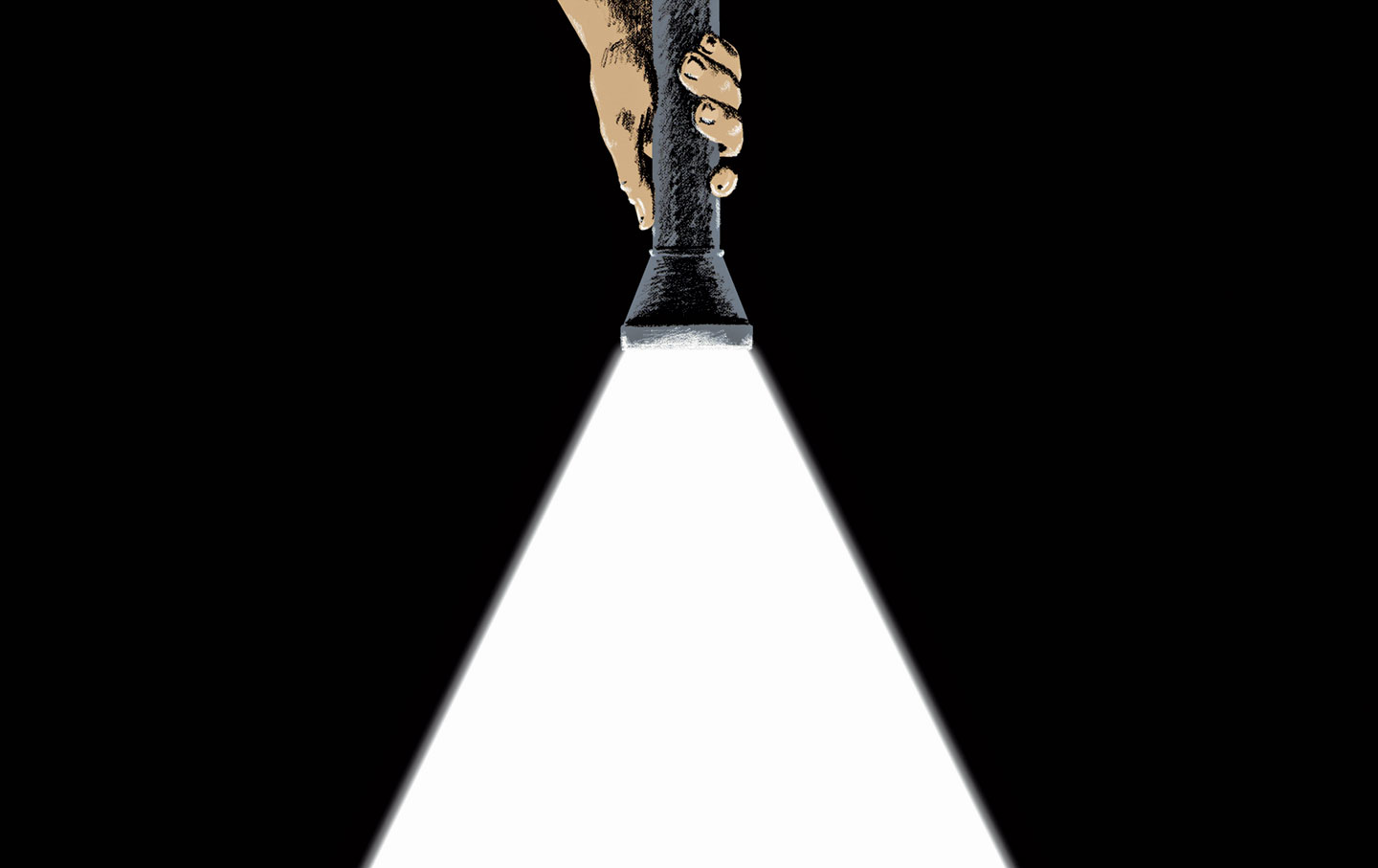
(Mirko Ilic) This article is part of The Nation’s 150th Anniversary Special Issue. Download a free PDF of the issue, with articles by James Baldwin, Barbara Ehrenreich, Toni Morrison, Howard Zinn and many more, here. 1. There has always been another world. In Neolithic times, they built megaliths, steles, timed to the solstices—so they had some astronomical sense. Failing that, there was always a saber-toothed tiger to run them down. In the Grecian Bronze Age was invented the cast of maniac characters known as the gods—each with a different competitive function usually attached to features of the natural world, but showing clearly an awareness of something in existence other than humankind. The pre-Socratics scientized this and spoke of elemental forces that powered the world, and they argued as to which were more elemental than others—water, fire, air or earth. Then came Democritus with his astonishing theory of the invisible atom as the basis of everything. Plato allegorized the problem, describing a cave of firelit shadows where most men lived, unaware of the sun outside. All of this was, of course, monotheisticized by the Abrahamic religions—one supreme Reality with His own reasons, His dos and don’ts. And in the eighteenth century, Immanuel Kant spoke of “things in themselves” as being beyond our phenomenological knowing—that the world was something else than what we could actually know, captured as we were in our own minds. John Searle is a contemporary philosopher with an unalterable belief in “things in themselves.” That makes him, philosophically, a Realist. Reality, in his refreshing advanced diction, is composed of “brute facts,” which for Searle consist entirely “of physical particles in fields of force, and in which some of these particles are organized into systems that are conscious biological beasts, such as ourselves.” The examples he cites of such ur-Reality are “mountains, planets, H2O molecules, rivers, crystals, and babies.” I would include the climatic biomes. But the examples of Reality are endless, of course, and include the stars in the skies, the skies and, in fact, what we understand as the entire universe. So Searle finds it convenient to wrap up Reality by reference to “the atomic theory of matter” and “natural selection.” These, he says, are the constituent facts of “a world independent of our representations of it.” What we are left with is the world of our own devising, to which Searle gives the traditional term “social reality.” Social reality is institutional, a matter of our historical invention. “Money, property, marriage, governments, elections, football games, cocktail parties” are Searle’s deftly chosen examples of social reality. They are factual, but they require “human institutions for their existence.” By way of alerting those keenly assured of the leftist subtexts of all philosophic thought, however conservative, I would add as examples of social reality the National Rifle Association, oil and coal companies, and Citizens United v. Federal Election Commission. The work of Searle’s from which I’ve quoted is The Construction of Social Reality (the Free Press edition, copyright ©1995 by Searle). We need not follow the intricacies of his discussion of social reality, whose metaphysics fascinate him—how, he asks, do we get from atomic particles to this?—nor linger with his insistent defense of Realism. I give him all that and take his two realities for my own purposes. * * * 2. To speak of the construction of social reality is to affirm the remarkable history of our species, which, as we tell our children, invented the wheel, made fire, discovered farming, built ships to sail the seas, and invented railroads, horseless carriages, aircraft, instant communication over great distances—all in an endless story of human progress through millions of years, advancing in its modes of social organization from tribes to nation states, from kings and despots to parliaments, from designated slaves to free people living now in vast, electrically powered and digitized cities with hospitals, libraries, museums and theaters, with poets of many languages, saloons, stock markets, churches, universities, zoos, national treasuries, and streets filled with the literate and well clothed. (If murderous war has been a constant, no one would think to claim for us angelicism.) And within this historic world, the real world of the “brute facts,” genetically manipulated or penetrated with particle accelerators, seems to be surprisingly unresisting, subject to such resourceful pumping of its oil, mining of its minerals, stripping of its forests, and fishing of its seas as to amount to a Reality that is no match for the social realities we’ve constructed from it. Joseph Conrad, in his novel Lord Jim, says of a minor character that he could not survive except within a well-developed civilization. No author sneers at his own characters as royally as Conrad, but in fact that dependence describes most of us. And why not, since civilizations are what the species has been designing for itself in its great epochal struggles to endure. In a favorable light, human history may be seen as the colossally effective enterprise of converting some of the brute facts of Reality into realities on which we can survive. Until now, as a geologically clocked obsessiveness, it has been, with the expansive genius of Homo sapiens, an immeasurable mythic wresting of life from its inhospitality. And the vast unknowable world we inhabit would seem to be represented in our imaginations only by the occasional mountain lion overturning a garbage can in the suburbs. * * * 3. Yet we have learned, with the knowledge that has made human beings conquistadors of the earth, that such executive success for so long brings with it—what to call it?—a cosmological arrogance. That arrogance, most compactly described, is the anthropic principle. It states that the exploding universe was formed fortuitously of such a specific chemical stew as to make the appearance of human life on the earth inevitable. Never mind the billions of years of gaseous storms, the firing up of photons and the slow whirling of constellations—according to the anthropic principle, it looks suspiciously as if we are the point of it all. And so, despite its hypothetical tone—there is said to be both a weak and a strong principle—we can hear in it a quasi-religious self-congratulation, another reading perhaps of Genesis, wherein the culmination of God’s great work comes on the sixth day with the supreme creation of the Bible writers themselves. * * * 4. If there is a consensus among scientists that the Reality independent of our representations of it is changing its nature, there is everywhere a resistance to the idea. To someone living in a great city, where the natural world is represented by a park with benches, life is made from the sum of social realities. If you go to work in an office building and are occupied with the pressures of the job, the competitive business institution, your mind is so busy and the circumstances of survival so personal that there is no time for the thought of a vengeful Reality. Or if you are the single parent providing your children with their breakfast cereal. Or if you are at war, lying in the sand with your rifle at the ready, these climatic circumstances demand of you a vocabulary too exotic to be seriously part of the thinking of someone inured to a private, if not to a powerless, life. To others, the so-called crisis of climate change is no more than the usual daily business of the planet—icebergs calving, songbirds going silent, obscure species of frogs dying in their ponds. Those who calmly hold to this view choose to believe nothing at all is happening that is inconsistent with normal changes in biological diversification—the thriving of some creatures, the dying out of others—or, regarding variations in the weather, what we have always known to be the hurricane season on this continent, the monsoons over there. Though, of course, they choose not to know of the climatic biomes, or to believe that climate and weather are two entirely different things. People have settled the earth where the climate made farming possible, or because desert sands were livable, or because prevalent tropical temperatures made life easy. The habitation of the earth, and growth of cultures, reflect age-old patterns of human distribution. This—the prevalence of sustaining lifelong climatic regions, not frogs in a pond—is what is changing. And then there are those who not only reject the idea of a global climate crisis but do so with scorn or suspicion, finding in the scientific consensus nothing less than a conspiracy. Though why a scientific conspiracy should exist, or to what purpose, is never made clear. But it is politicians, officeholders of the right, who broadcast this paranoia. Finally, there are the corporate leaders in the energy industries—the coal operators, the oil producers—who would prevent any regulation of carbon emissions or other modifications of their business practices. As the presumptive beneficiaries of the human colonization of Earth, they are afflicted with the latent conceit of triumphalism, in which social reality is Reality, the two are merged, and there is no distinguishing them. * * * 5. But there is a dynamic here that is nothing new. When Galileo reported his telescopically informed conclusion that Copernicus was right—it was the earth that moved around the sun—he was tried for heresy by the Inquisition. He recanted, though he did not entirely avert punishment, spending the rest of his life under house arrest. He had discovered a brute fact that contradicted the prevalent social reality of church teaching, that the sun moved around the earth—social realties being even to this day as much a matter of the political manipulation of fantasy as of inventions such as the cellphone. It was only in 1992 that the Catholic Church admitted that Galileo might be right. While we no longer accuse scientists of heresy, there is a residual suspicion of the subversive capacity of science, with its famous “method,” to overturn the comfortable social realities that people find to their advantage. The high clergy of the Middle Ages were beneficiaries of the religious domination of society: they ate quite well and dressed in finery. It seems apparent that today, too, those who abjure the ineluctable Reality of global warming are the conservatives among us, the same Republicans who themselves live quite well and do not like universal healthcare, or raises in the minimum wage, or any government oversight of investment banks. If they are not all malefactors of great wealth, they tend to include those of the corporate executive culture who can’t abide any interest, even humankind’s, that is not in their corporation’s interest. And if the class of citizen-deniers includes Tea Party exegetes not themselves in the economic upper percentiles, we can’t condemn them, so pathetically misinformed are they in the face of a looming planetary crisis. It is true that people in other countries want what we have, and so they cut down trees, and poach, and cook with coal fire, in that great quest for “me” that is the mark of our species. But I speak of the American situation. There is a preoccupation here with “Holy Scripture” that is dogged, hates Darwin, and insists on the literal and sacred truth of primitive documents thousands of years old. About this, nothing can be done. * * * Please support our journalism. Get a digital subscription for just $9.50! 6. But someone must bear the responsibility for this widespread national resistance, someone with propagandistic resources, someone richer than most and so in a position to negate, deny, and hold up to scorn any reasonable scientific explanation of what is happening to our planet. In this country, we cede to the plutocrats. I would choose the Koch brothers as likely villains, those malefactors of great wealth, except that their malefaction is only incidental to the problem. Their sin, as influential men of wealth hiding their own brutal interests behind a libertarian facade, is worse than that. Look at it this way: as Americans, we pride ourselves on getting things done, as people knowing what to do and when to do it—this is as basic an American identity as there is. From Ben Franklin on up through the Franklin Roosevelt of the Second World War, we have been archetypally more than given to solve any task, secure any dream. Therefore, the Koch brothers’ failure is only incidental to their wealth. Theirs is the sin of what can hardly be imagined as a factor of power: it is maladaptive failure, the failure to understand the realities and do something about them. The Kochs have lost that; they are staggering about in the woods with no idea what to do beyond preserving their fiefdom. We need not go into the reasons for this failure—psychological, emotional, structural—the cost to us is too great. * * * 7. At this stage of the climatic problem, it is not the priests, rabbis or ministers among us who are saying that “pride goeth before the Fall”; it is the scientists. That interests me—this turn to religious moralizing on the part of the secular community. It may represent an enormous cultural shift, a kind of re-establishment of a new liturgical authority. Because it is an undeniable worship of the earth that would ask us to save it. If anyone were to walk the streets with a sign saying The End Is Near, I would expect it to be someone with a PhD in physics. This would explain the public aversion of some to the idea of science: that its practitioners speak, however technically, as prophets—a prophet, of course, being someone to be ignored. It may be with some resentment that we feel, after all that has been done to the earth in many thousands of years, that it should fall to us, to our generations, to pay the price. Yet it was only the Industrial Revolution of the eighteenth century that sped us into recognizably modern times. Wordsworth wrote in the early 1800s: “The world is too much with us; late and soon, / Getting and spending, we lay waste our powers: / Little we see in Nature that is ours….” For those who do imagine a catastrophe of astronomical magnitude, our imagination is limited. What do movies know? We may see cities in smoking ruins. With winds which we have never known for their iciness, and waters for their heaving, thunderous rages, and morning suns burning our lands to cinders, and all of it happening consistent with each of our maniacally trashed biomes. Perhaps then we will see wars for potable water, tillable land. And who will be left after the plagues but some lonely stragglers looking for community—and finding no other humans but hideous creatures of natural selection who have sprouted energetically in this new, unrecognizable Reality. But there is no telling what will be. The planet going through its agonies may end up quietly enough—just not the home we thought it was. It is a few seers in our time who remind us that, for all our intrepid world-making social realities, we are dealing with something inexplicable: Reality is still there, as mysterious as ever. Einstein tells us that scientific knowledge is like a searchlight whose expanding beam brings more and more of what was once dark into the light—but as it does, so does the circumference of darkness expand.
Mar 23, 2015 / Books & the Arts / E.L. Doctorow

Can Women and Men Live Together Again? Can Women and Men Live Together Again?
I hope we might meet as rebels together—not against one another, but against a social order that condemns so many of us to meaningless or degrading work in return for a glimp...
Mar 23, 2015 / Books & the Arts / Barbara Ehrenreich
The Bear The Bear
April 18, 1928 The bear puts both arms round the tree above her And draws it down as if it were a lover And its choke-cherries lips to kiss goodby, Then lets it snap back upright in the sky. Her next step rocks a boulder on the wall. (She’s making her cross-country in the fall.) Her great weight creaks the barbed wire in its staples As she flings over and off down through the maples, Leaving on one wire tooth a lock of hair. Such is the uncaged progress of the bear. The world has room to make a bear feel free. The universe seems cramped to you and me. Man acts more like the poor bear in a cage That all day fights a nervous inward rage, His mood rejecting all his mind suggests. He paces back and forth and never rests The toe-nail click and shuffle of his feet, The telescope at one end of his beat, And at the other end the microscope, Two instruments of nearly equal hope, And in conjunction giving quite a spread. Or if he rests from scientific tread, ’Tis only to sit back and sway his head Through ninety-odd degrees of arc it seems, Between two metaphysical extremes. He sits back on his fundamental butt With lifted snout and eyes (if any) shut (He almost looks religious but he’s not), And back and forth he sways from cheek to cheek, At one extreme agreeing with one Greek, At the other agreeing with another Greek, Which may be thought but only so to speak. A baggy figure equally pathetic When sedentary and when peripatetic. This article is part of The Nation’s 150th Anniversary Special Issue. Download a free PDF of the issue, with articles by James Baldwin, Barbara Ehrenreich, Toni Morrison, Howard Zinn and many more, here. Reviewing Robert Frost’s first book, A Boy’s Will, in 1915, The Nation described him as “a poet by endowment,” but “a symbolist only by trade.” Frost (1874–1963) wrote four poems for The Nation in the 1920s. When he died, the sportswriter Roger Kahn wrote in the magazine of his friend: “Robert Frost is dead and my mortality and yours is thus more stark.”
Mar 23, 2015 / Books & the Arts / Robert Frost
Weird Bedfellows Weird Bedfellows
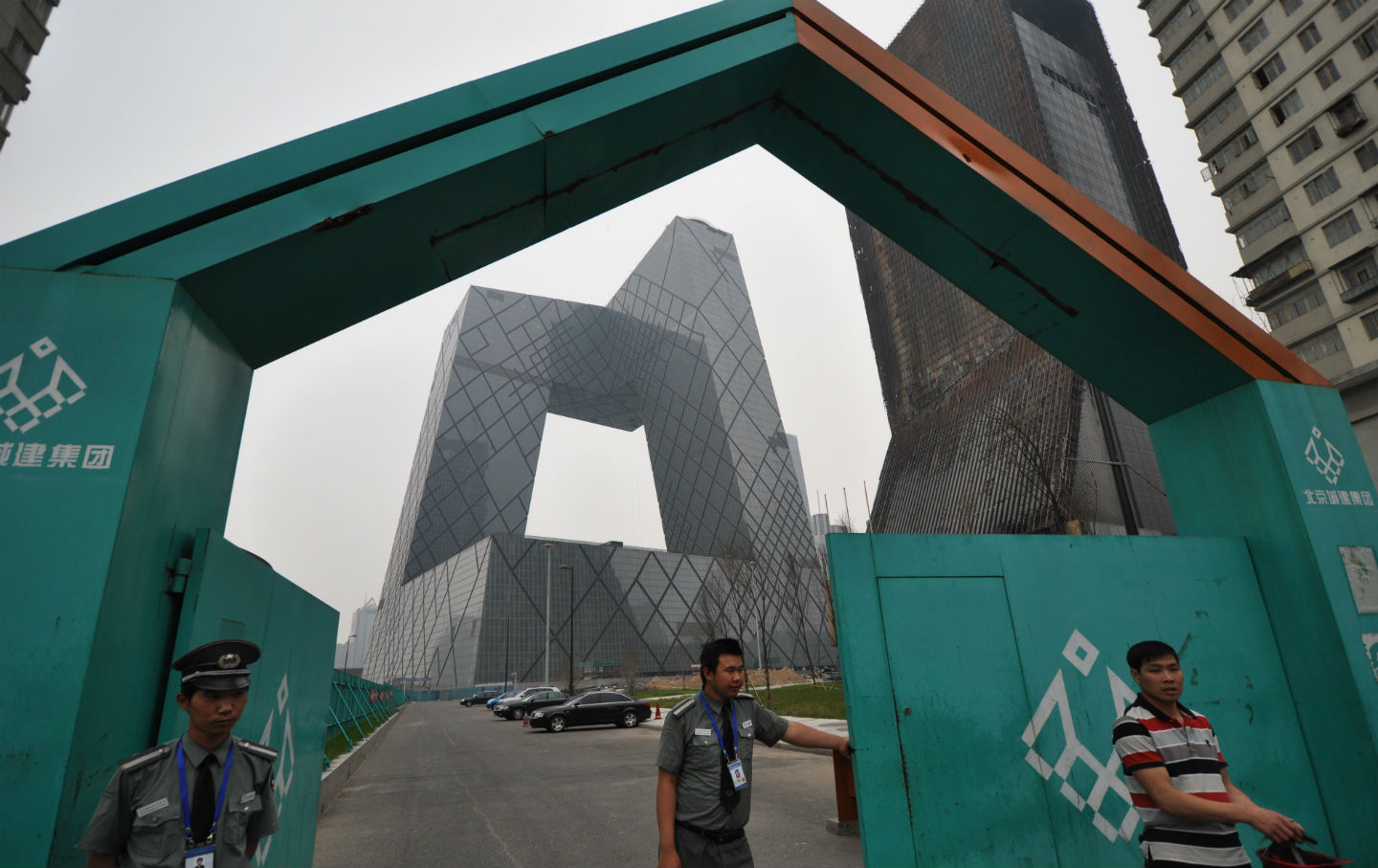
In their defense of “tradition” against the liberating potential of architecture, Prince Charles and Xi Jinping find unlikely common ground.
Mar 23, 2015 / Books & the Arts / Michael Sorkin
Magna Carta Messed Up the World, Here’s How to Fix It Magna Carta Messed Up the World, Here’s How to Fix It
The “logic” of capitalist development has left a nightmare of environmental destruction in its wake.
Mar 23, 2015 / Books & the Arts / Noam Chomsky

East, West—Is There a Third Way? East, West—Is There a Third Way?
The cold war has become a habit, an addiction, supported by very powerful material interests in each bloc.
Mar 23, 2015 / Books & the Arts / E.P. Thompson
The Fall of Rome The Fall of Rome
June 14, 1947 The piers are pummeled by the waves; In a lonely field the rain Lashes an abandoned train; Outlaws fill the mountain caves. Fantastic grow the evening gowns; Agents of the Fisc pursue Absconding tax-defaulters through The sewers of provincial towns. Private rites of magic send The temple prostitutes to sleep; All the literati keep An imaginary friend. Cerebrotonic Cato may Extol the Ancient Disciplines, But the muscle-bound Marines Mutiny for food and pay. Caesar’s double-bed is warm As an unimportant clerk Writes I DO NOT LIKE MY WORK On a pink official form. Unendowed with wealth or pity, Little birds with scarlet legs, Sitting on their speckled eggs, Eye each flu-infected city. Altogether elsewhere, vast Herds of reindeer move across Miles and miles of golden moss, Silently and very fast. This article is part of The Nation’s 150th Anniversary Special Issue. Download a free PDF of the issue, with articles by James Baldwin, Barbara Ehrenreich, Toni Morrison, Howard Zinn and many more, here. W.H. Auden (1907–1973) contributed many poems and critical essays to The Nation between 1938 and 1951.
Mar 23, 2015 / Books & the Arts / W.H. Auden
Separated at Birth Separated at Birth
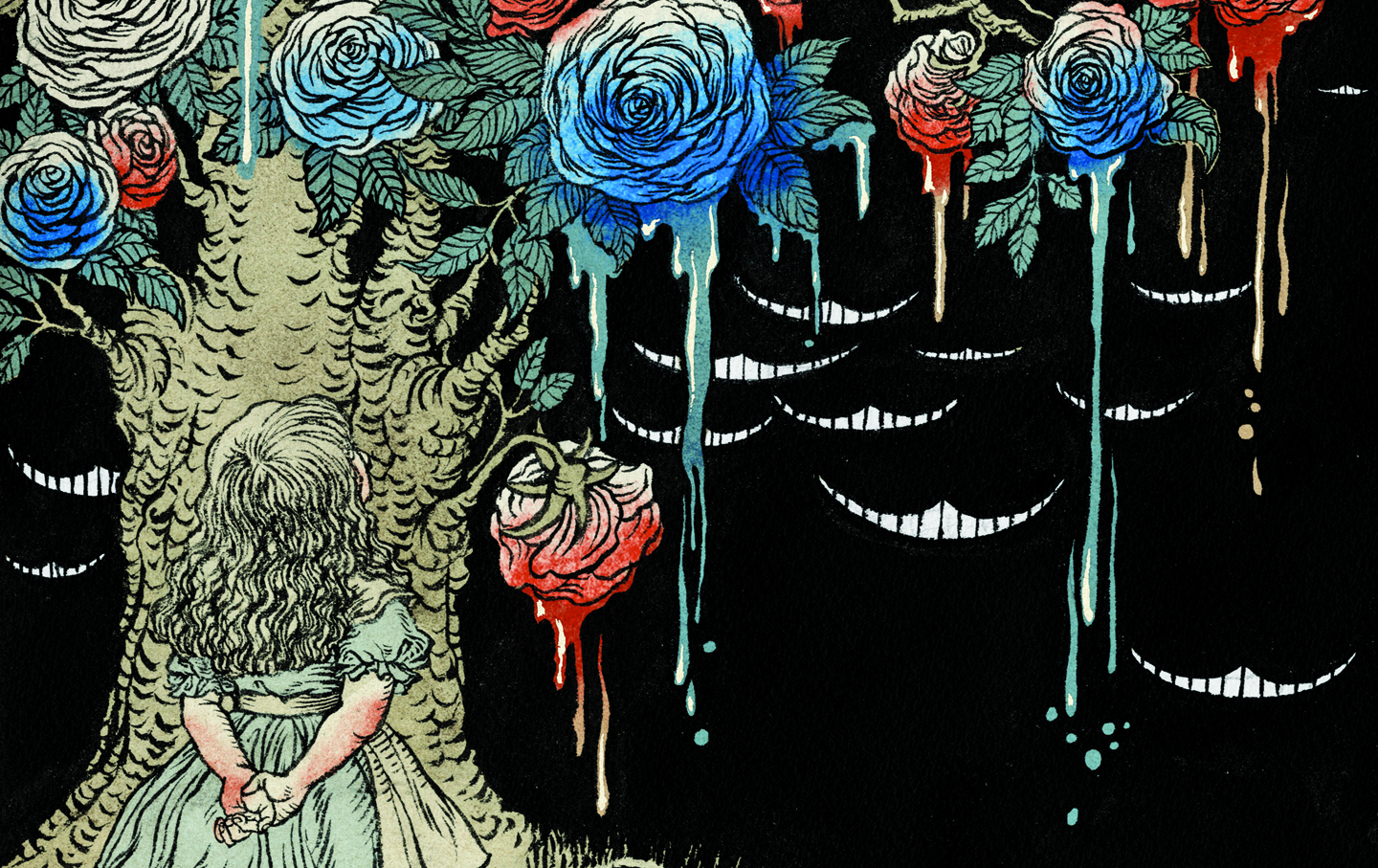
The Nation and Alice in Wonderland were born within days of each other. In this seditious reading, they rejoin the dance.
Mar 23, 2015 / Books & the Arts / Ariel Dorfman
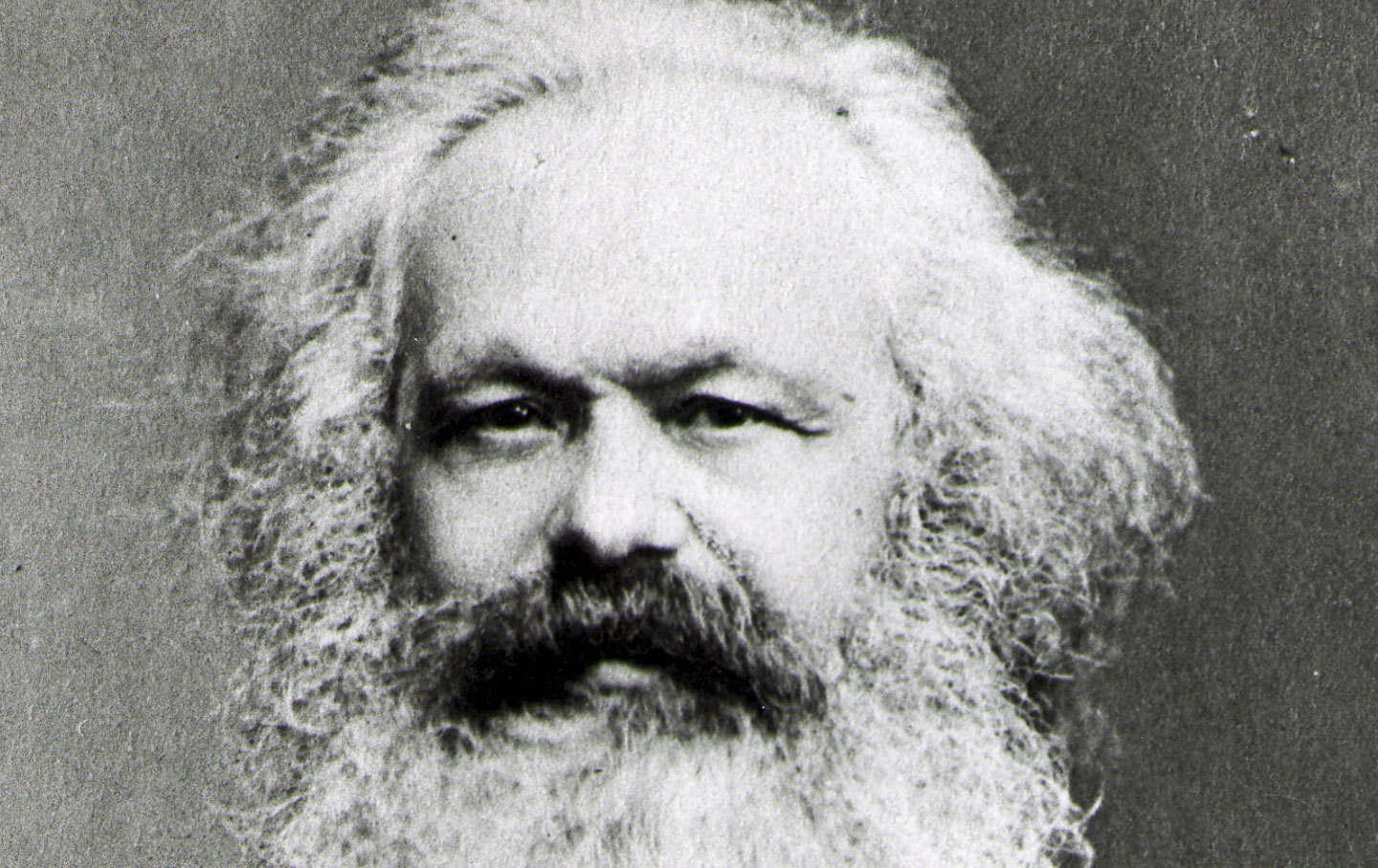
Reclaiming Socialism Reclaiming Socialism
While honoring the legacy of American communists, a new generation of radicals has chosen to organize under the “socialist” banner.
Mar 23, 2015 / Books & the Arts / Bhaskar Sunkara