The New York Times Is Failing Its Readers Badly on Covid
“The New York Times” Is Failing Its Readers Badly on Covid
A pair of shoddy opinion pieces proves that the paper is letting its audience down and undermining the fight to improve our knowledge of the virus.
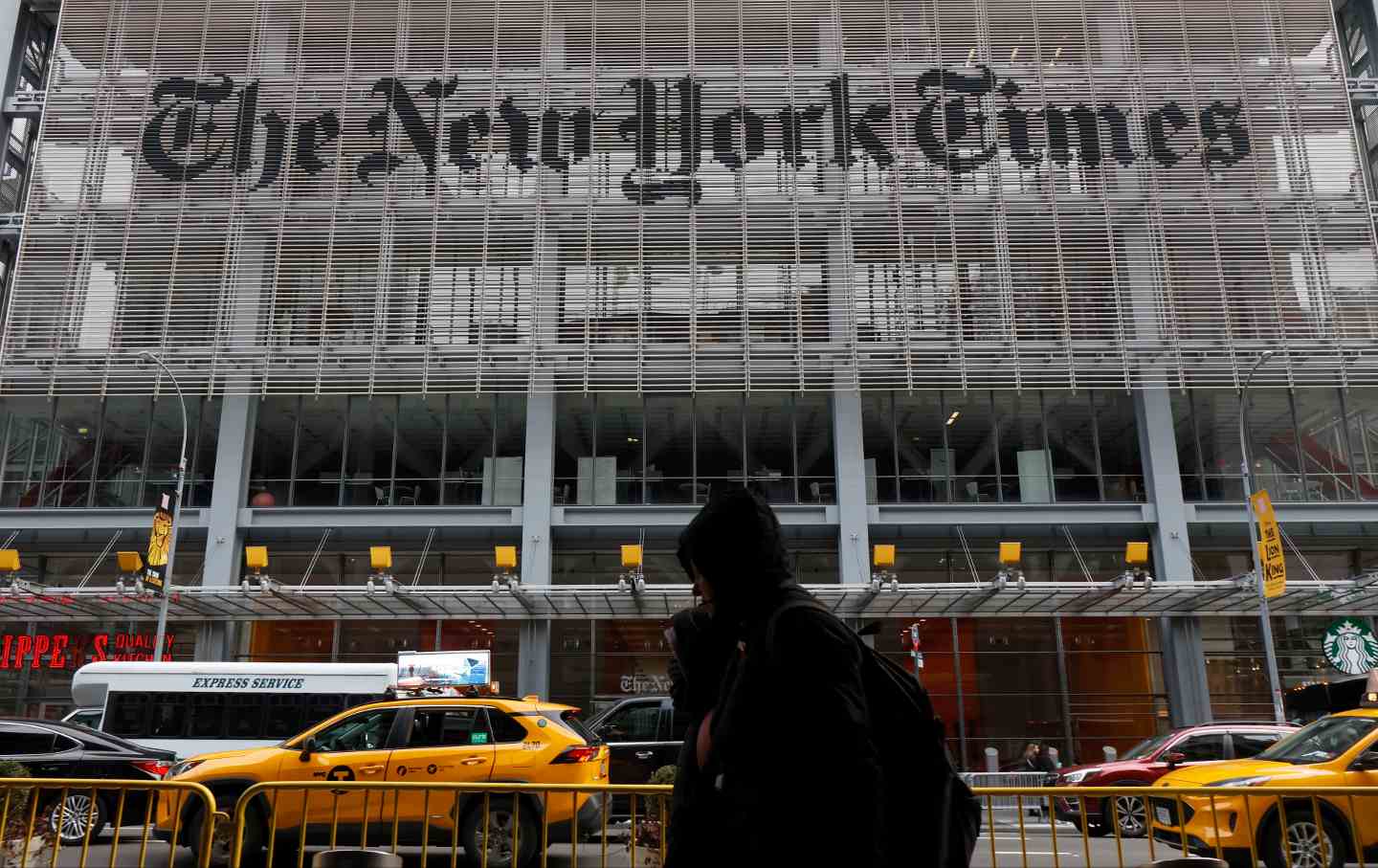
The New York Times building in December 2023.
(Gary Hershorn / Getty Images)Over the past few weeks, we have seen a flurry of revisionist press articles seeking to rewrite the history of the Covid-19 pandemic. These pieces describe a past that we do not recognize from our perspectives as infectious disease and public health researchers—and that’s alarming, because how we think about the past plays such an important role in how we shape our collective future.
These articles fall into a genre we’ll call “science opinion,” where non-experts pontificate with their notions about the pandemic virus and our response to it. This is distinct from science journalism— much of it truly excellent—where experts in translating science to the general public report on technical developments.
We’ve interacted with many science reporters over our combined 80 years working on HIV/AIDS and Covid-19; the best of them are exceptionally skillful at simplifying complex subjects for a wider audience. But what of science opinion? This kind of writing exploded during the pandemic when people with limited or no expertise in virology, immunology, or the epidemiology of infectious diseases appointed themselves as qualified arbiters of the science of SARS-CoV-2 and the national response to this virus.
The New York Times published two problematic examples of the science opinion genre earlier this month. The first was a rehashing of old and frequently rebutted arguments that the Covid-19 pandemic started at the Wuhan Institute of Virology (WIV) in Wuhan, China. The author, Dr. Alina Chan, has never worked on infectious diseases or the science of how viruses enter the human population, but she has become the go-to expert for proponents of the lab leak theory.
To be clear: while the ultimate origins of SARS-CoV-2 are still unknown and may well never be fully understood, the preponderance of the evidence implies that the virus jumped from an animal to a human host in a Wuhan “wet market”. Unfortunately, Chan’s utterly one-sided article overlooked this aspect of the pandemic origin story. Ironically, the Times’ science and politics reporters have covered all aspects of this saga objectively and fairly.
The key point here is that we see a “science be damned” aspect to both Chan’s opinion piece and the decision to run it. No new facts were presented in the piece. And an awful lot of words were spent speculating about the alleged role of the National Institutes of Health as a key funder of virology research at the WIV when those dollars were a very small fraction of the institute’s funding, most of which the Chinese government provided. Much space was also allocated to promoting a “cover-up” argument that hinges on paperwork and not virology. All of this plays into the hands of right-wing politicians eager to bash science and find scapegoats. Science works slowly—for instance, it took years to understand the origin of HIV-1 in chimpanzees—and the arduous process of scientific discovery is being weaponized here to promote conspiracy theories and sinister motives without evidence to back them up.
From our perspective as researchers who have worked on AIDS for decades, we see analogies here to articles suggesting that HIV is not the cause of AIDS. Non-experts made these claims in the early years of the AIDS pandemic, but they were never granted space in The New York Times—indeed, quite the opposite.
The second example of “science opinion” run amok in the Times is a piece on public trust and the pandemic by Dr. Zeynep Tufekci. Here again, a commentator with no training or expertise in the biological sciences or epidemiology stands in judgment of the scientific and public health communities. Tufekci’s main contention is that Anthony Fauci and public health leaders misled the country about Covid during 2020 and thereby destroyed the public’s faith in science. As scientists who watched these same events unfold, we believe this telling of history is highly simplistic and all too often flawed.
Tufekci focuses much of her writing on the early debates about the origins of the virus, the transmission of SARS-CoV-2, and the role of masking. She seems to favor the lab leak hypothesis but offers no new insights and elects instead to attack individuals, fairly and not, for their actions and opinions during the earliest stages of the pandemic—when facts were few and uncertainties abundant. Again, she plays into the hands of the anti-science politicians who now seek vengeance on the flimsiest of grounds.
Tufekci also adds to the ongoing pile-on about whether the directive to maintain a distance of six feet from others was needed. Although the precise distance was indeed somewhat arbitrary, there was no possibility of obtaining hard data in the relevant time frame. The six-foot distance was a reasonable assumption based on public health history, and the practice of social distancing for other respiratory pathogens, particularly those spread by droplets. It was also adopted in multiple other countries, for the same reasons.
The problem here isn’t that Tufekci is questioning the evidentiary basis of the six-foot rule—science and public health cannot progress if we don’t evaluate the results of our work. But that progress is more effective when grounded in good-faith inquiry, rather than the kinds of attacks Tufekci levels against government scientists for doing their best in desperate circumstances. This only serves to bolster the forces who seek to destroy the US public health infrastructure, not make it better.
Tufekci also leaves the impression that she alone realized SARS-CoV-2 was airborne early on. In fact, the debate about transmission was fast and furious within the scientific community at that time. Nobody knew in the first months of 2020 what became clear only much later about how the virus was transmitted and under what circumstances. The same applies to mask-wearing. We now know that masks do in fact reduce virus transmission. But obtaining, collating, and understanding the data isn’t a rapid process; a randomized clinical trial was impossible. Nonetheless, clinicians and scientists made an unequivocal case for masks, specifically N95 respirators, as early as February 2020, for healthcare workers.
It is true that government scientists initially discouraged masking by the general public. That does seem inexcusable in hindsight, and we would have liked to have seen the earlier promotion of masks, but understanding the context matters. One reason for the delay in the adoption of masks by the general public was the acute shortage of personal protection equipment (PPE) for healthcare workers on the front lines, which meant that the supplies we had needed to be devoted to their safety given their higher risk of infection. Healthcare workers had to self-source supplies and even developed a national campaign to Get Us PPE. We saw this shortage up close; one of our labs received a request in mid-March to scour supply cabinets for masks, gloves, and gowns to deliver to medical staff.
Moreover, government scientists were subject to the political whims of other members of the Trump administration. We should never forget President Trump’s personal aversion to masks—he mocked them mercilessly—it’s a critical part of the story. Officials who knew better were clearly constrained in what they could and could not say publicly. Bucking the president they worked for by speaking the truth was always a tough ask.
The public’s trust in science is important. Pew surveys suggest this is now a partisan phenomenon—while there has been a slight dip in confidence in science since 2020 among Democrats, a far greater drop is among Republicans. Tufekci is misguided here to blame public health leaders; the true culprit is the organized campaign to undermine public health that has been bankrolled by right-wing foundations, supported by right-wing media, and embraced by Republican politicians.
So, in the space of just a few weeks, the Times has revived the lab leak hypothesis, muddied the waters about the origins of the virus, and undermined the scientists who seek to better understand viral emergence and how new pathogens may soon threaten us. It is not helpful to elide the uncertainties of the early days of the pandemic, to ignore the real-time scientific debates that took place, and to trash the seat-of-our-pants actions taken when hospitals and morgues were overflowing.
Why does this happen? We think it’s because too many commentators don’t understand the limitations of their knowledge. It’s essential to understand what you don’t know, and refrain from pontificating on it. Neither of us would opine on climate science or nuclear physics, and nobody should pay attention if we did. Today’s appetite for hot takes unmoored from expertise has become fashionable for some of the largest media outlets, including the Times. This does not serve us well.