The Killing of Charlie Kirk Is Part of a Terrible New Era of Political Violence
Wide-open gun culture and hyper-polarization are bringing the “years of lead” to the USA.
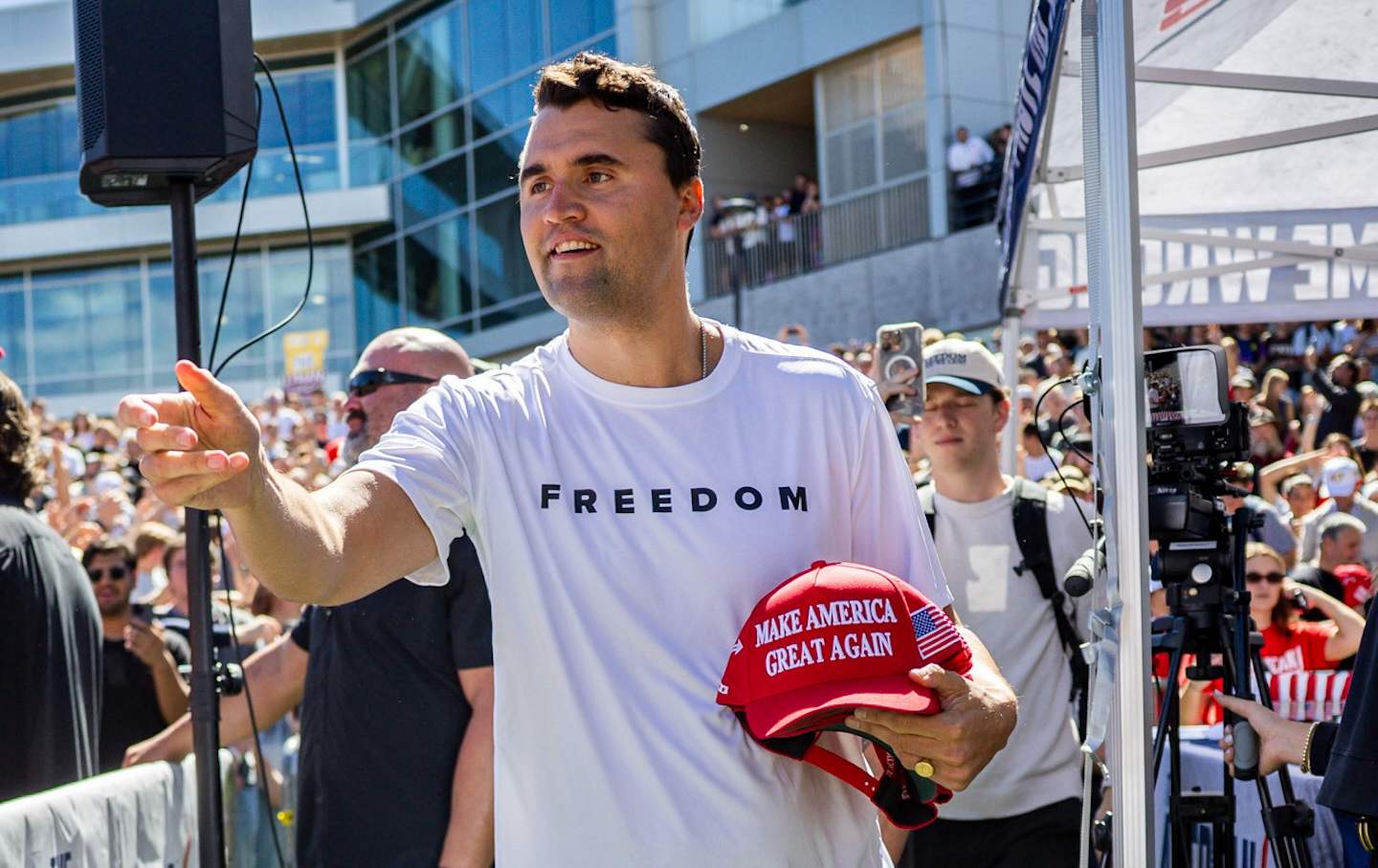
Charlie Kirk hands out hats before speaking at Utah Valley University in Orem, Utah, Wednesday, Sept. 10, 2025.
(Tess Crowley / The Deseret News via AP)The assassination of Charlie Kirk, the 31-year-old right-wing activist who led Turning Point USA, in Utah on Wednesday was horrifying and upsetting. Kirk was fatally shot in the neck while speaking at Utah Valley University. His death was confirmed hours later by President Donald Trump and others. He was the father of two young children.
Yet, as shocking as Kirk’s killing was, the fact that there was this kind of assassination is sadly not that unexpected. After all, America is awash in violence, political or otherwise, every day of the year.
Responding to the initial reports of the shooting, Representative Jaime Raskin wrote: “Condemning another absolutely disgraceful act of gun violence.” The word “another” captures the disturbing truth of the news: Gun violence, whether in the form of school shootings or political violence, is out of control in the United States. This violence is a product of a political system that refuses to implement gun control even as the social fabric frays.
We have known this for a long time. Writing in The New York Times in June, University of Chicago political scientist Robert Pape argued that “since the beginning of President Trump’s second term in January, acts of political violence in the United States have been occurring at an alarming rate.”
Pape cited the assassination of Minnesota lawmaker Melissa Hortman and the attempted assassination of one of her colleagues; the arson at the home of Pennsylvania Governor Josh Shapiro; and the killing of Israeli embassy staffers in Washington, DC. He also noted that this surge in violence, which dates back to the polarization that started with Trump’s candidacy in 2016, also manifested itself in the January 6 insurrection, the attack on Nancy Pelosi’s husband, and the assassination attempts against Trump, among many other cases.
Pape painted a dismal picture of society where political violence is becoming much more common and socially accepted:
Today’s political violence is occurring across the political spectrum—and there is a corresponding rise in public support for it on both the right and the left. Since 2021, the Chicago Project on Security and Threats, which I direct, has conducted national surveys on a quarterly basis on support for political violence among Americans. These surveys are telling because, as other research has shown, the more public support there is for political violence, the more common it is.
Our May survey was the most worrisome yet. About 40 percent of Democrats supported the use of force to remove Mr. Trump from the presidency, and about 25 percent of Republicans supported the use of the military to stop protests against Mr. Trump’s agenda.
As an alternative to this bloody cycle, Pape urged the creation of a bipartisan united front against political violence:
My research suggests that to de-escalate the political environment and reduce the risk of violence, America’s political leaders need to cross their political divides and make joint statements (and ideally joint appearances) that denounce all political violence, welcome all peaceful protest and call for respecting the rules, process and results of free and fair elections in the country. [California Governor Gavin] Newsom and Mr. Trump, for instance, ought to make such a joint statement.
This proposal seems wildly utopian in the current moment. Trump is not a man to seek calm. In terms of political violence, he’s an arsonist, not a firefighter. He mocked the assault on Paul Pelosi and joked about “Second Amendment people” going after Hillary Clinton. He has hailed the January 6 rioters as heroes. He is helping fuel violence in conflicts around the world, particularly in the Middle East. And he leads a government that frequently luxuriates in violent rhetoric against its enemies. There’s every reason to think that, as he did in recent National Guard deployments in Los Angeles and Washington, DC, Trump will use the Kirk killing to justify an authoritarian crackdown.
In earlier decades, political violence could spur a productive unity and search for solutions. After the attempted assassination of Ronald Reagan in 1981, there emerged a bipartisan coalition in support for the 1993 Brady Bill, a gun control measure named after Reagan’s press secretary James Brady, who had been paralyzed in the shooting. But the Republican Party of Ronald Reagan and James Brady was of a different orientation.
If, as expected, the Kirk shooting is used as a pretext for more repression, Trump’s political opponents have to hold the line. The killing of Kirk was an atrocity that should be condemned without reservation. But Democrats have to be prepared to resist any onslaught against civil liberties, not least because a crackdown will only increase the likelihood of far worse violence.