Two Simple Lessons for Democrats to Win the Working Class
A poll conducted of 1,000 Pennsylvania voters tested the strength of Kamala Harris’s messaging against Trump. The best and worst strategies to pick up voters were crystal clear.
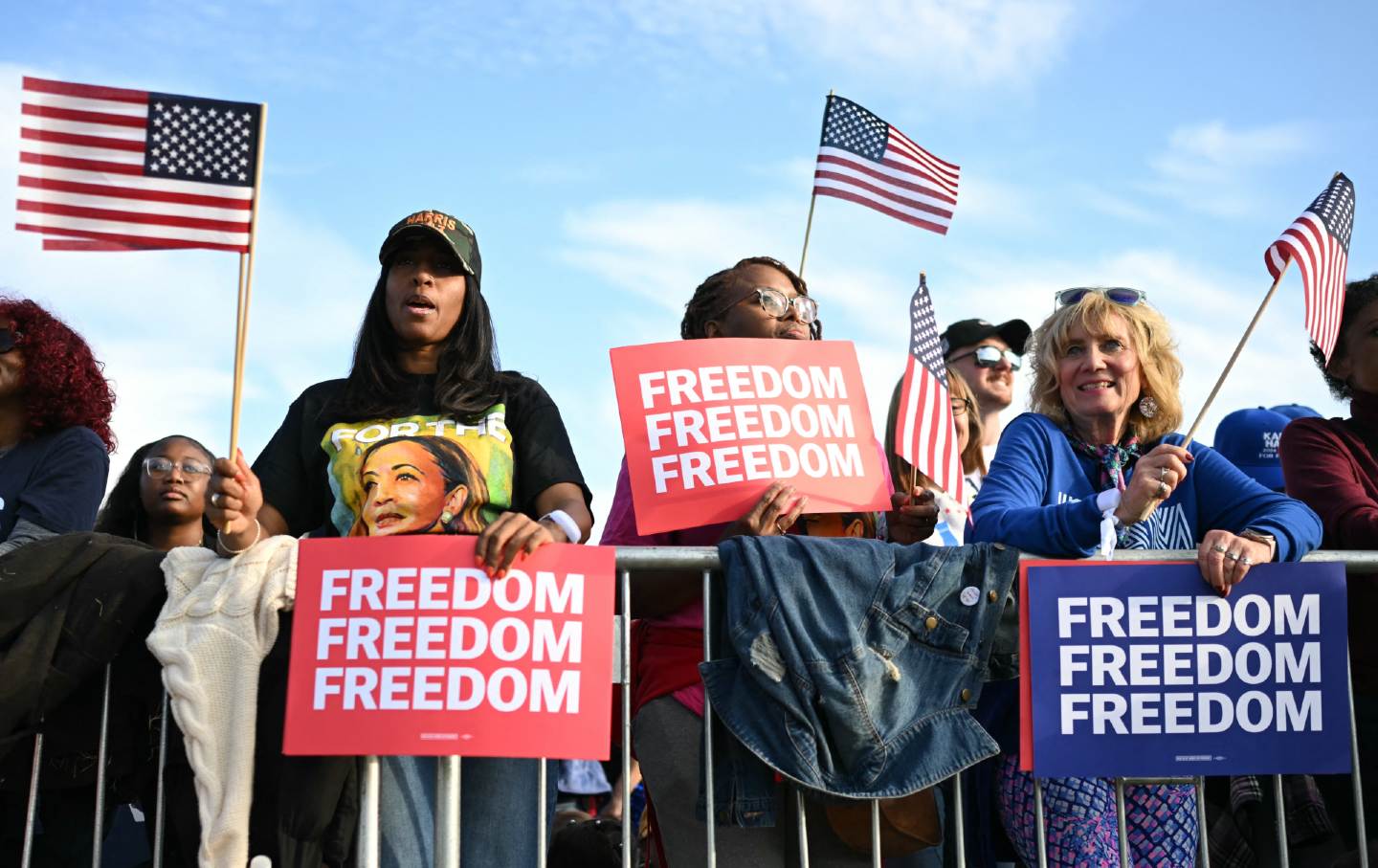
A recent poll by the Center for Working-Class Politics found that messaging around Trump as a threat to democracy was the worst performing campaign tactic.
(Andrew Caballero-Reynolds / AFP via Getty Images)In 1964, Democrats painted Republican presidential candidate Barry Goldwater as the unstable genius of his day, telling voters, “In your guts, you know he’s nuts.” President Lyndon Johnson’s campaign cranked up its attacks on Goldwater’s fitness for office in an infamous September 7 TV ad that portrayed a young girl counting the petals of a daisy before cutting to a mushroom cloud. The ad’s conclusion is narrated by Johnson, who warns, “These are the stakes, to make a world in which all of God’s children can live or to go into the dark. We must either love each other, or we must die.”
In 2024, the Democratic Party is repeating Johnson’s playbook, dismissing Trump and Vance as “weird” and portraying them as an existential threat to the future of our country. But whereas “Daisy” may have played a role in securing Johnson’s landslide victory, the opposite appears to be true for Harris.
A recent poll conducted by the Center for Working-Class Politics (CWCP), Jacobin, and YouGov of 1,000 Pennsylvania voters tested the strength of Kamala Harris’s messaging around Trump as a threat to democracy against several other key campaign messaging themes—economics, populism, abortion, and immigration—to determine which messaging approaches faired best and worst.
The results were unequivocal: Messaging around Trump as a threat to democracy performed worse than all other appeals. It trailed the most popular message tested—which focused on economic populism—by 9 percentage points and was least favored among virtually all demographic groups including independents and Republicans, men and women, rural and urban voters, union and non–union members, and more.
Trump and democracy messaging performed particularly poorly among the all-important working-class voters of Pennsylvania, who make up the majority of the state’s electorate. Regardless of how the CWCP/YouGov poll measured class—by income, education, or occupation—scaring voters straight with rhetoric about Trump and democracy was the most ineffective approach.
What’s more, the damage this messaging did to Harris’s support relative to the most successful messages tested was much greater among working-class respondents than Pennsylvanians as a whole: Trump as a threat to democracy messaging received 13 and 12 percentage points less support than the top-performing Harris message among respondents without a college degree and blue-collar workers, respectively.
This is lesson #1 for Democrats: Attacking Trump as a threat to democracy is a losing strategy.
Whatever the actual threat of a second Trump presidency, most of the voters that Harris needs to win in key swing states aren’t that concerned. Trump may be a liar and a terrible human being, but so, in the eyes of many voters, are most politicians. Yeah, he says crazy and even dangerous things, they concede, but they don’t take his bluster that seriously.
What they do take seriously is the feeling that politicians don’t care about them and never deliver on their promises. Whatever empirical validity these claims may hold, they are an understandable reaction to decades of wage stagnation, a Democratic Party that has veered further and further away from its traditional working-class base, and years of post-Covid inflation.
Rather than exhorting Americans to vote for Harris because Trump would be so much worse, the CWCP/YouGov poll found that the best approach was to take a strong economic populist stance.
Here’s the message we tested to represent strong economic populism:
Working-class Americans are struggling while the billionaires just get richer. We’re paying too much for gas, groceries, and even the medicine we need. It’s time we stand up to big corporations and the politicians in Washington who serve them. I’ll fight to cap prescription drug costs, crack down on price gouging, make sure corporations pay their fair share, and end tax breaks for billionaire crooks. It’s time to put working families first.
We wrote it to speak to American workers’ anger and frustration at being left behind while billionaires and their Washington cronies just get richer and to promise to prioritize working-class families.
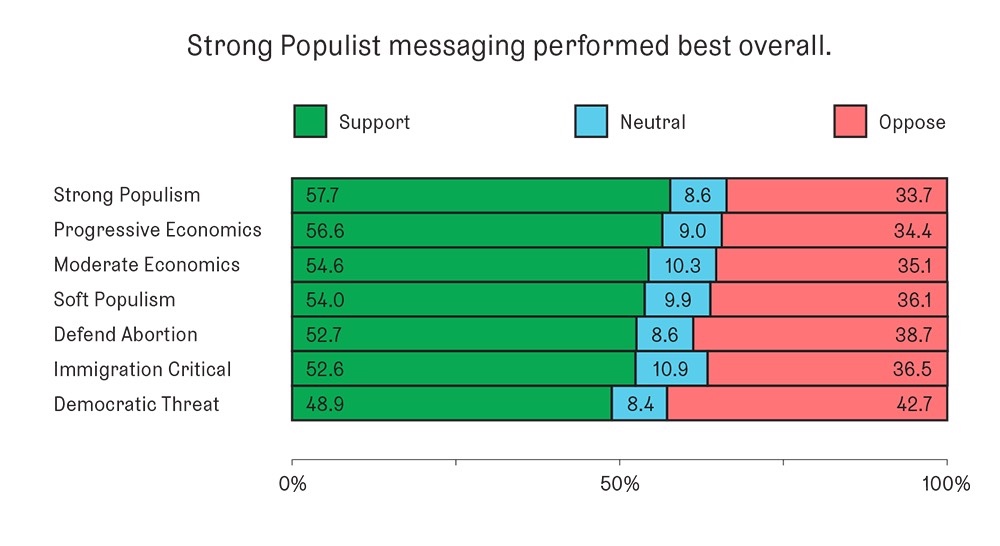
This finding is consistent with previous studies conducted by the CWCP that have tested the power of populist messaging by hypothetical Democratic congressional candidates and examined the real-world electoral impact of populist rhetoric among nearly 1,000 Democratic 2022 Congressional candidates.
In our most recent poll, not only did strong economic populist messaging perform better than all other sound bites tested in the survey among Republicans, rural voters, blue-collar workers, and respondents without a college degree, it was equally or nearly as popular relative to other messages among every key Democratic base constituency—such as African Americans, women, urban voters, voters under 30, service workers, and professionals.
In other words, the survey found that populist messaging appeals to demographics with whom Democrats have struggled in recent years and has few electoral tradeoffs among other important groups in the Democratic coalition.
Popular
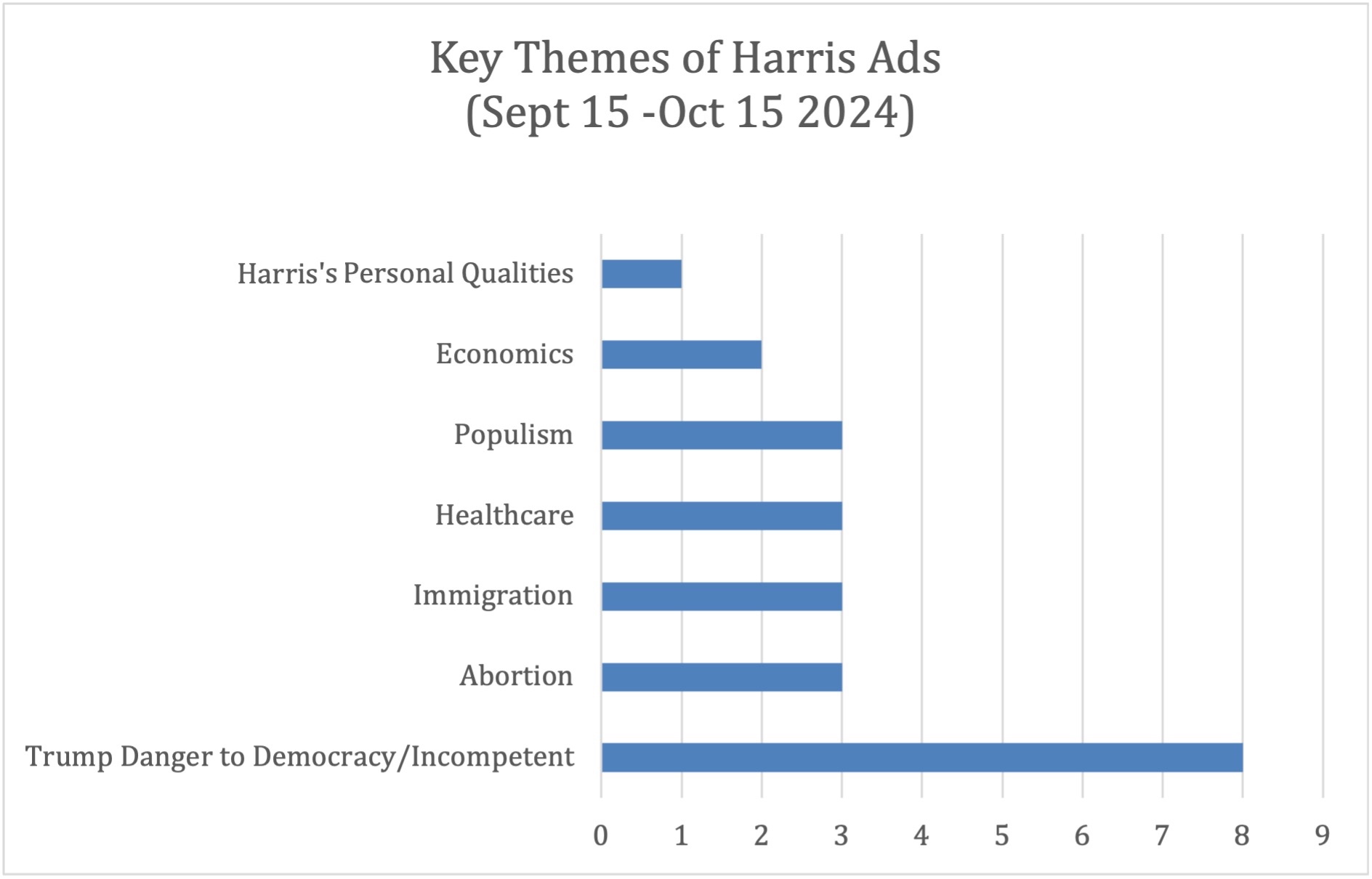
“swipe left below to view more authors”Swipe →Unfortunately, however, the Harris campaign’s recent messaging is focused much less on economic populism than on Trump as a threat to democracy. Of the 25 Harris campaign TV ads posted on the Harris YouTube page between September 15 and October 15, Trump as a threat to democracy or his incompetence as a leader were the focus of eight—more than any other theme. By contrast, economic populism was centered in just three ads, and economic elites—apart from Donald Trump himself—were mentioned in just four.
Other themes of Harris’s recent TV spots were the economy, healthcare, immigration, and abortion. The CWCP/YouGov poll suggests that any of these approaches would be preferable to messaging around Trump as a threat to democracy, but none would be quite as effective as economic populism.
Importantly, the poll’s message around economic populism did not employ Harris’s own language, but instead pushed beyond the populist-inspired messaging she sometimes invokes on the campaign trail. To evaluate Harris’s own populist-flavored rhetoric, the survey included a message drawn directly from her own language that calls out bad apples on Wall Street and in corporate boardrooms for price gouging and tax evasion while recognizing that most businesses do play by the rules.
By contrast, the poll’s strong populist message used more aggressive language against economic elites, pitted elites’ greed directly against the suffering of American workers, and blamed not only economic elites (as in Harris’s own populist messaging) but also politicians in Washington for abandoning American workers.
Lesson #2 for Democrats: Working-class voters will listen when you show them you hear their frustrations and identify more with working people than elites on Wall Street or in Washington—elites whom many workers instinctively assume you represent.
Appeals to working-class voters are more effective when delivered by working-class candidates, and Harris obviously has an elite background, but populist appeals have historically given other candidates an advantage as well. In the past, absurdly wealthy coastal elites from Franklin Roosevelt to Donald Trump have successfully connected with working people using the language of economic populism.
It will, of course, take much more than messaging tweaks to build a lasting Democratic majority that can deliver the gains American workers have been promised for so long. But in the short term, there are some simple steps that Democrats can take to improve their odds against MAGA nation: Stop imagining that most swing voters can be moved by scary messages about Trump’s authoritarian proclivities and instead focus on connecting with working Americans around their sense of disillusionment that the economy is rigged against them and that politicians don’t care about them.