California Lawmakers Fight Back Against Trump’s Secret Police Force
Two bills making their way through the California legislature seek to end masking of federal agents and other tactics that are terrorizing communities.
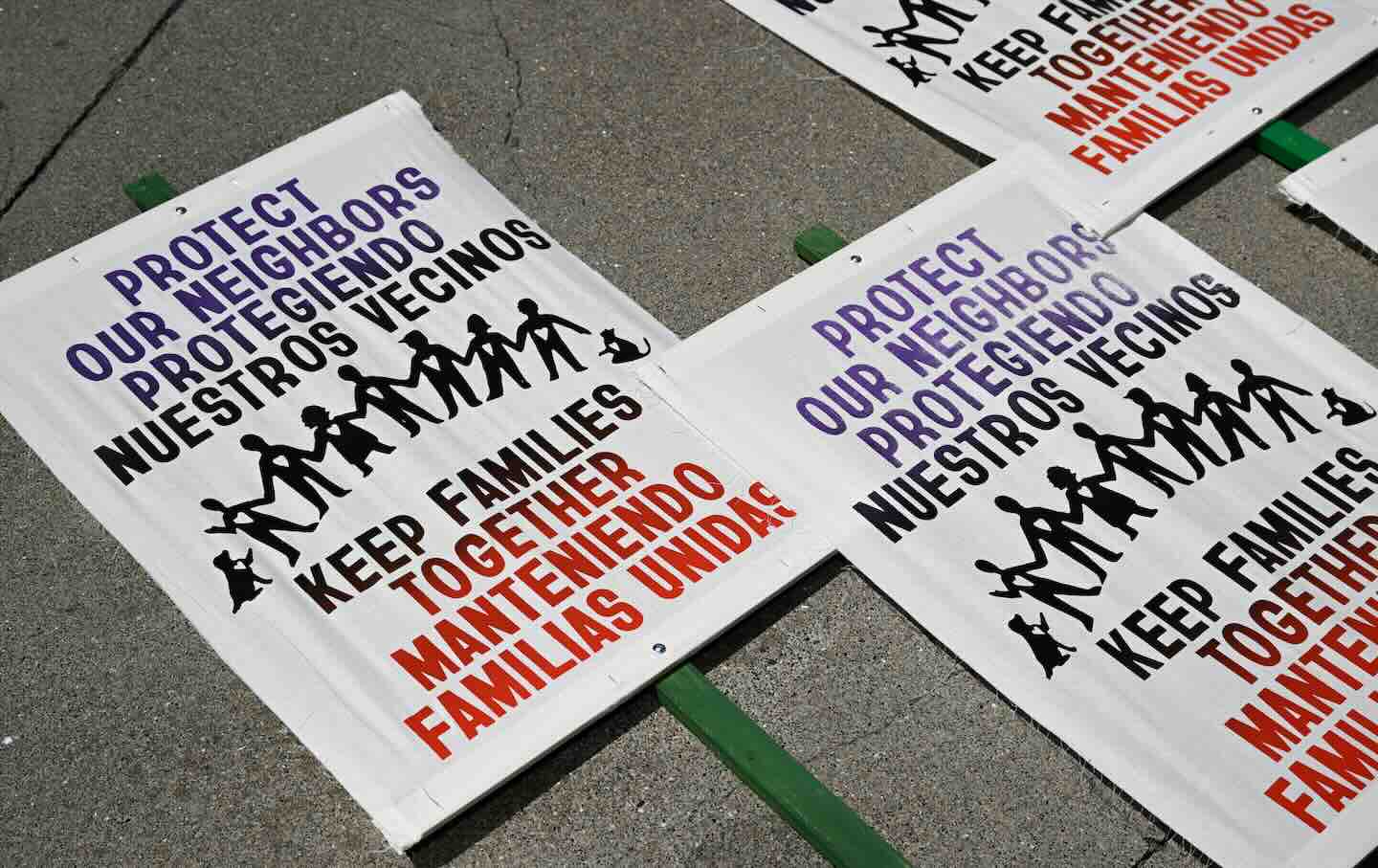
Protest signs on the ground outside of the Phillip Burton Federal Building in San Francisco in July that read, “Protect Our Neighbors / Protegiendo Nuestros Vecinos” and“ Keep Families Together / Manteniendo Familias Unidas.”
(Tayfun Coskun / Anadolu via Getty Images)California state Senator Scott Wiener (D-11th District) is on a mission to rein in America’s new secret police. His bill, the No Secret Police Act (SB 627), would make it illegal for law enforcement officers to wear masks while making arrests, in most cases, and would empower local police and sheriffs to intervene should they do so. “We need to nip this in the bud and make clear it’s not okay to do secret policing,” Wiener told me. His colleague Renée Pérez has put forward a companion bill, the No Vigilantes Act (SB 805), which requires law enforcement officers to properly identify themselves.
“The fact of masked law enforcement officers running around, essentially with ski masks on, grabbing people and throwing them into unmarked cars is terrifying,” said Wiener. “It’s the opposite of what a free society is supposed to be. We don’t do secret police in this country—and that’s what’s emerging.” Add into the mix the stories of vigilantes and criminals masquerading as masked federal agents to carry out their dirty work, and Wiener says we have the makings of a calamity. He also worries that if secret police methods get normalized at the federal level, eventually they will percolate down to state and local law enforcement.
“I work very closely with our state and local law enforcement. They do just tremendous work, and I want to make sure that it stays that way,” he said. “But what the federal government is doing right now is so harmful, and I do worry it could have impacts on law enforcement culture more broadly. What ICE is doing is deeply harmful to the men and women in local law enforcement.”
Both his bill and Pérez’s have picked up considerable support in recent weeks, including from the reform-oriented Prosecutors Alliance Action, headed by Cristine Soto DeBerry, former chief of staff to former San Francisco district attorneys George Gascon and Chesa Boudin. DeBerry told me that when masked agents go into communities and systematically violate residents’ Fourth Amendment rights, it makes it “incredibly difficult for prosecutors to pursue criminal cases” against people arrested during these proceedings, since the arrests themselves are so tainted.
Wiener is aware that even if the California legislature passes his bill, which is being debated by the Assembly this week and will likely be taken up by the Senate next week, and Pérez’s bill, it will be an uphill battle to enforce them given the sense of impunity with which federal agencies are currently operating. But he says that it is a fight worth having. “The enforcement here is not easy or straightforward,” he says. “But we have to try and we have to do what we can do.”
The bill has been carefully worded to apply to all law enforcement officers, not just federal agents—which Wiener and DeBerry believe should insulate it from court challenges, as states are, historically, given large leeway as to how to control their own policing functions.
Legislators in New York are debating a similar bill, as are their colleagues in Illinois. Meanwhile, council members in the town of Evanston, Illinois, have put forward an anti-masking resolution. These bills and resolutions could provide templates for Democratic legislators and city councils around the country. They could also accelerate the legal standoffs between city, state, and federal authorities.
If the California bill passes by a two-thirds majority—a likely scenario given Democrats’ supermajority in both chambers— its provisions will kick in immediately; if it passes only by a simple majority, then the legislation won’t take effect until January. Either way, it will provide much-needed ammunition to the Golden State in its fight against an increasingly lawless federal administration.
Once law, the onus will be on local DAs and police departments to launch criminal investigations, complete with subpoena powers, should unidentified masked agents continue to terrorize their communities. They will be able to request personnel documents from ICE and other federal agencies, logbooks showing who was on duty where, and other information allowing them to work out who the men and women behind the masks are. And they will be able to request grand-jury indictments against officers who have committed illegal acts.
A recent incident in San Bernadino sheds light on why such a law is needed. Masked immigration agents shot into a car with a family inside as they tried to remove the driver from the vehicle and take him into custody. The family managed to escape and get home, where they called the local police. In the ensuing standoff, dozens of community members turned up to protect the family, while television crews filmed the confrontation. Had SB 627 been in place, San Bernardino police would have been empowered to arrest the federal agents, and the local DA would also have been empowered to open an investigation into the use of excessive force and the hiding of the federal agents’ identities. Under the law, the residents also could have filed a civil case against their masked assailants.
For DeBerry, what happened in San Bernardino ought to be something that the feds themselves investigate—masked agents using excessive, potentially deadly force, against unarmed residents. But, of course, in the Trump era, such federal investigations won’t happen. Trump himself has told law enforcement to be “extraordinarily rough” in his anti-crime and anti-immigrant crackdowns.
“There’s no federal response to egregious behavior,” DeBerry says, “and [lawmakers] are having to work out how to step into that gap.”
SB 627 and SB 805 aren’t, by any stretch of the imagination, panaceas. But in an era in which the secret police practices of dictatorships are being imported wholesale into the United States by a wannabe caudillo, they at least give Californians some additional protections against the predations of Trump’s lawless, violent, immigrant-hunters.