Articles

Bierced

Bierced Bierced

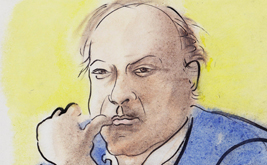
Ours is an age of the unexpected, the extraordinary—the uncanny. What better time to resurrect the stories of Ambrose Bierce?

Jun 24, 2010 / Books & the Arts / Victor LaValle

Cornered

Cornered Cornered

Heidi Ewing and Rachel Grady's 12th & Delaware; Tim Hetherington and Sebastian Junger's Restrepo; Michael Winterbottom's The Killer Inside Me; Lisa Cholodenko's The Kids Are Al...

Jun 23, 2010 / Books & the Arts / Stuart Klawans

Exchange: Robin Shrugged Exchange: Robin Shrugged

  Robin Shrugged   New York City Corey Robin, in "Garbage and Gravitas" [June 7], quotes some important Ayn Rand passages, but his critique raises ad hominem to a new level: Rand favored some classical composers over others and preferred operetta to opera, so her ideas are invalid. More shocking is this argument: Ayn Rand held that whether you live or die is of fundamental importance to you, and Adolf Hitler held that whether the state "lives" or "dies" is of fundamental importance to you, so Rand and Hitler are the same. We are asked to equate Hitler with the modern era's greatest defender of the individual's right to his own life. Rand, the creator of a morality based on one's life as one's ultimate value and reason as one's only guide is equated with the anti-individual, obedience-demanding, death-worshiping Nazi ideology. How about responding to Rand's arguments, for key Objectivist tenets, notably: reason is man's only means of knowledge, reason is man's means of survival, the choice to think or not is the locus of man's free will, rational thought cannot be coerced, man's life as a rational being is the standard of morality, rationality is man's primary virtue, individual rights are moral principles of social interaction following from the preceding. Robin quotes criticism by Sidney Hook that mistakes Rationalism for Objectivism. Objectivism holds that all knowledge is based, directly or indirectly, on sensory observation. The role of axioms, such as A is A, is not to provide premises for some Rationalist deduction but rather to ground methods of inference and norms of cognition. "Axiomatic concepts are epistemological guidelines" (Introduction to Objectivist Epistemology). Because A is A, modus ponens is valid. Because contradictions can't exist, we must check our conclusions for consistency: "No concept man forms is valid unless he integrates it without contradiction into the total sum of his knowledge" (Atlas Shrugged). Rather than rely on dubious anecdotes about Rand's personal life, a serious intellectual would investigate her nonfiction and consult the best of the secondary literature by philosophy professionals. HARRY BINSWANGER     Seattle "Far from needing explanation, Rand's success explains itself." So why does Corey Robin, through five pages of sneering vitriol, feel the need to "explain" her to us? This is trying too hard, which makes one wonder what he's trying to hide from us, or himself. I'll pass over the patently silly insinuations of a connection between Rand and fascism; that kind of smear was perfected by Whittaker Chambers (and discredited) long ago. Instead, on to the real issues: Rand's philosophical significance? Notwithstanding the cluelessness of Sidney Hook and Robert Nozick, her importance sure seems evident to the Ayn Rand Society, an affiliated group of the American Philosophical Association. Rand's grasp of Aristotle or her place in the Aristotelian tradition? With Aristotle, Rand holds that: (1) there's a knowable, objective reality; (2) life is sustained by constant internally generated action (an idea the reviewer seems to resent); (3) it is possible to live, flourish and be happy by discovering a moral code of rationally selfish values. She improves on Aristotle by explicitly validating an objective standard of value, "man's life qua man," whereas Aristotle begged the question by looking at qualities displayed in his prior-designated "great-souled" men. Thereupon Rand discusses why the primary virtues are: rationality, honesty, integrity, independence, productiveness and pride. All this is what Robin wants to ridicule? Really? Perhaps it's Rand's worship of achievement that most upsets him, and her agreement with Spinoza that "all things excellent are as difficult as they are rare." Or her sui generis status. In ethics alone, how then to explain why she provides the only fundamental account opposing Kant's ethics of duty and self-sacrifice on the one hand, and Nietzsche's blatantly irrational, predatory, cynical egoism on the other? Is Robin seriously objecting to Rand's holding out the possibility that individuals can live together in a mutually beneficial, nonsacrificial social arrangement, i.e., where the right to life, liberty, property and the pursuit of happiness is consistently upheld? This isn't a worthy inquiry? One other point: Robin has Rand's literary method wrong. Her primary concern is not "the conflict between the creative individual and the hostile mass": she sees the masses (insofar as they are unreflecting) as inconsequential "ballast." In The Fountainhead she portrays what it means to be a first-handed valuer, as in the character of her hero, Howard Roark. Nor is Rand's primary literary concern the conflict between producers and moochers, good or bad: she saw evil moochers as powerless on their own. In Atlas Shrugged the drama centers on how the conflicted premises of heroes like Dagny Taggart and Hank Rearden unwittingly aid their would-be destroyers, and how that is resolved. Rather than rely on the soul of malice who penned this screed, or take at face value "biographers" who neither understand nor care to understand her philosophy, readers should read Ayn Rand and decide for themselves what she's all about. TYM PARSONS       Robin Replies   Brooklyn, N.Y. I'm afraid Harry Binswanger and Tym Parsons haven't read me—or Rand, for that matter—very carefully. I did not claim that Rand's belief in Rachmaninoff's superiority called her ideas into question; I suggested that it called her taste into question. I did not claim or suggest that "Rand and Hitler are the same." I said that there are "similarities between the moral syntax of Randianism and of fascism," which is quite a different point. I did not claim that Rand saw A is A as the premise "for some Rationalist deduction." But Binswanger errs even further when he says that Rand believed A is A was merely one of several "methods of inference and norms of cognition." As Rand wrote in For the New Intellectual: "That there is only one reality, the one which man perceives—that it exists as an objective absolute (which means: independently of the consciousness, the wishes or the feelings of any perceiver)—that the task of man's consciousness is to perceive, not to create, reality—that abstractions are man's method of integrating his sensory material—that man's mind is his only tool of knowledge—that A is A." More than a statement of epistemological best practices, A is A was meant to be taken as the summation, the climax, of Rand's metaphysical credo. As for consulting "the best" literature on Rand, I did read Tara Smith's enormously helpful Ayn Rand's Normative Ethics, which brings me to Parsons. He says Rand is philosophically significant because the Ayn Rand Society, on whose steering committee Smith sits, is an affiliate of the American Philosophical Association. Yet the APA explicitly disavows any such affiliation on its website. Were Parsons to attend a meeting of the APA, however, he would learn of a great many philosophers—Philippa Foot, Alasdair MacIntyre, John Finnis and Rosalind Hursthouse, to name a few—who offer an alternative to Kant and Nietzsche. Parsons also wonders why, if I believe that "Rand's success explains itself," I seek to explain "her to us." The answer, of course, is that there is a difference between Rand's success and her arguments, even if her followers conflate the two. As for Parsons's claim that Rand's concern is not "the conflict between the creative individual and the hostile mass" (a statement I actually challenge in my article), here is Rand herself: "All achievement and progress has been accomplished, not just by men of ability and certainly not by groups of men, but by a struggle between man and mob." Since Parsons seems so interested in my psyche, let me close with a confession. If there is one reaction I have to Rand and her followers, it is a sense of embarrassment for men and women who peddle so much ignorance with such great confidence. COREY ROBIN

Jun 23, 2010 / Our Readers and Corey Robin

Drone Attacks to Stimulate Economy? Drone Attacks to Stimulate Economy?

What's worse: backstabbing a president or bombing lots of civilians?

Jun 23, 2010 / Laura Flanders

After McChrystal, Time to Change Course in Afghanistan After McChrystal, Time to Change Course in Afghanistan

More than six months after the implementation of McChrystal's strategy, it's clear that the policies Obama endorsed in Afghanistan are failing on all fronts.

Jun 23, 2010 / Katrina vanden Heuvel

After Donovan’s Goal: Joy or Jingoism? After Donovan’s Goal: Joy or Jingoism?

The US's miraculous World Cup victory over Algeria shouldn't give a green light to Islamophobia.

Jun 23, 2010 / Dave Zirin

Could the Right to Rent Stop the Foreclosure Hurricane? Could the Right to Rent Stop the Foreclosure Hurricane?

The foreclosure crisis is now hitting even the safest borrowers. That makes passing the Right to Rent Act, which would enable homeowners who can't get loan modifications to stay in...

Jun 23, 2010 / Greg Kaufmann

Aram Roston: US Military Funds Afghan Warlords Aram Roston: US Military Funds Afghan Warlords

A six-month congressional investigation has confirmed that US taxpayer funds are ending up in Afghan warlords' hands.  Aram Roston, author of the Nation story that sparked th...

Jun 23, 2010 / Press Room

US Hikers Were Seized in Iraq: WikiLeaks Document Corroborates Nation Report

US Hikers Were Seized in Iraq: WikiLeaks Document Corroborates Nation Report US Hikers Were Seized in Iraq: WikiLeaks Document Corroborates Nation Report

A military report released by WikiLeaks confirms: Iranian forces crossed the border to arrest the American hikers.

Jun 23, 2010 / Feature / Babak Sarfaraz

Aram Roston: US Military Funds Afghan Warlords Aram Roston: US Military Funds Afghan Warlords

Aram Roston's Nation cover story on taxpayer dollars being used to pay off the Taliban created a stir of controversy, and after a six-month investigation, Congress has confirmed th...

Jun 23, 2010 / GRITtv

x