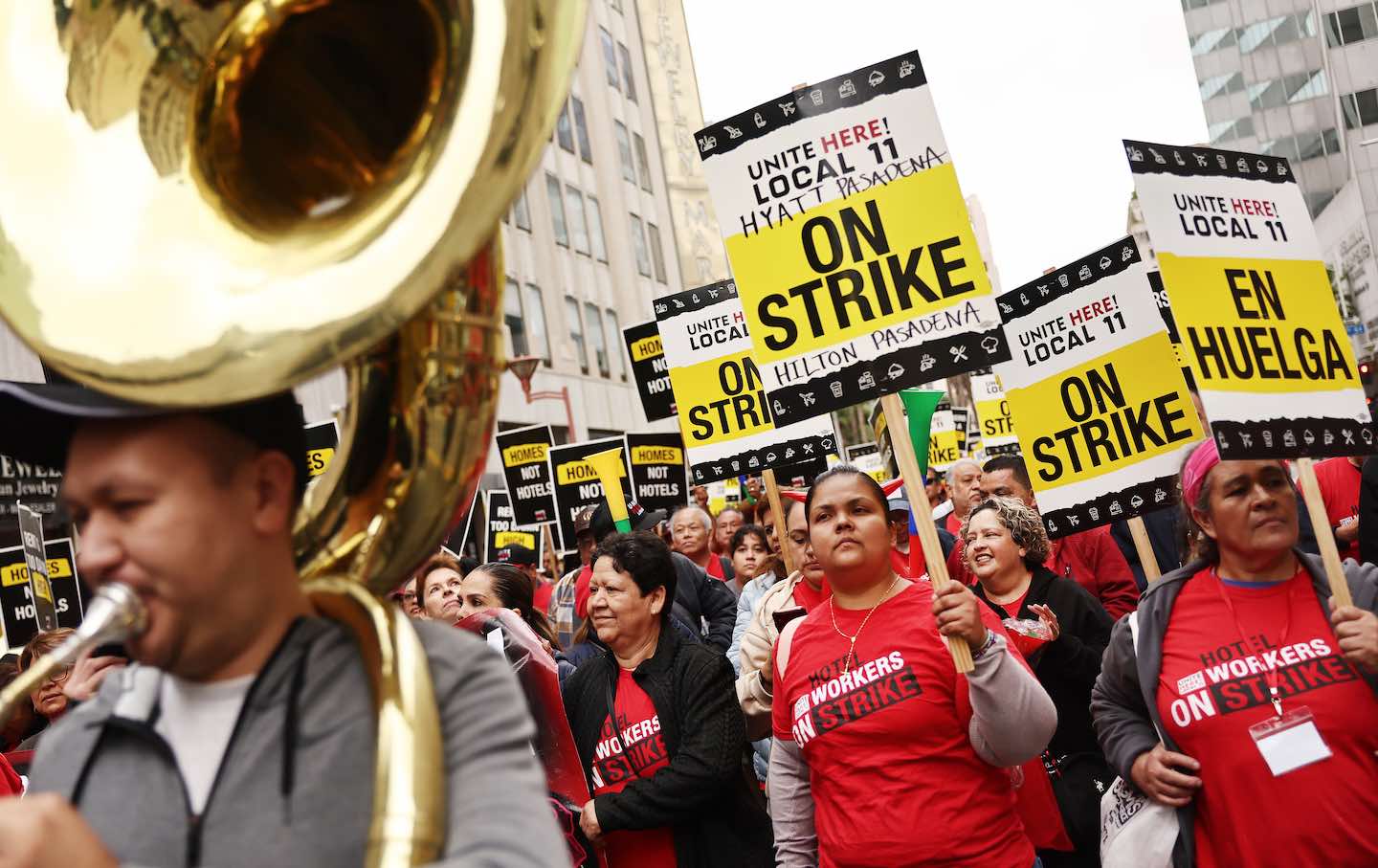
Hotel workers with Unite Here Local 11 march through downtown LA on October 25, 2023.
(Mario Tama / Getty Images)Months after the end of the screenwriters’ and actors’ strikes, another Los Angeles labor action continues apace. The city’s forgotten strike is that of the hotel workers organized by Unite Here! Local 11, who have been engaged in a series of rolling strikes against dozens of LA-region hotels. Even as workers’ contracts have expired, the hotels have balked at agreeing to new contracts with union negotiators.
In recent weeks, an increasing number of owners have cried uncle and settled with their workers, agreeing to improved pay rates, better benefits packages and stronger worker protection measures. As of this week, thirty-four hotels have agreed to new contracts, which include a $5-per-hour initial pay increase, translating to a 20 percent hike in wages, and a cumulative pay increase of $10 per hour by 2027 for room attendants, cooks, and other non-tipped workers. The hotels also agreed to continue paying the vast majority of health insurance premiums for employees and their families, with the workers themselves not having to pay more than $20 per month.
This continues an emphasis that Local 11—one of a slew of progressive, activist, service-sector unions that have risen to the forefront of labor organizing in Los Angeles, Las Vegas, and other western cities in recent years—has placed on winning not just better wages, but, equally importantly, better benefits: since 2018, the union has secured pension contribution increases from the hotels totaling 600 percent. As a result, their pension fund is one of America’s best funded for service workers. They have also pushed for equitable hiring opportunities for people with criminal justice convictions, and for increased protections for immigrant workers. Cumulatively, this package represents an extraordinary win for labor in the country’s second-largest city.
Many other hotels, however, including well-known Downtown hotels such as the Hotel Figueroa, have, so far, refused to settle with the union. In February, more than one hundred non-unionized food and beverage operators who were trying to unionize were fired at the Figueroa. That same month, several striking workers were shot at with ball bearings by unknown assailants, as they walked the picket line outside the hotel—one was hit in the head. In the wake of these developments, Local 11 called for a boycott of the hotel. They also called for a boycott of the Maya Hotel, in Long Beach, which has also seen violence against striking workers.
“We’ve been doing this fight for eight months now,” says Nohelia Gonzalez, 52, who has worked as a housekeeper at the Figueroa for the past three years. “The hotel knows what’s been going on, that we’ve fighting for this contract for months now, and they’ve chosen not to listen to us.”
The union is particularly incensed about the firing of the non-unionized workers and has asked the city’s district attorney to open an investigation to determine whether the action violates the new Los Angeles Hotel Workers’ Retention Ordinance. This measure came out of the pandemic, putting in place protections for temporarily laid-off workforces so that they would be rehired as the hotels bounced back from the pandemic closures. Local 11 alleges that the hotel closed the restaurant on February 11 and reopened two days later with brand new workers, thus doing an end-run around the unionization efforts.
For Gonzalez, this speaks to a broader issue: what the union sees as management’s disregard for the basic needs of its workforce. One of the union’s biggest complaints is that workers are paid too little to allow them to afford housing, in LA’s expensive housing market, that is near their place of employment. Gonzalez herself commutes two hours each way, on two busses and the LA Metro, from her $2,250 per month rental unit. On the $24 per hour that she currently earns—a wage that in some states generates at least a degree of economic stability, but in California doesn’t allow workers to build up savings and security—she can’t afford to pay the higher rents that landlords charge nearer the center of the city.
“So we’re going to continue to fight,” Gonzalez says. The union is, according to spokesperson Maria Hernandez, urging would-be customers at the Figueroa “not to eat, sleep, party, spend money, patronize the hotel until a contract is signed, workers are brought back, and there’s an end to the violence.”
Support independent journalism that does not fall in line
Even before February 28, the reasons for Donald Trump’s imploding approval rating were abundantly clear: untrammeled corruption and personal enrichment to the tune of billions of dollars during an affordability crisis, a foreign policy guided only by his own derelict sense of morality, and the deployment of a murderous campaign of occupation, detention, and deportation on American streets.
Now an undeclared, unauthorized, unpopular, and unconstitutional war of aggression against Iran has spread like wildfire through the region and into Europe. A new “forever war”—with an ever-increasing likelihood of American troops on the ground—may very well be upon us.
As we’ve seen over and over, this administration uses lies, misdirection, and attempts to flood the zone to justify its abuses of power at home and abroad. Just as Trump, Marco Rubio, and Pete Hegseth offer erratic and contradictory rationales for the attacks on Iran, the administration is also spreading the lie that the upcoming midterm elections are under threat from noncitizens on voter rolls. When these lies go unchecked, they become the basis for further authoritarian encroachment and war.
In these dark times, independent journalism is uniquely able to uncover the falsehoods that threaten our republic—and civilians around the world—and shine a bright light on the truth.
The Nation’s experienced team of writers, editors, and fact-checkers understands the scale of what we’re up against and the urgency with which we have to act. That’s why we’re publishing critical reporting and analysis of the war on Iran, ICE violence at home, new forms of voter suppression emerging in the courts, and much more.
But this journalism is possible only with your support.
This March, The Nation needs to raise $50,000 to ensure that we have the resources for reporting and analysis that sets the record straight and empowers people of conscience to organize. Will you donate today?