Garment Workers Are Getting Closer to a Fair Wage
Advocates are working to get a version of California’s Garment Workers Protection Act passed at the federal level.
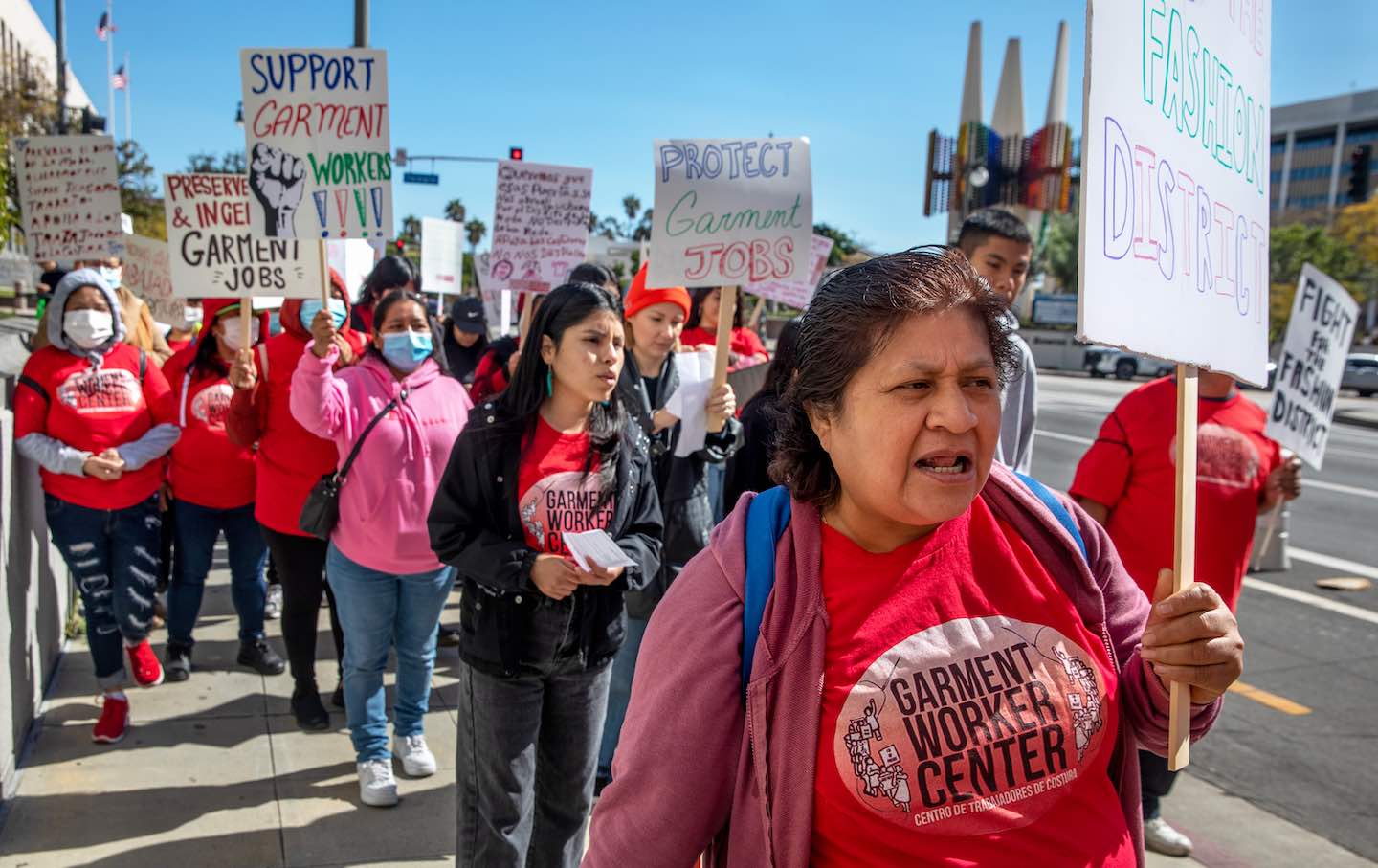
Members of the Protect LA’s Garment Jobs Coalition, along with garment workers and labor and affordable-housing allies, attend a rally outside City Hall in April 2023 in Los Angeles, Calif.
(Irfan Khan / Los Angeles Times)Two years ago, California legislators passed the Garment Workers Protection Act, SB 62. The act, which went into effect on January 1, 2022, is intended to largely eliminate piece work in an industry that employs more than 30,000 people in the greater Los Angeles region, and that has long paid extremely low wages to workers who live on the margins and often lack legal immigration status. Employers are now either mandated to negotiate piece-rates with workers’ collective bargaining units or to pay at least the minimum hourly wage to employees. They are also now entitled to lunch breaks, as well as to toilet breaks. As importantly, the legislative language holds the fashion industry—those name brand companies that contract out to garment manufacturers that use sweatshop labor to produce their clothing—responsible for wage theft in the factories.
Since then, the Garment Worker Center, which advocates on behalf of workers in the industry, has filed more than 40 wage claim cases with the State Labor Commission, the hearings for which are ongoing. It takes a couple years for these cases to play out, and, to date, none have been settled. But, says Marissa Nuncio, executive director of the GWC, “workers are bringing claims forward and are able to name fashion brands during their wage claims.” Enforcement of the new law is difficult, especially since so many of the workers live in the immigration shadows. Yet the Garment Worker Center has documented increasing numbers of factories shifting over from piece-rate pay to hourly wages, as they seek to stay on the right side of the law. “That’s really heartening to hear,” Nuncio says. “But it will take some time to see wholesale change in the industry.”
Advocates for garment workers are hoping to parlay their success in California into action on the national stage. Earlier this week, Nuncio was part of a group of more than 80 people, made up of advocates from the GWC and from the San Francisco–based Remake—an organization working to shine a spotlight on what it calls “fashion brand accountability nationally and overseas”—as well as workers who journeyed to Washington, D.C., to lobby members of Congress to pass a Federal version of California’s landmark legislation.
To date, 275 individuals and groups have endorsed the FABRIC Act—more formally known as the Fashioning Accountability and Building Real Institutional Change Act—which is being introduced in the Senate by Kirsten Gillibrand and in the House by Jerry Nadler. These groups include unions such as the SEIU. The act would mandate that garment factories across the country pay workers at least a minimum wage. It would also create a $40 million grant program, to be administered by the Department of Labor, to help garment factories modernize and incorporate greener technology, and to assist community organizations in training would-be garment workers to use the latest technology in the field. If it passes, it will affect some of America’s lowest-paid workers around the country—while GWC estimates that roughly one-third of all America’s garment workers are in the LA region, there are also thousands of workers in New York, Texas, the Carolinas, and several other states who would be affected by these wage protections.
When the 80 garment workers and their advocates met with political leaders this week, California Senators Padilla and Feinstein came out in support of the bill. The workers also met with several of the state’s House members.
One of these workers, Los Angeles–based Delia, told them, “I’m asking you for your support for the FABRIC Act. Los Angeles garment workers like myself organized to pass the law SB62 in California in 2022. This law guarantees me a minimum and fair wage in my work. The purpose of the FABRIC Act is to extend these protections to garment workers in every state.”
Passing such a bill ought to be common sense. But in modern American politics, even a no-brainer like this runs into a brick wall of partisanship, and Nuncio knows that the FABRIC Act is facing an uphill battle. When the bill was first introduced last year, with seven congressional sponsors, not a single Republican voted for it. So far, this year, the Republicans have also shown unanimity in opposing legislation that would provide just a modicum of economic security to these vulnerable workers.
All this means that the garment workers, many of them from California, are girding for a long fight on the national stage. If the FABRIC Act doesn’t pass this year, they say that they will push for it again next year and the year after that. They will, Nuncio says, keep coming back until the justice of their cause is recognized across the political spectrum.
“The FABRIC Act would put an end to piece rate work in American garment factories and protect garment workers, small companies, and set a standard for wages,” says Francisco, another LA garment worker. “It would stop exploitation for workers throughout the United States of America. The future will be a better future for all of us and our families.”
Support independent journalism that does not fall in line
Even before February 28, the reasons for Donald Trump’s imploding approval rating were abundantly clear: untrammeled corruption and personal enrichment to the tune of billions of dollars during an affordability crisis, a foreign policy guided only by his own derelict sense of morality, and the deployment of a murderous campaign of occupation, detention, and deportation on American streets.
Now an undeclared, unauthorized, unpopular, and unconstitutional war of aggression against Iran has spread like wildfire through the region and into Europe. A new “forever war”—with an ever-increasing likelihood of American troops on the ground—may very well be upon us.
As we’ve seen over and over, this administration uses lies, misdirection, and attempts to flood the zone to justify its abuses of power at home and abroad. Just as Trump, Marco Rubio, and Pete Hegseth offer erratic and contradictory rationales for the attacks on Iran, the administration is also spreading the lie that the upcoming midterm elections are under threat from noncitizens on voter rolls. When these lies go unchecked, they become the basis for further authoritarian encroachment and war.
In these dark times, independent journalism is uniquely able to uncover the falsehoods that threaten our republic—and civilians around the world—and shine a bright light on the truth.
The Nation’s experienced team of writers, editors, and fact-checkers understands the scale of what we’re up against and the urgency with which we have to act. That’s why we’re publishing critical reporting and analysis of the war on Iran, ICE violence at home, new forms of voter suppression emerging in the courts, and much more.
But this journalism is possible only with your support.
This March, The Nation needs to raise $50,000 to ensure that we have the resources for reporting and analysis that sets the record straight and empowers people of conscience to organize. Will you donate today?