
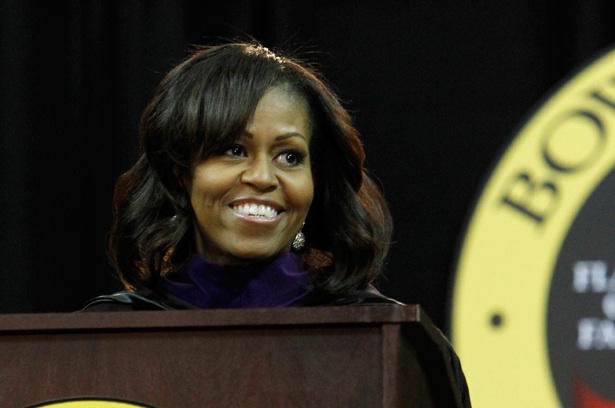
First lady Michelle Obama speaks at the commencement ceremony for Bowie State University at the University of Maryland in College Park, Maryland, Friday, May 17, 2013. (AP Photo/Ann Heisenfelt)
In light of the recent news out of Chicago, I think we should take another look at first lady Michelle Obama’s remarks from her commencement address at Bowie State University. Particularly this part:
But today, more than 150 years after the Emancipation Proclamation, more than 50 years after the end of “separate but equal,” when it comes to getting an education, too many of our young people just can’t be bothered. Today, instead of walking miles every day to school, they’re sitting on couches for hours playing video games, watching TV. Instead of dreaming of being a teacher or a lawyer or a business leader, they’re fantasizing about being a baller or a rapper.
I hope the first lady has seen this video of 9-year-old Asean Johnson, on the eve of Chicago’s Board of Education vote to close fifty schools, telling a crowd of protesters, “You should be investing in these schools, not closing them. You should be supporting these schools, not closing them.” He wasn’t alone and this wasn’t the first demonstration. Young black people were out in the streets fighting for their right to an education and they were ignored.
The situation is similar in Philadelphia. Twenty-three schools in that city are slated to close, and on the anniversary of the Brown v. Board of Education decision, the one that was supposed to end “separate but equal,” students organized a walkout to protest budget cuts that would further decimate their schools, eliminating libraries, extracurricular activities and, yes, sports. I hope the first lady has read the statement issued by these students where they said: “We are willing to break the stereotypes and expectations of urban youth, and are taking this opportunity to tell the world that urban school districts deserve funding, and it is your responsibility under the Commonwealth Charter to provide us with more than a ‘bare bones education.” They want more. They want the resources for an education that will become the foundation of their future. Their government is building prisons instead.
What was so frustrating about hearing the first lady regurgitate these well-worn stereotypes about black children being more interested in video games than getting an education, aside from pathologizing in black kids rather normal childhood activities, is that it ignored what black children have in store when they do show up to school. If black kids are more disinterested, it would serve us well to ask why. It’s hard to find value in a place where you don’t feel welcome.
Let’s not pretend the school-to-prison pipeline isn’t real. Black children’s very existence has been criminalized inside the same institutions responsible for educating them. They find their hallways policed, their behavior over-disciplined; they are over-suspended, and eventually shipped off to juvenile detention facilities at alarming rates. They are chastised by community and thought leaders for not wanting an education, but when they show up for one they’re met with all the hostility and contempt one reserves for their greatest enemies.
There are black children who don’t value education. Not because they are black, but because they are children and that’s what children do. The more tragic and infuriating thing is that they grow up in a society that doesn’t value educating black children and is hellbent on doing everything it can to stop them from learning.
Read more on the StudentNation blog on how students across the country are protesting school closures and racial profiling.

