
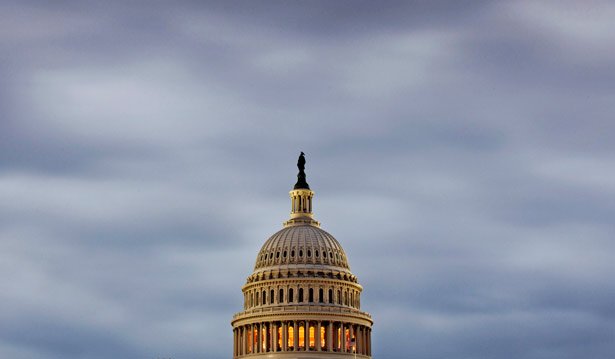
The Capitol in Washington, Monday, Oct. 7, 2013. (AP Photo/J. Scott Applewhite)
The shutdown of the government is a crisis for Americans, who rely not just on the services provided by the affected agencies but on the efficiency of their delivery. When 800,000 federal employees are furloughed, it is not just the immediate damage that is of consequence; over time, the whole system begins to fray and weaken. While those furloughed employees will eventually be paid, the abrupt cutoff in pay has a ripple effect in the broader community. At a time when America’s economic recovery is at best uneven, the financial uncertainties brought about by the shutdown have idled not just large federal contractors but small businesses on Main Street.
Another crisis is playing out as well, one that must be understood and addressed if this country is to avoid the kind of blackmail that might satisfy Ted Cruz and the Tea Party firebrands in the House, but that most Americans will understand as a threat to democracy.
The shutdown (and the threat to allow a debt default) seeks to undo the results of the 2012 election by giving a minority within the losing party the power to decide whether government will operate or not. The founders of the American experiment established a separation of powers, but that is not the cause of today’s crisis. In 2012, Barack Obama won the presidency by 5 million votes. He won 51 percent of the overall vote, and he won the Electoral College 332 to 206. But the Democratic victory did not end there. The Democrats were expected to lose Senate seats, but they actually gained, and the overall turnout in those races gave them a 10 million–vote advantage. In House races, Democrats secured an overall margin of 1.7 million votes; the chamber is under Republican control not because of the desires of American voters, but because of a combination of gerrymandering, big money and winner-take-all voting structures.
So House Republicans are “governing” by other means. Worse yet, the House leadership is compelled to take the most extreme position because the vast majority of GOP districts have been so gerrymandered that even reasonable Republicans are more fearful of a Tea Party primary challenge than of a November challenge in which the whole electorate might hold them to account (for more on the gerrymander “suicide caucus,” see Ari Berman's Noted article).
In the short term, Obama and the Democrats must focus on avoiding any concessions that would allow a minority within a minority to force cuts in Social Security, Medicare and Medicaid. But the crisis has created an opening for a discussion of gerrymandering and other structural challenges to democracy. The president has spoken before about the prospect that the Constitution will have to be amended to restore the rights of citizens to control the flow of big money in politics. This is vital. Just as vital is his support for renewal of the Voting Rights Act. But now he has to speak to the American people about the role that gerrymandering plays not just in limiting competition, but in empowering extremists who reject negotiation, compromise and the public good.
The American people are frustrated with Congress and are looking for ways to address this crisis. Groups like Common Cause and FairVote, which have campaigned on behalf of democratic reform for years, are at the ready with smart proposals—from nonpartisan redistricting commissions to proportional representation to creation of multi-member districts. Obama should use his bully pulpit not just to end the immediate crisis but to call for a national dialogue about the tattered state of our democracy. And he should call for reforms to ensure that Americans will never again be forced to live from crisis to crisis.
The Nation’s Lee Fang writes about how evangelical operatives are contributing to the government shutdown.

