
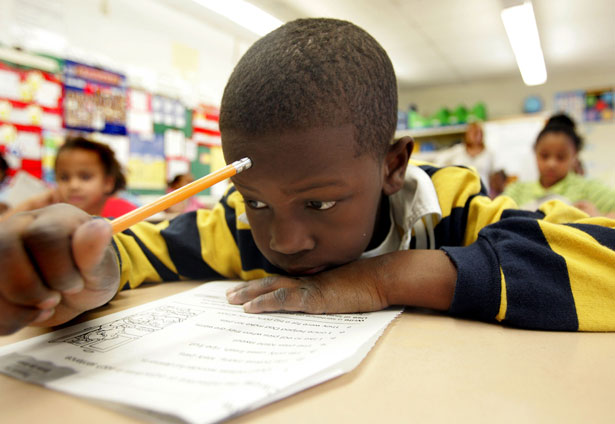
A student reads at a school in New Jersey. One in four black students were suspended in 2009-10, compared to one in fourteen white students. (AP Photo/Jose F. Moreno.)
Until last month, I had never seen a stop-and-frisk happen. Despite the amount of attention devoted to the controversial New York City policy in the last year, despite the protests, and despite having lived in the city for almost four years, I had never witnessed a stop-and-frisk. And then, a few weeks ago, I watched as two policemen stopped middle-aged black man on 98th Street, and frisked him. I wondered, not for the first time, what it would take for those same policemen to stop and frisk me. Controlling for all other factors—location, time of day, behavior—what would it take for the cops to stop and frisk a pretty white lady on the Upper West Side?
Somewhere in America, there’s a politically aware white high school student asking himself the same question, not about stop-and-frisk, but about school suspension. How much would I have to misbehave to run the same risk of suspension as my black classmates?
If you’re a white middle or high school student, and you don’t have a disability, your odds of being suspended from school are one in fourteen. If you’re a black middle or high school student without a disability, your odds are one in four. According to a new study by the Civil Rights Project at UCLA, a quarter of black students were suspended in the 2009-2010 school year. A quarter. For students with disabilities, the odds are one in five. And for black girls, the numbers are a stark demonstration of what happens when two forms of discrimination intersect: Black girls are more likely to be suspended than black boys or white girls. And, to the surprise of absolutely no one, when you add a third axis—disability—the figures get even worse. Black girls with disabilities are suspended at a rate sixteen percent higher than white girls with disabilities.
Schools, under-funded and over-populated, are suspending students for minor infractions like cell phone use or loitering (or for violating dress codes, which are problematic for a host of reasons), and being suspended dramatically increases your chance of dropping out altogether. One Florida study found that a single suspension in ninth grade doubled dropout rates, from sixteen percent to thirty-two percent. And though suspension rates are unnecessarily high, they’re disproportionately high for those students who are already marginalized.
There are ways to bring down the number of suspensions across the board, as the study notes. Changes to codes of conduct, implementing positive behavioral supports, better training and supporting teachers, and implementing principles of restorative justice, are all ways to reduce the number of suspensions. But that reduction in raw numbers will not be enough unless schools also address the disproportionate punishment of minority students.
Punishment rates in schools mirror the rates in the “real world” – though what could be more real than entrenched discrimination in our schools? – and in fact, contribute to those real world figures. The Civil Rights Project report notes that the abuse and misuse of suspensions can turn them into “gateways to prison.” Even if that were not the case, even absent a school-to-prison pipeline, the situation would be grim enough. What this report reveals is a disregard for the wellbeing of marginalized populations that, were it directed at other groups, would never be allowed to stand. If a quarter of white middle school boys were being suspended every school year, and if pretty white ladies were being frisked on the streets of Manhattan, there’d be uproar.
What would it take for the police to stop and frisk a pretty white lady on the Upper West Side? What would it take for a school to suspend a young white man with no disability? These are important – if upsetting – thought experiments. But the real question is, what will it take for us to fix this system that punishes students and citizens for no other reason but their membership in marginalized groups?
Read Chloe Angyal on the Boston Marathon bombings and why some of those injured could someday run again.

